Why Conflict Resolution Training Is a Leadership Skill You Can’t Afford to Skip
Conflict resolution training gives leaders, managers, and teams a structured set of skills to handle disagreements before they drain productivity, damage trust, or cost you good people. Here is what it covers at a glance:
- What it is: A structured learning process that builds skills in communication, de-escalation, mediation, and negotiation
- Who it is for: Managers, HR professionals, executives, team leads, educators, and business owners
- What you learn: Active listening, emotional regulation, interest-based problem solving, and how to facilitate difficult conversations
- Key formats: In-person workshops, live virtual sessions, self-paced courses, and certificate programs
- Why it matters: Mismanaged conflict costs organizations time, money, and talent — and most leaders were never taught how to handle it well
When a team is underperforming, the root cause is rarely strategy. More often, it is a conversation that never happened, a tension that was never addressed, or a disagreement that quietly became a wall between people. That is where most leaders feel stuck — not because they lack intelligence or commitment, but because no one taught them how to work through conflict in a structured, confident way.
The cost of getting this wrong is real. Organizations lose productivity, retention, and momentum when conflict is ignored or handled poorly. The good news is that conflict resolution is a learnable skill, not a personality trait.
This guide breaks down everything you need to know: what conflict resolution training includes, who needs it most, which formats work, and how to measure whether it is actually working.
I’m Andrew Lamb, an executive coach and leadership advisor with more than 25 years of senior global leadership experience, including over two decades at HP, where I saw how unresolved team conflict quietly erodes execution, culture, and business value. At 4 Leaf Performance, I bring that experience directly into our conflict resolution training work with growth-stage companies and the leaders running them. If you are managing a team where tension is slowing things down, this guide is built for you.
Conflict resolution training definitions:
What Conflict Resolution Training Is and Why It Matters
At its core, conflict resolution training teaches people how to work through disagreement without making the problem worse. That sounds simple. It is not.
Most conflict is not really about the surface issue. It is about unclear expectations, bruised trust, poor listening, power dynamics, stress, identity, or competing priorities. Training helps people slow down, read what is actually happening, and respond with skill instead of instinct.
In workplaces and communities, that matters because unmanaged conflict spreads. One tense meeting becomes two departments avoiding each other. One ignored complaint becomes turnover. One defensive leader creates a culture where people stop speaking up.
For leaders, conflict skill is closely tied to psychological safety, accountability, and execution. Teams do better work when they can disagree clearly and recover quickly.
What conflict resolution training actually teaches
Strong programs usually include a mix of practical and interpersonal skills, such as:
- Conflict analysis
- De-escalation methods
- Active listening
- Emotional regulation
- Respectful feedback
- Negotiation basics
- Mediation fundamentals
- Root-cause discovery
- Perspective-taking
- Cultural awareness and humility
Many programs also teach participants how to tell the difference between a disagreement, a recurring pattern, and a full-blown conflict. That matters because the response should fit the problem. You do not need a formal mediation process for every awkward email. But you do need more than vague advice like “just communicate better.”
Why conflict resolution training matters more for leaders than general communication tips
General communication training helps people present ideas more clearly. Leadership training often focuses on decision-making, motivation, or strategy. Conflict training is different because it prepares people for communication under pressure.
That means learning how to:
- Address tension when emotions are high
- Handle performance issues without triggering shutdown
- Manage power imbalances between manager and employee
- Support HR processes without becoming robotic
- Guide teams through hard conversations that have no easy answer
From our WHY.OS perspective, conflict often reveals system breakdowns, not just personality issues. If your team fights over ownership, priorities, or decisions, the problem may be less about attitude and more about unclear roles, missing norms, or weak operating rhythm. Training works best when it helps leaders see both the human behavior and the system behind it.
Who Should Invest in Conflict Resolution Training
The short answer is this: anyone whose success depends on working with other humans. So, yes, almost everyone.
But some roles get outsized value because they sit closest to friction, feedback, and decisions.
- Executives and senior leaders
- Managers and supervisors
- HR professionals
- Team leads
- Educators and facilitators
- Consultants and coaches
- Nonprofit and community leaders
- Business owners
- Professional mediators or aspiring mediators
Conflict resolution training for managers, HR, and team leaders
Managers need this training because they are usually the first line of response when tension shows up. They handle missed expectations, performance conversations, role confusion, and cross-functional friction.
HR professionals need it because they often step in after conflict has already escalated. They benefit from tools for neutral facilitation, bias-sensitive dialogue, and respectful confrontation.
Team leaders need it because they influence norms every day. The way they respond to disagreement teaches the team what is safe, what gets punished, and what gets ignored.
If this is a priority for your organization, our conflict management training program is designed to build practical skills leaders can use right away.
When small business owners and senior leaders need conflict resolution training most
In small and mid-sized organizations, conflict often hides inside growth.
You may need training most when:
- The team has grown faster than your structure
- Roles are unclear and decisions bottleneck at the top
- Founders or senior leaders are misaligned
- Feedback is avoided until it becomes a blow-up
- Culture starts drifting as new people join
- High performers begin disengaging
This is where conflict connects directly to profit and execution. Hidden tension creates hidden waste. Meetings drag. Decisions stall. People work around each other. Good employees leave. In our WHY.OS work, we often find that conflict is one of the fastest ways to spot hidden performance leaks.
Main Formats of Conflict Resolution Training
Not every team needs the same format. The right choice depends on your goals, timeline, team size, and how much practice people need.
Common formats include:
- In-person workshops
- Live virtual training
- Self-paced online courses
- Certificate programs
- Multi-session cohorts
- Custom onsite or enterprise programs
In-person vs virtual conflict resolution training
In-person training is great for high engagement, live role-play, and stronger group connection. It works especially well when a leadership team needs to reset trust or practice difficult conversations face to face.
Virtual training has become much stronger in recent years. Good live online workshops use breakout rooms, coaching, polls, and scenario practice. They are especially useful for hybrid and global teams.

Here is a simple comparison:
| Format | Best for | Strengths | Watch-outs |
|---|---|---|---|
| In-person | Leadership offsites, team resets, deep practice | High energy, richer role-play, stronger connection | More scheduling and travel complexity |
| Live virtual | Hybrid teams, global organizations, faster rollout | Flexible, scalable, interactive when well designed | Easier for participants to multitask badly |
| Self-paced | Foundational knowledge, individual learning | Convenient, low friction, repeatable | Limited live feedback and practice |
| Certificate program | Deep skill building, formal development | Structured, rigorous, often includes CE credits | Bigger time commitment |
Self-paced courses and certificate programs
Self-paced learning can work well for basic concepts, especially when people need flexibility. Some online courses can be completed entirely on an internet-connected device and may satisfy employer or court-related requirements, depending on the program.
Certificate programs go deeper. Research shows that some mediation and conflict resolution certificates run as 40-hour programs, while others are shorter intensives or multi-week cohorts. Some also offer continuing education credit for legal or HR professionals. In 2026, there are programs offering HRCI, SHRM, CLE, and MCLE-related options depending on the provider and audience.
For example, broader professional development options in the field include Negotiating for Conflict and Dispute Resolution (2026) | UNITAR and Peacemaking and Mediation in International Conflicts Today | Oxford Lifelong Learning, University of Oxford.
How to choose the right conflict resolution training format
Ask these questions first:
- Do we need awareness, skill practice, or certification?
- Is this for a few leaders or the whole organization?
- Are our conflicts mostly interpersonal, cross-functional, or systemic?
- Do we need customization using real internal cases?
- Will participants get coaching or follow-up after training?
- Are we solving an urgent issue or building long-term capability?
If your workforce is remote or distributed, live virtual plus follow-up coaching often works well. If your leadership team is stuck in recurring tension, in-person practice may create faster breakthroughs.
Core Skills and Frameworks You Learn in Conflict Resolution Training
The best programs do not just talk about conflict. They make people practice it.
Common skills include:
- Active listening
- Emotional self-management
- Respectful feedback
- Perspective-taking
- De-escalation
- Interest-based bargaining
- Mediation process basics
- Facilitation under stress
- Positive neutrality
- Root-cause analysis
Some approaches focus on helping parties move beyond positions and understand underlying needs. Others emphasize interest-based negotiation or structured mediation. Regardless of the model, the key shift is this: stop arguing only about solutions and get clear on what each person actually needs.
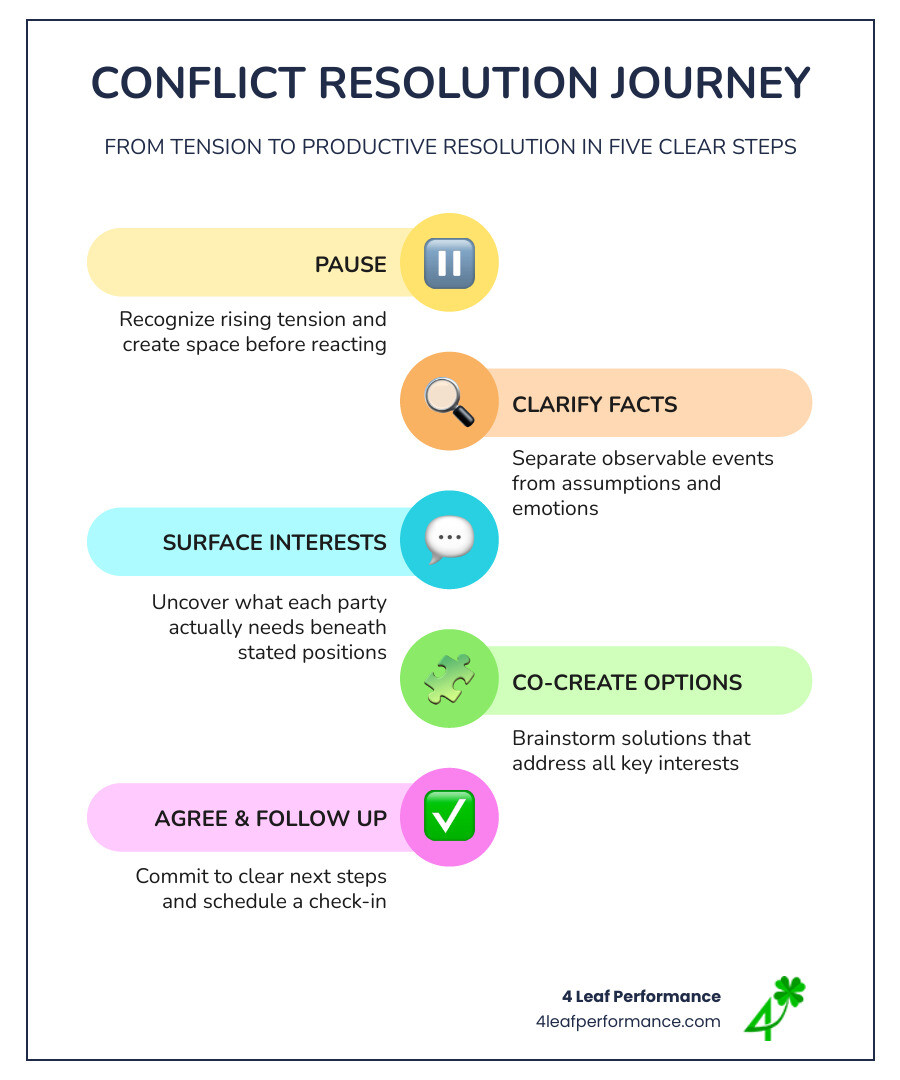
A simple 5-step conflict resolution process leaders can use right away
Here is a practical framework we use with leaders who need a repeatable process.

Pause and regulate
- Do not enter the conversation hot.
- Notice your own story, assumptions, and emotional triggers.
- If needed, take a short break before meeting.
Clarify facts
- What happened?
- What is observable versus interpreted?
- Where are expectations unclear?
Surface interests
- Ask what matters most to each person.
- Look below positions to needs, concerns, risks, and priorities.
- This is where good listening earns its paycheck.
Co-create options
- Brainstorm possible paths forward.
- Focus on what is workable, fair, and sustainable.
- Avoid the trap of trying to “win” the first five minutes.
Agree next steps and follow up
- Define actions, owners, and timing.
- Decide how success will be measured.
- Revisit the agreement before old patterns return.
This works well for peer conflict, manager-employee tension, and cross-functional breakdowns. It also fits our WHY.OS lens because it forces leaders to examine not just the conversation, but the operating system around it.
Conflict resolution training vs communication or leadership training
This is where many buyers get confused.
Communication training teaches expression. Leadership training teaches direction. Conflict resolution training teaches intervention.
That means it is more likely to include:
- Escalation control
- Multi-party problem solving
- Negotiation under stress
- Mediation techniques
- Handling defensiveness
- Working with power imbalance
- Facilitating dialogue when trust is low
In other words, communication training helps you speak clearly. Conflict training helps you keep the room from catching fire. Sometimes both are needed.
High-impact skills practiced in conflict resolution training
The strongest workshops use active practice, not passive slides. That often includes:
- Role-play based on real workplace scenarios
- Listening drills
- Structured confrontation practice
- Feedback loops from facilitators and peers
- Simulations with competing priorities
- Collaborative problem-solving exercises
For deeper practical tools, see our resources on active listening skills and effective confrontation.
How to Measure Results and Choose the Right Provider
If training feels good for a day and changes nothing after a month, it was a nice event, not a business solution.
To measure value, look at both behavior change and business impact.
Measurable benefits of conflict resolution training for organizations and individuals
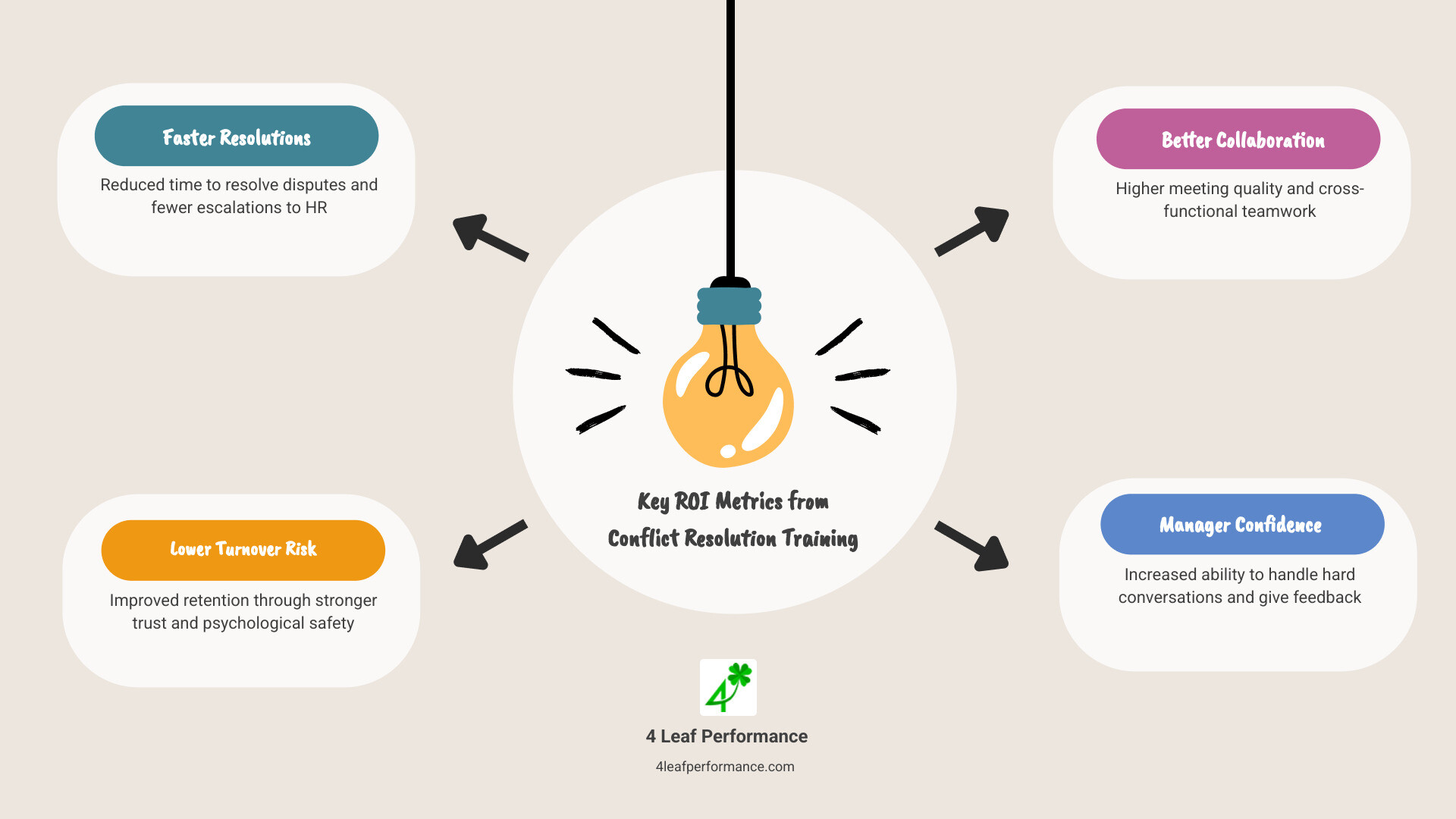
Organizations often see gains such as:
- Faster issue resolution
- Lower escalation to HR or leadership
- Better meeting quality
- Improved cross-functional collaboration
- Reduced turnover risk
- Stronger feedback culture
- Better trust and psychological safety
Individuals often report:
- Higher confidence in hard conversations
- Better emotional control
- Less avoidance
- More resilience under pressure
- Improved ability to handle disagreement without taking it personally
Research consistently points to the business cost of unmanaged conflict. Organizations lose time, money, and talent when conflict is ignored or mishandled.
Useful metrics include:
- Employee relations case volume
- Time to resolve disputes
- Manager confidence scores
- Engagement survey items on trust and voice
- Turnover in high-friction teams
- Number of recurring issues reopened after “resolution”
What to look for in a conflict resolution training provider
Look for a provider that offers:
- Facilitators with real leadership and conflict experience
- Customization to your culture and business context
- Scenario-based practice
- Clear learning objectives
- Follow-up coaching or reinforcement
- Tools managers can use after the workshop
- A way to measure adoption and outcomes
We believe this is where many off-the-shelf programs fall short. They teach concepts, but not transfer. At 4 Leaf Performance, we tie conflict capability to leadership credibility, operating clarity, and team performance.
Questions to ask before you buy a program
Before you commit, ask:
- What specific skills will participants practice?
- Is the content designed for leaders, HR, or frontline staff?
- Will the training use our real scenarios?
- How much live practice is included?
- What support exists after the session?
- How will we measure success?
- Are there certificate or continuing education options if needed?
- Do managers get toolkits, guides, or coaching?
Good providers should answer these clearly. If the answer is mostly buzzwords and stock photos of smiling people in blazers, proceed carefully.
Real-World Applications and Ongoing Support After Training
Conflict resolution training matters most when it shows up in real moments, not just workshop notes.
Typical workplace scenarios covered in conflict resolution training
Common scenarios include:
- Missed deadlines and blame cycles
- Role confusion between departments
- Personality clashes
- Feedback avoidance
- Email tone misunderstandings
- Competing priorities between teams
- Return-to-office tension
- Bias concerns and identity-based friction
- Resistance to change
- Customer or client disputes
These scenarios matter because leaders rarely face textbook conflict. They face messy, layered, very human conflict. Often with calendar invites.
What happens after training: reinforcement and support
The best learning happens after the main session. Useful reinforcement can include:
- Executive or manager coaching
- Refresher workshops
- Practice labs
- Job aids and scripts
- Manager playbooks
- Peer learning groups
- Office hours with facilitators
- Internal champions who model the skills
This is where culture change happens. One workshop can spark awareness. Repetition builds habit.
Helpful resources for continued learning
If you want to keep building skill after formal training, these resources can help:
- How to Improve Conflict Resolution in the Workplace by Understanding DISC Styles
- The Advantages of Workplace Conflict
- Why Smart Leaders Embrace Conflict and You Should Too
- From Conflict to Creativity: The Power of Diverse Perspectives
- Negotiation course for dispute settings
- Mediation and peacebuilding course overview
Frequently Asked Questions About Conflict Resolution Training
How long does conflict resolution training take?
It depends on the goal.
- A 60-minute workshop can introduce core ideas
- A half-day session can build awareness and basic skills
- A multi-session cohort allows practice and reflection
- A 14-hour intensive can go deeper into workplace application
- A 40-hour certificate usually supports more formal skill development
- Self-paced options vary based on pace and depth
If behavior change is the goal, more practice and reinforcement usually beat one-and-done sessions.
Is conflict resolution training worth it for small and mid-sized organizations?
Yes, especially when managers influence a large share of the employee experience.
In smaller organizations, one unresolved leader conflict can affect the whole business. Training reduces avoidable drama, speeds execution, strengthens retention, and creates healthier norms. It also helps leaders stop reacting and start leading with intention.
Can conflict resolution training be customized for our team?
Absolutely, and it should be.
The most effective programs reflect your team structure, leadership level, policies, culture, and actual conflict patterns. That might include hybrid work issues, cross-functional friction, growth-stage chaos, or sensitive feedback challenges. Customization is often the difference between polite participation and real change.
Conclusion
Conflict is not the problem. Avoided conflict is.
Handled well, conflict becomes a source of clarity, accountability, and better decisions. Handled poorly, it becomes a hidden tax on your culture and results. That is why conflict resolution training is not a nice-to-have for leaders. It is a core operating skill.
At 4 Leaf Performance, we help leaders build the credibility, structure, and communication habits that turn tension into traction. Our approach combines practical tools, leadership development, and the WHY.OS framework so teams can solve real issues instead of circling them.
If you are ready to strengthen your team’s ability to navigate hard conversations, start here:
If conflict is slowing execution, trust, or growth in your organization, schedule a discovery call with us. We will help you identify what is really driving the friction and what to do next.