Why Trust Is the Foundation Every Team Needs
Building a high-trust culture is one of the most powerful things a leader can do for their team — and their bottom line.
Here is what it means and why it matters:
| What It Is | Why It Matters |
|---|---|
| Everyone does what they say they will do | Teams move faster with less friction |
| People feel safe to speak up and take risks | Better ideas and fewer costly mistakes |
| Leaders are honest, even when it is hard | Employees stay longer and work harder |
| Blame is replaced with learning | Innovation grows instead of fear |
| Purpose is shared, not just assumed | Alignment replaces guesswork |
If your team feels tense, disengaged, or stuck, low trust is likely the hidden cause.
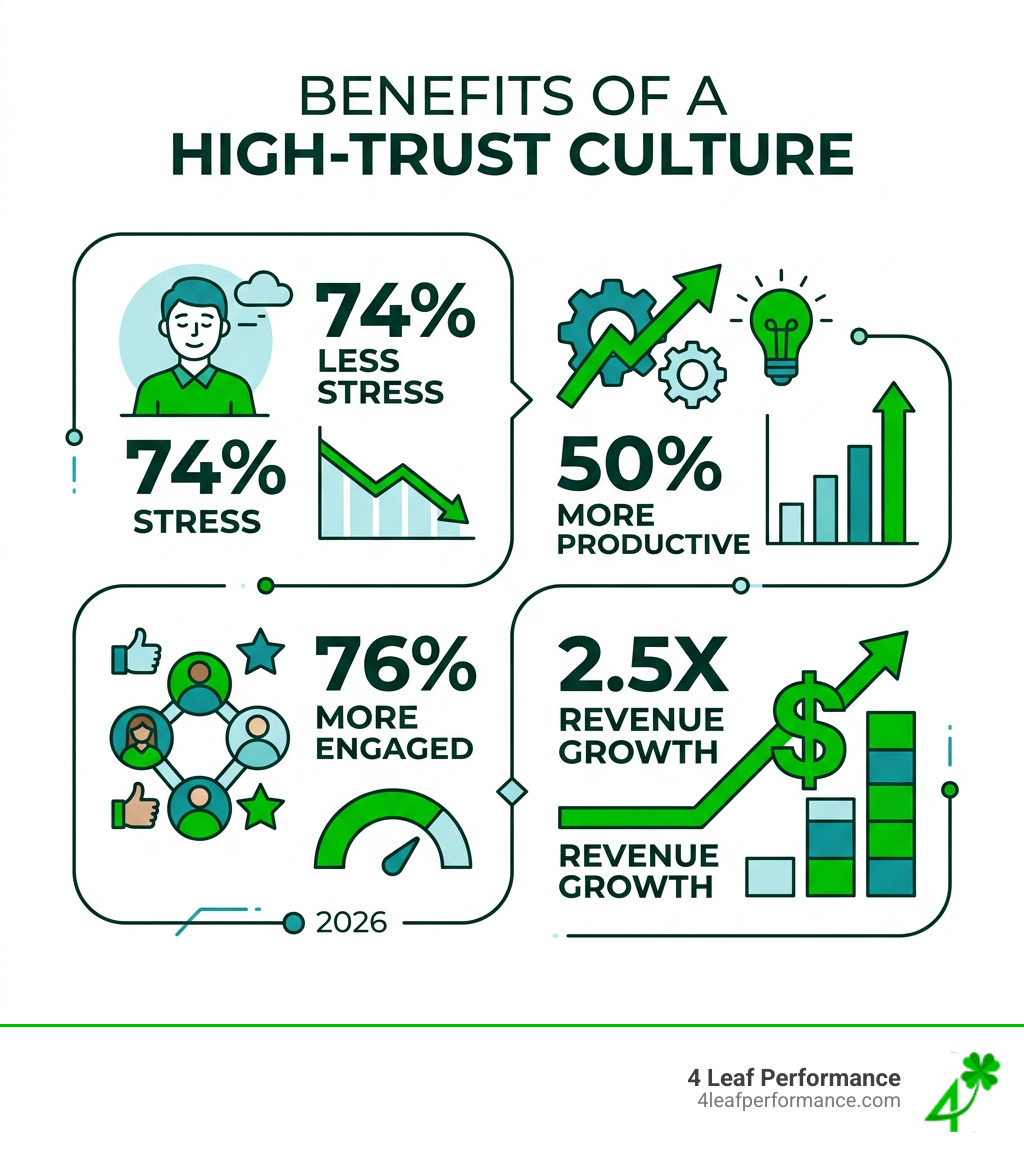
The numbers back this up. Employees in high-trust workplaces report 74% less stress and 50% higher productivity than those in low-trust environments. They are also 76% more engaged — not because of perks or ping-pong tables, but because they genuinely believe in their leaders and their teammates.
Trust is not a soft skill. It is a business result.
Many leaders know something feels off — but they cannot name it. The tension in meetings. The silence after a bad decision. The slow drip of good people walking out the door. That is what broken trust looks like from the inside.
I am Andrew Lamb, a leadership advisor and executive coach with over 25 years of experience in senior global leadership roles, including two decades at HP — where I saw how trust either quietly holds a team together or slowly tears it apart. Building a high-trust culture is not a one-time initiative; it is a leadership discipline I have spent my career studying and applying in organizations at every stage of growth.
In this guide, we will break down exactly how to build it — without the corporate clichés.
Why Building a High-Trust Culture is Your Secret Weapon
When we talk about Building a high-trust culture, we aren’t just talking about being “nice.” We are talking about a massive competitive advantage. According to research from Schultz Law, companies with high trust have employees who are 106% more energetic at work. Imagine if every person on your team had double the energy they have right now.
Trust also acts as a magnet for talent. We know that trust builds retention from the inside out. People don’t leave companies; they leave environments where they feel watched, doubted, or ignored. When trust is high, employees are 50% less likely to look for a new job. That saves you a fortune in hiring and training costs.
The most exciting part is the impact on your bank account. High-trust companies are more than 2.5 times more likely to be high-performing organizations in terms of revenue growth. When people trust each other, they don’t waste time protecting their “turf.” They spend their time winning.

Breaking Down Silos and Helping Teams Work Together
Have you ever noticed how different departments sometimes act like they are on different teams? This is called a “silo.” It happens when Marketing doesn’t trust Sales, or Operations doesn’t trust Finance.
A study in Harvard Business Review found that only 9% of managers feel they can rely on colleagues in other functions all the time. This lack of trust is expensive. In fact, silos can cost a business thousands of dollars every single day because of missed insights and slow work.
Building a high-trust culture breaks these walls down. When we align everyone around a shared purpose, the “turf wars” stop. Instead of fighting over who gets the credit, teams focus on how to solve the customer’s problem. This creates a “positive buzz” where everyone moves in harmony, like professional dancers who know exactly where their partner is going to step next.
The Building Blocks of a Trustworthy Workplace
Trust isn’t something you can buy. It is something you build, one brick at a time. The first brick is integrity. Integrity is simply the “say-do gap.” If you say you will send an email by 5:00 PM and you do it, the gap is zero. Trust goes up. If you say it and don’t do it, the gap grows. Trust falls down.
We believe that ethical leadership and transparency for building trust and resilience are non-negotiable. This means being honest about the numbers, the goals, and even the mistakes. When leaders are transparent, employees feel like they are part of the “inner circle.” They don’t have to play detective to figure out what is actually happening.
Leading the Way in Building a High-Trust Culture
Trust starts at the top. As Joel Peterson notes in his posts on leadership, a business is only as trustworthy as its leaders. You cannot ask your team to be honest if you are hiding information. You cannot ask them to be on time if you are always late.
We focus on creating a culture that serves. This is called servant leadership. Instead of being a boss who sits in a high chair and gives orders, you become a leader who asks, “How can I help you do your job better?” When you show that you care about your team’s success more than your own ego, they will move mountains for you. This alignment of values creates a virtuous cycle where being trusted makes people want to be even more trustworthy.
Aligning Team Interests with Big Goals
In a low-trust workplace, everyone has their own “secret” goals. Maybe they just want to get through the day without getting yelled at. In a high-trust culture, everyone is pulling the same rope in the same direction.
| Low-Trust Goals | High-Trust Goals |
|---|---|
| “Don’t get blamed for mistakes.” | “Let’s learn how to do this better.” |
| “Make my department look good.” | “Make the whole company succeed.” |
| “Do the bare minimum to stay safe.” | “Innovate and try new things.” |
| “Keep information to myself.” | “Share everything to help the team.” |
When we align team interests with a big, meaningful purpose — like helping the community or solving a major problem — work stops being a chore. It becomes a mission.
Practical Steps to Foster Psychological Safety
You might have heard the term “psychological safety.” Research by Amy Edmondson defines this as a shared belief that the team is safe for taking risks.
In a safe team, you can say, “I have a crazy idea,” or “I don’t understand this,” without anyone making fun of you. This is the secret sauce of high-performing teams. Google found that psychological safety was the number one predictor of team success. It wasn’t about how smart the individuals were; it was about how much they trusted each other.
Communication Strategies for Building a High-Trust Culture
Communication is the “breathing” of an organization. If it’s shallow and fast, everyone gets stressed. If it’s deep and steady, everyone stays calm. A Deloitte study on trust shows that trusting employees are 260% more motivated.
To get there, you have to be a master at spotting silent culture cracks. These are the little things, like people stopped asking questions in meetings or a rise in “water cooler” gossip. To fix this, use an open-door policy that actually works. Don’t just say your door is open — go out and talk to people. Listen more than you speak. When you paraphrase what someone said to make sure you understood, you show them respect. Respect is the fastest way to build trust.
How High-Trust Teams Handle Mistakes and Risks
In a low-trust office, a mistake is a crime. People try to hide it or blame someone else. This is a “culture killer.” In a high-trust office, a mistake is a data point.
We use “blameless reviews.” When something goes wrong, we don’t ask “Who did this?” We ask “What happened, and how can we make the system better so it doesn’t happen again?” When you stop finger-pointing, people stop being afraid. When they stop being afraid, they start taking the kind of risks that lead to huge breakthroughs.
How to Measure and Sustain Your Progress
You cannot manage what you do not measure. Some companies use tools like the HX TrustID survey to get a “score” on how much their employees trust them. This is a great start because leaders often think their team trusts them much more than they actually do.
However, culture beats clean data every time. A survey is just a snapshot. The real measurement happens in one-on-one chats. If your employees feel safe enough to tell you bad news or tell you that you are wrong, your trust score is high. If they only tell you what you want to hear, you have work to do.
Empowering Your People Through Flexibility and Support
One of the biggest “trust signals” you can send is giving people freedom. Employees who have flexible schedules have 40% more trust in their bosses. When you say, “I trust you to get your work done, whether you are in the office or at home,” you are giving them a gift of autonomy.
Support also means caring about their personal goals. If an employee wants to learn a new skill or needs time for a family event, support them. When you are “about your people’s success,” they will be about your company’s success. Also, remember to give away the credit. When the team wins, let them take the stage. When the team loses, you take the blame. That is what a high-trust leader does.
Avoiding Trust-Breakers and Rebuilding What is Broken
Trust is like a mirror — once it is cracked, it is very hard to fix. But it is not impossible. First, you must avoid the “trust-killers”:
- Micromanaging: Checking every tiny detail says “I don’t trust you.”
- Gossip: Talking behind someone’s back destroys safety for everyone.
- Hoarding Information: Keeping secrets makes people feel unimportant.
- Breaking Promises: Even small ones matter.
If trust is broken, you have to apologize. No excuses. Just say, “I messed up, and I am sorry.” Then, you have to show consistent action over time. You cannot talk your way out of a problem you behaved your way into. You have to behave your way out of it.
Conclusion: Start Building Your High-Trust Culture Today
Building a high-trust culture is the most important journey you will take as a leader. It turns a group of people into a team. It turns a job into a mission. And it turns a struggling business into a profit-making machine.
At 4 Leaf Performance, we help you Lead Better and Profit Smarter. We use the WHY.OS framework to help you and your team find your “Why.” When you know why you do what you do, trust becomes much easier to build. You stop guessing and start leading with intention.
Don’t let another year go by with long hours and tight margins because your team is stuck in “low-trust” mode. You can have a business that grows without consuming your life. It starts with clarity, and it grows with trust.
Are you ready to see where your hidden profits are hiding? Start building your high-trust culture today and see how our Profit Accelerator can help you scale without the burnout. Your team is waiting for a leader they can truly trust. Be that leader.