Why Effective Leadership Coaching Is the Skill Every Leader Needs Right Now
Effective leadership coaching is a structured, one-on-one approach where a leader helps others grow, think clearly, and take action — instead of just giving orders or answers.
Here is a quick look at what it involves:
| Element | What It Means |
|---|---|
| Goal | Unlock the potential of each person on your team |
| Method | Ask powerful questions, listen deeply, give honest feedback |
| Mindset | Guide and support — not control or direct |
| Result | Higher trust, stronger teams, better performance |
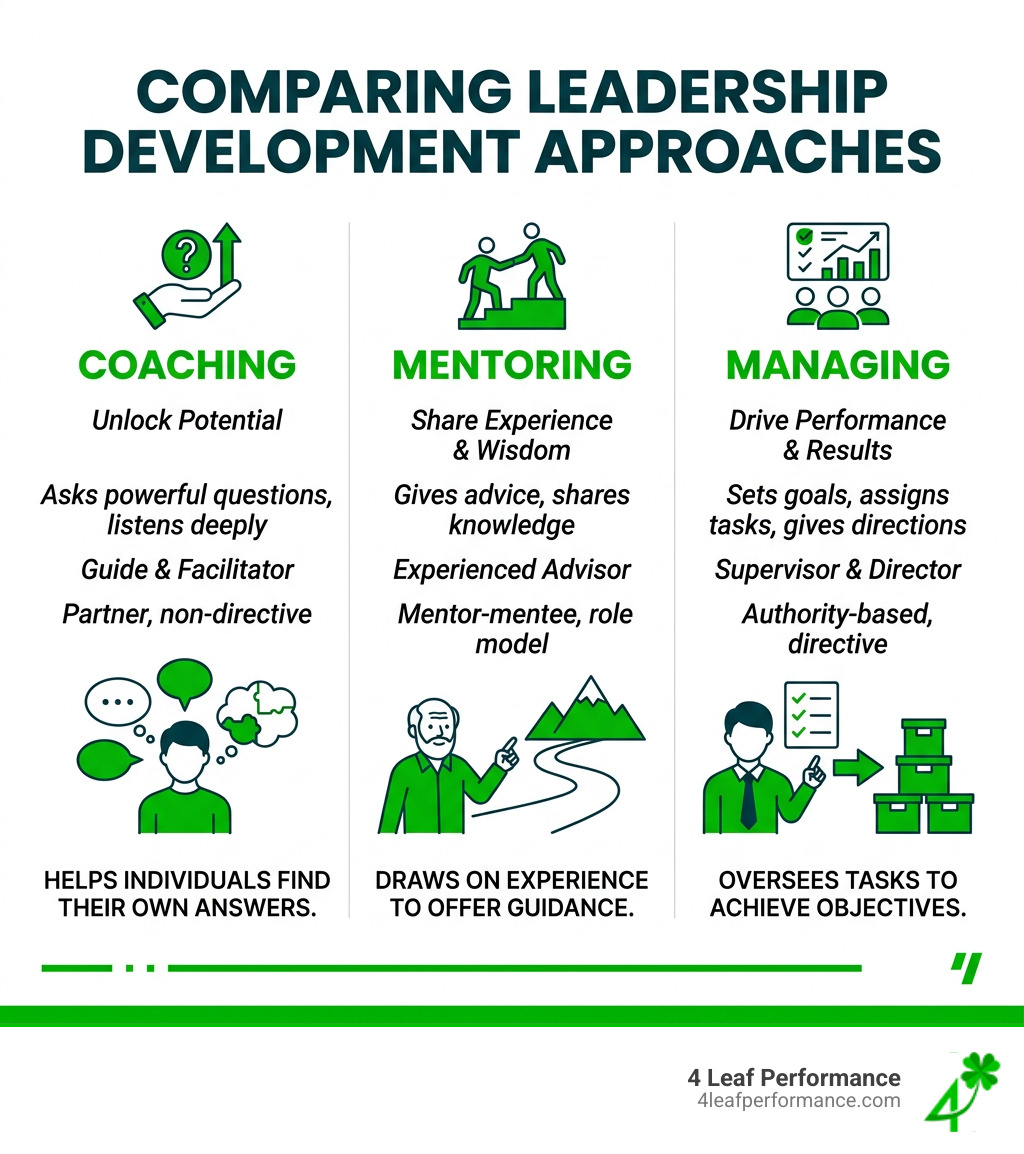
It is not the same as training (which teaches skills) or mentoring (which shares advice from experience). Coaching is about helping someone find their own answers.
And the need for it is real. Nearly 40% of leaders say they have never received good coaching from their own managers. Yet teams with highly engaged, coaching-style leaders are 21% more productive and have 59% lower turnover — according to Gallup research.
Most leaders were never taught how to coach. They were promoted because they were good at their jobs. But managing tasks and developing people are two very different things.
That gap is exactly what this guide is here to close.
I’m Andrew Lamb — leadership advisor, executive coach, and founder of 4 Leaf Performance, with over 25 years of senior global leadership experience, including two decades at HP, where I saw how effective leadership coaching separates teams that grow from teams that stall. The six principles ahead are drawn from that experience and built to give you something you can use right away.
What Makes Effective Leadership Coaching Different?

When we talk about Effective leadership coaching, many people think of a boss giving a pep talk. But it is much deeper than that. To be a great coach, you have to know how it differs from other ways of helping.
Coaching vs. Mentoring
A mentor is like a wise guide who says, “I have been there before, here is what I did.” They share their own stories to help you. Coaching is different. A coach does not give you the answers. Instead, they help you find the answers inside yourself. It is about your growth, not their history. You can learn more about these differences in our guide on business coaching and mentoring vs consulting.
Training vs. Coaching
Training is usually for a group. It teaches everyone the same skill at the same time. Coaching is one-on-one. It is personal. It looks at your specific strengths and the things that trip you up. While training gives you the “how-to,” coaching gives you the “why” and the “what’s next.”
The Power of Active Listening and Empowerment
In a normal meeting, the boss does most of the talking. In Effective leadership coaching, the leader listens more than they speak. This empowers the employee. When people solve their own problems, they feel more confident. Research shows that leaders who use a coaching style see huge jumps in trust and how well the team works together.
Why Modern Leaders Need a Coaching Mindset
The world moves fast now. Leaders cannot know everything or control every tiny detail. The old “command and control” style just makes people tired and burnt out.
Modern leaders need to be adaptable. According to a Gallup survey on engagement, teams with leaders who coach are much more productive. This is because coaching builds trust. When people feel trusted, they work harder and stay at the company longer.
The ROI of Effective Leadership Coaching
Investing in coaching is not just a “nice” thing to do. It makes a lot of money for the business. Research on senior-level coaching ROI shows that companies get back about six times what they spend.
That is a huge win! It leads to:
- Better business growth.
- Keeping your best employees (retention).
- Smarter decision-making.
You can see more about how this works in our article on roi on executive coaching does leadership mentoring work.
6 Core Principles for Coaching Success
To get these results, you need a plan. You can’t just wing it. We use six core principles to make sure coaching actually works. If you want to dive deep into these, check out the definitive guide to leadership coaching programs.
Principle 1: Build Trust and Safety
Coaching only works if the person feels safe. Think of it like a “safe harbor.” They need to know they can be honest without getting in trouble.
- Vulnerability: The leader should show they are human too.
- Confidentiality: What is said in coaching stays in coaching.
- Ethics: Dr. Mary Kay on ethical leadership says that leaders who stay true to their values build the most trust.
Principle 2: Master Active Listening and EQ
Emotional Intelligence (EQ) is the secret engine of great leadership. Mercy Matsika on EI says EQ helps leaders connect and inspire. One big rule we use is the 60/40 speaking ratio. Huthwaite research shows that the person being coached should do 60% of the talking. Your job is to listen for the meaning behind their words, not just the words themselves.
Principle 3: Use Powerful Questioning
Instead of saying “Do it this way,” try asking “What do you think is the best next step?” This is the Socratic method. It sparks curiosity. Good questions help people see their “blind spots”—the things they are doing that they don’t even realize are causing problems.
Principle 4: Focus on Strengths and Growth
We want people to have a “mastery orientation.” This means they want to get better because it feels good to grow, not just to win a prize. We often use tools like the Hogan Personality Assessment to see what someone is naturally good at. When you focus on strengths, people grow much faster.
Principle 5: Provide Constructive Feedback
Feedback should not be scary. We like the idea of “Radical Candor”—caring about the person while being very direct.
- Feedforward: Instead of talking about past mistakes, talk about what to do next time.
- Behavior-specific: Don’t say “You were rude.” Say “When you interrupted Sarah, she stopped sharing her ideas.” This helps the whole team get better. Read more on everything you need to know about executive coaching for teams.
Principle 6: Drive Accountability with Frameworks
A framework is like a map for your conversation. It keeps you on track.
- GROW: Goal, Reality, Options, Will.
- FACT: Facilitate, Advise, Coach, Train.
- ACS: Assessment, Challenge, Support. These tools help turn big ideas into SMART goals (Specific, Measurable, Achievable, Relevant, Time-bound). Even in virtual team coaching, these frameworks keep everyone moving forward.
Real-World Impact of Effective Leadership Coaching
Does this stuff really work? Yes! Some of the biggest companies in the world use these exact ideas.
Lessons from Tech Giants
At Microsoft, they use something called the Model-Coach-Care framework. Instead of just checking work, managers “model” good behavior, “coach” their team to improve, and “care” about them as people. You can read more about Microsoft’s leadership framework to see how they changed their culture.
Google also believes in coaching. Their famous coach, Bill Campbell, helped leaders like Sundar Pichai and Eric Schmidt. Bill Campbell’s impact at Google was huge because he helped them see themselves as others saw them.
Justin Bariso on Google’s coaching shares how simple questions can break big stalemates in decision-making. Even the smartest CEOs need a coach to help them think clearly!
The Future of Effective Leadership Coaching
The coaching world is growing fast. Experts say the market will reach over $200 billion by 2032! Here is what is coming next:
- AI Personalization: Using technology to give leaders data-driven tips.
- Inclusive Leadership: Making sure coaching helps everyone, no matter their background.
- Scalable Ecosystems: Making coaching available to everyone in a company, not just the top bosses.
Frequently Asked Questions about Leadership Coaching
How is coaching different from traditional training?
Training is like a school class where everyone learns the same thing. Coaching is a private partnership that focuses only on what you need to grow.
What are the most common coaching frameworks?
The most popular one is the GROW model. It stands for Goal, Reality, Options, and Way Forward. Others include the ACS (Assessment, Challenge, Support) model used to stretch a leader’s thinking.
How can a company measure the success of a coaching culture?
You can look at numbers like ROI (return on investment), but also at employee engagement scores and how many people stay at the company. If teams are happier and hitting their goals, the coaching is working!
Conclusion
At 4 Leaf Performance, we know that Effective leadership coaching is the key to unlocking your business’s hidden potential. Most owners feel like they are juggling too much. Our Profit Accelerator Coaching Program is designed to help you stop reacting and start leading.
We use our 25 years of global experience and the WHY.OS framework to help you see your numbers differently and lead with intention.
Lead Better. Profit Smarter.
Are you ready to grow without losing your sanity? It is time to get a coach in your corner and a system at your fingertips.
Start Your Profit Accelerator today for just $499 a month. Let’s find those hidden profits together!