
Why Building High-Performing Teams Changes Everything
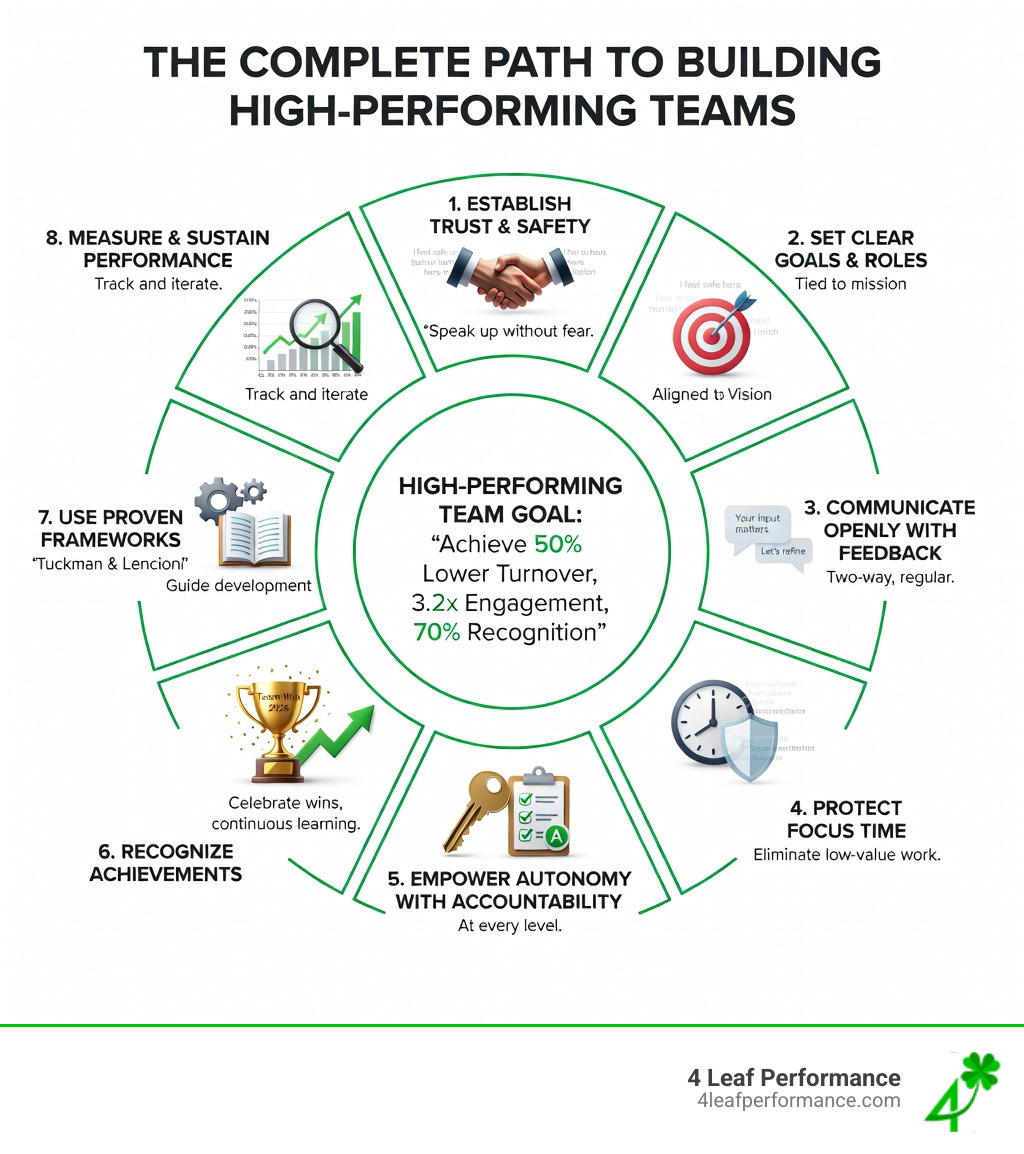
Build high performing teams and you open up something powerful: faster results, better decisions, stronger retention, and real momentum. Here’s what it takes:
- Foster trust and psychological safety so people speak up without fear
- Align everyone around clear goals tied to your organization’s mission
- Define roles and responsibilities so no one’s guessing what success looks like
- Communicate openly with two-way feedback and regular check-ins
- Protect focus time by eliminating distractions and low-value work
- Empower autonomy while maintaining accountability at every level
- Recognize wins and invest in continuous learning
- Use proven frameworks like Tuckman’s stages or Lencioni’s model to guide development
Why does this matter? Because high-performing teams are more productive, more creative, and make better decisions. Companies with strong teams see 50% lower turnover. Employees aligned with organizational goals are 3.2 times more engaged. And when people know their work matters, 70% feel recognized for their contributions.
But here’s the reality: only 15% of employees actually know their organization’s most important goals. Teams fail not because people lack talent, but because leaders haven’t built the structure, trust, and clarity needed to open up that talent.
Think about the automotive parts manufacturer that faced an $80 million project failure every two years like clockwork. The issue wasn’t skill—it was team performance. When leaders finally investigated, they finded the breakdowns came from unclear roles, poor communication, and a lack of shared purpose.
You can’t wish your way to a great team. You have to build it with intention.
That means creating psychological safety where people can take risks. Setting goals everyone understands. Giving feedback that actually helps. Celebrating wins. Managing conflict productively. And yes, sometimes just getting out of the way so talented people can do their best work.
I’m Andrew Lamb, and over 25 years in global leadership roles—including two decades at HP—I’ve seen what separates teams that thrive from teams that spin their wheels. At 4 Leaf Performance, we help leaders build high performing teams using the WHY.OS framework to create fast alignment and clarity that drives real execution.
What Makes a Team Truly Great?
A great team is more than just a group of smart people sitting in the same room. It is a group that works together like a well-oiled machine. To build high performing teams, you need a mix of skills and heart. Research shows that high-performing teams value each other and trust each person. They don’t just “do their jobs.” They believe in each other.
When a team is truly great, they don’t just work faster. They work smarter. They share ideas without being scared. They fix mistakes before they become huge problems. This kind of teamwork leads to 50% lower turnover. That means people stay at their jobs longer because they are happy and feel like they belong.

Building a Safe Space
The most important part of a great team is trust. We call this “psychological safety.” It means everyone feels safe to take a risk. They can say, “I made a mistake,” or “I have a crazy idea,” without anyone laughing at them.
Leaders play a big role here. You have to show your team how to be open. When you share your own struggles, it helps others do the same. You can learn how great leaders turn tension into teamwork by talking about problems early. Instead of hiding from a fight, great teams use disagreements to find better answers. If everyone always agrees, you might be missing a better way to do things!
Proven Steps to Build High Performing Teams
Building a team that wins takes a plan. You can’t just hire people and hope for the best. You need to give them a map so they know where to go. When teams have a clear plan, they become more productive and creative. They stop wasting time on things that don’t matter.
Setting Clear Goals to Build High Performing Teams
Imagine playing a game of soccer where no one knows where the goal is. Everyone would just run around in circles! That is what happens when a team doesn’t have clear goals. We know that purpose-driven teams thrive because they know why their work matters.
To build high performing teams, you must:
- Tell everyone the big mission.
- Set small goals that lead to the big one.
- Make sure everyone knows their specific job.
When an employee’s personal goals match the company’s goals, they are 3.2 times more likely to be engaged. They aren’t just working for a paycheck; they are working to win.
Learning from Real World Mistakes
Sometimes we learn the most from what goes wrong. There was a huge car parts company that lost between $80 million and $100 million every two years. Why? Because their big projects kept failing.
A new leader came in to investigate. He didn’t find that the workers were lazy. He found that the teams weren’t talking to each other. They didn’t have a shared purpose. By looking at these “big events” as team failures instead of just bad luck, the company could finally fix the root of the problem. You can avoid these costly mistakes by making sure your team is aligned from day one.
Leading Your Team to Success
Being a leader doesn’t mean you have to do everything yourself. In fact, the best leaders are “decentered.” This means they don’t have to be the boss of every tiny decision. Instead, they empower their team to make choices. This is one of the 3 essential strategies to boost team productivity.
Using Autonomy to Build High Performing Teams
People work harder when they feel like they “own” their work. If you tell someone exactly how to do every step, they stop thinking for themselves. But if you give them a goal and let them find the best way to get there, they will surprise you with great ideas.
To build high performing teams, you have to trust your people. Give them the power to make decisions. Of course, they are still accountable for the results. But when people have autonomy, they feel more proud of what they build.
Protecting Your Team’s Time
One of the biggest killers of a high-performing team is “busy work.” This includes too many meetings, constant emails, and interruptions. Leaders should act like a shield for their team.
Try using “focus blocks.” These are times during the day when no one is allowed to schedule meetings. This lets your “makers” (like programmers or writers) stay in the zone. If you eliminate low-value work, your team can spend more time on the big things that actually grow the business.
How to Sustain High Performance and Growth
Building a great team is a marathon, not a sprint. You have to keep the energy up. Since 90% of organizations face disruptions like market changes or new technology, your team needs to be resilient. They need to be able to bounce back when things get tough.
One way to keep a team going is through meaningful recognition. This doesn’t just mean a trophy once a year. It means saying “great job” in the moment. It means celebrating small wins. When people feel seen, they want to keep doing their best.
Using Frameworks for Better Results
You don’t have to guess how to help your team grow. Experts have created “maps” called frameworks to help you. Here are two of the most famous ones:
| Model | Focus | Key Stages or Levels |
|---|---|---|
| Tuckman’s Stages | How teams grow over time | Forming, Storming, Norming, Performing |
| Lencioni’s Model | Fixing team problems | Trust, Conflict, Commitment, Accountability, Results |
Understanding the stages of group development helps you realize that “Storming” (arguing) is actually a normal part of becoming a great team! You can also look into how to build a high-performing team using the DISC framework. This helps you understand different personalities so everyone can work together better.
Managing Conflict and Innovation
Conflict isn’t always bad. In fact, if your team never disagrees, you might not be innovating. The key is to have “healthy” disagreements. This is where people argue about ideas, not about each other.
Understanding the psychology of motivation helps you see what keeps your team excited. When you have a feedback loop where people can share their thoughts honestly, you solve problems faster. High-performing teams don’t hide from conflict; they use it to get better.
Frequently Asked Questions about High-Performing Teams
What are the biggest mistakes leaders make?
The biggest mistake is micromanaging. When you try to control every little thing, you crush your team’s spirit. Other mistakes include having unclear goals or ignoring a “toxic” person who is hurting the team’s trust.
How do you measure team performance?
Don’t just look at how many hours people work. Look at results! You can measure things like “deployment frequency” (how often you finish a project) or “quality bars” (how few mistakes are made). The best measure is whether the team reached the goals they set.
Can any team become high-performing?
Yes! But it doesn’t happen by accident. It takes a leader who is willing to put in the work. You need to have the right people in the right seats, a clear mission, and a culture of trust.
Conclusion
At 4 Leaf Performance, we know that your business is only as strong as your team. We help you build high performing teams by using our 25 years of global experience. We don’t just give you a “to-do” list. We use the WHY.OS framework to help you and your team find your true purpose.
When you lead with intention, you stop reacting to chaos and start driving results. You can find hidden profits and scale your business without burning out. Remember: Lead Better. Profit Smarter.
Are you ready to turn your group of employees into a high-flying squad? Start your team transformation today and see what your business can really achieve.