Why Most Leaders Struggle to Turn Vision into Action
Executive strategic planning is the process of defining where your organization is going and how you’ll get there—with clear goals, measurable steps, and the buy-in you need from your team. Done right, it transforms scattered effort into focused progress. Done wrong, it becomes a binder that sits on a shelf.
Quick Answer: What Makes Executive Strategic Planning Work?
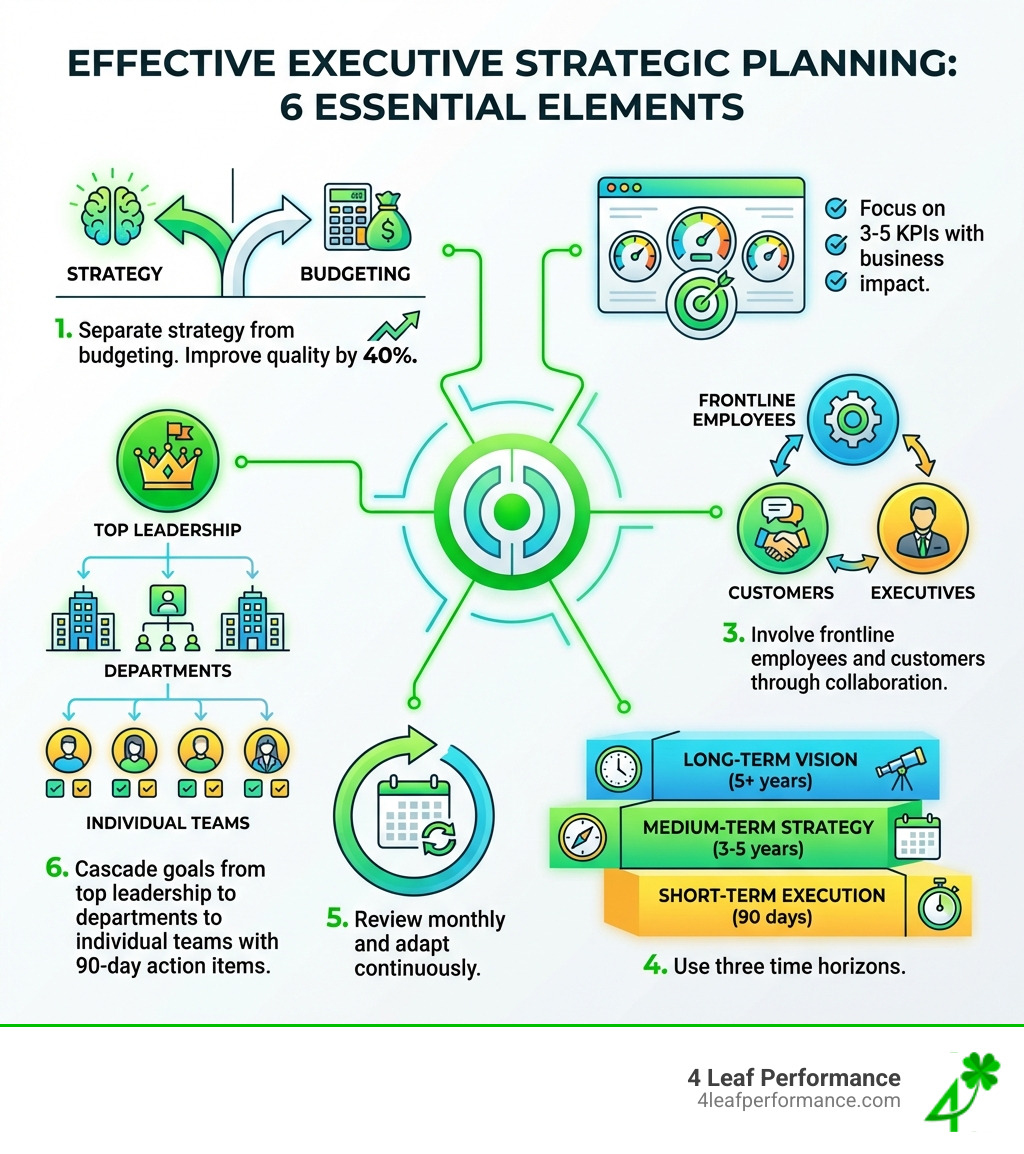
- Separate strategy from budgeting to open up bold thinking
- Focus on 3-5 key performance indicators that truly matter
- Involve frontline employees and customers in the planning process
- Use distinct time horizons: long-term vision (5+ years), medium-term strategy (3-5 years), and short-term execution (90 days)
- Review and adapt monthly—not just annually
- Cascade goals from the top to every department and team member
Here’s the uncomfortable truth: 60-90% of strategic plans never fully launch or fail during execution. Only 32% of executives believe their company’s strategic planning process actually works. The rest? They describe it as a time-consuming ritual that produces documents no one reads and decisions no one remembers.
The problem isn’t that leaders lack vision. It’s that traditional planning processes are broken. They mix strategy with budgeting, which kills innovation. They happen once a year on the calendar instead of when business needs demand it. They isolate executives in conference rooms instead of bringing in the people who actually see customers and solve problems every day.
When planning fails, companies drift. Teams work hard but pull in different directions. Resources get spread thin across too many priorities. And the gap between what leadership wants and what actually happens keeps growing.
But it doesn’t have to be this way. The best executive teams treat strategic planning as a living process, not an annual event. They keep plans simple enough to remember and flexible enough to adjust when reality changes. They measure what matters, communicate constantly, and make sure everyone—from the C-suite to the front line—knows how their work connects to the bigger picture.
I’m Andrew Lamb, and I’ve spent over 25 years helping leadership teams turn strategic chaos into clear, executable plans that actually drive results. At 4 Leaf Performance, we use the WHY.OS framework to help leaders master Executive strategic planning by aligning their teams around purpose, priorities, and profit—fast.
Why Traditional Executive Strategic Planning Often Fails
Most leaders have a big dream for their business. They want to grow, help more people, and make more money. But there is a huge gap between having a dream and making it happen. Research shows that 60-90% of plans never fully launch. That is a lot of wasted time!
One big reason for this is having too many priorities. When you try to do everything at once, you end up doing nothing well. We often see leaders who are overwhelmed by unfocused plans. They have so many “top priorities” that their team doesn’t know what to do first.
Another reason is the “calendar effect.” Many companies only think about strategy once a year because the calendar says it is time. But the world moves fast. If you only plan in October, you might miss a huge change that happens in March. To learn more about why things go wrong, check out our guide on Why Strategy Fails (and How to Fix It).
Stop Mixing Strategy with Budgeting
Imagine you are trying to build a rocket ship. If you start by looking at your checkbook and saying, “I only have fifty dollars,” you will never build a rocket. You will build a paper airplane.
This is what happens when executives mix strategy and budgeting. Budgeting is about saving money and being careful. Strategy should be about big ideas and winning. When you separate these two things, the quality of your strategy can go up by 40%.
Executives who separate them are more likely to be bold. They can think about innovation first. Once the big, winning idea is set, then you can figure out how to pay for it.

The Main Parts of a Good Plan
A good plan doesn’t have to be 100 pages long. In fact, the best plans are often the simplest. If your team can’t remember the plan, they can’t follow it. We like to say that a great plan should fit on a single sheet of paper. You can use tools like an A3 or an X-Matrix to keep things tight.
Clear communication is also key. You have to explain the “why” behind your choices. If you tell your team to “turn left,” they might do it. But if you tell them, “We are turning left to avoid the storm and reach the gold mine faster,” they will run to turn that wheel. For more on this, read “3 Ways to Communicate your Company’s Strategy” by Constantinos and MacLennan.
Setting Goals and Picking 3-5 KPIs
What are we trying to accomplish? This is the most important question. You need to define a clear end goal. Once you have that, you need to know if you are getting closer.
We recommend picking only 3-5 Key Performance Indicators (KPIs). These are the numbers that really matter. If you track 50 things, you are just looking at data. If you track 3 things, you are managing a business. These KPIs should be shared with everyone so there is total transparency. Learn how to do this right in our article on How to Set Goals for Your Business.
Planning for Today and Tomorrow
Executive strategic planning needs to look at different times all at once. We use “time horizons” to do this:
- Long-term Vision (5+ years): This is your North Star. Where do you want to be in the far future?
- Medium-term Strategy (3-5 years): These are the big moves you will make to get toward that vision.
- Short-term Execution (90 days): These are the specific steps you are taking right now.
Think of it like a ship. The vision is the destination across the ocean. The strategy is the route you take. The execution is how you sail the ship today.
Working Together for Better Results
Strategy shouldn’t just happen in a fancy office. The best ideas often come from the people who talk to your customers every day. Frontline employees know what is actually happening on the ground.
When you involve your team, you get “buy-in.” This means they feel like the plan is theirs, too. One great way to do this is called “Catchball.” It’s like a game. Leadership throws an idea to the team. The team catches it, adds their ideas, and throws it back. This makes the plan stronger. You can read more about this journey in the McKinsey article on Managing the strategy journey.
Getting Help from an Outside Expert
Sometimes, you are too close to the problem to see the solution. That is why many successful leaders use an outside facilitator or a peer advisor group.
An outside expert can ask the hard questions that your employees might be afraid to ask. They help make sure everyone’s voice is heard. They also keep the meeting on track so you don’t spend three hours talking about the color of the office carpet.
Tools and Techniques for Executive Strategic Planning
We use several proven tools to help our clients succeed. One is the TOWS Matrix. It’s like a SWOT analysis (Strengths, Weaknesses, Opportunities, Threats) but it goes a step further. It helps you match your strengths to your opportunities to create a real plan of action. For a deep dive, see our post on Navigating Business Challenges Through SWOT Analysis.
We also use SMART goals. This means your goals must be:
- Specific
- Measurable
- Achievable
- Relevant
- Time-bound
Another great tool is a Strategy Map. This is a picture that shows how your goals connect. It helps the whole team see how their hard work helps the company win.
Sharing Goals and Making Them Stick
A plan is only good if people actually do it. This is called “cascading.” You take the big company goals and break them down for each department. Then, you break them down for each person.
Every person in your company should know exactly what they need to do to help the big plan. We like to use 90-day action plans. These are short bursts of work that keep everyone moving fast. To see how to turn your vision into daily work, read From Vision to Action: How to Translate Business Strategy into Daily Execution.
Making Executive Strategic Planning a Living Document
Don’t put your plan in a drawer! It should be a “living document.” This means you look at it all the time.
We suggest having a strategy meeting for 2-4 hours every week or two. You should also have a big review every month. If something isn’t working, change it! The best companies are 60% more likely to make good decisions if they plan based on what the business needs, not just what the calendar says.
Real-World Success and Your Next Steps
Many famous companies have used these steps to win. For example, a global bank once stopped their old way of planning and started meeting every two weeks to talk about strategy. This helped them fix their balance sheet and focus on their best customers.
Another company, Philips, saw that people were getting older and cared more about health. They used their strategic planning to shift from making TVs to making healthcare machines. This saved their business!
| Old Planning Style | New Executive Strategic Planning |
|---|---|
| Happens once a year | Happens all the time |
| Only the bosses talk | Everyone helps |
| 50+ goals and KPIs | 3-5 key KPIs |
| Mixed with the budget | Separate from the budget |
| Hard to change | Flexible and living |
Frequently Asked Questions about Strategic Planning
Why do most plans fail?
Most plans fail because they are too complicated, have too many goals, or don’t have the support of the employees. Also, if the plan is just a list of things to do without a “why,” people won’t stay motivated.
How many KPIs should we have?
We recommend 3 to 5. If you have more than that, it is hard to stay focused. You want to measure the things that have the biggest impact on your profit and growth.
How often should we review the plan?
You should look at your progress every week. You should have a deeper review every month. Once a year, you should do a big review to see if your long-term vision needs to change.
Conclusion
Executive strategic planning is the secret to moving from just “working” to actually “winning.” It gives you clarity, helps your team work together, and makes sure you are making a profit.
At 4 Leaf Performance, we know that growth should not cost your sanity. We use our 25 years of experience and the WHY.OS framework to help you lead with intention. You don’t have to grow alone. We can help you find the hidden profits in your business and build a team that loves the journey.
Are you ready to stop guessing and start leading? Start Your Profit Accelerator today for just $499 a month. Let’s turn your vision into victory together.