Why Transformational Leadership Coaching Is the Missing Piece
Transformational leadership coaching is a development process that helps leaders create irreversible change in how they think, communicate, and lead. Unlike traditional training that focuses on skills and behaviors, transformational coaching rebuilds the mental models and beliefs that shape how leaders see themselves, their teams, and their work. The result is not just better performance—it’s a fundamental shift in who you are as a leader.
Quick Answer: What Makes Transformational Leadership Coaching Different?
- Targets mental models, not just behaviors or skills
- Creates lasting change you can’t go back from
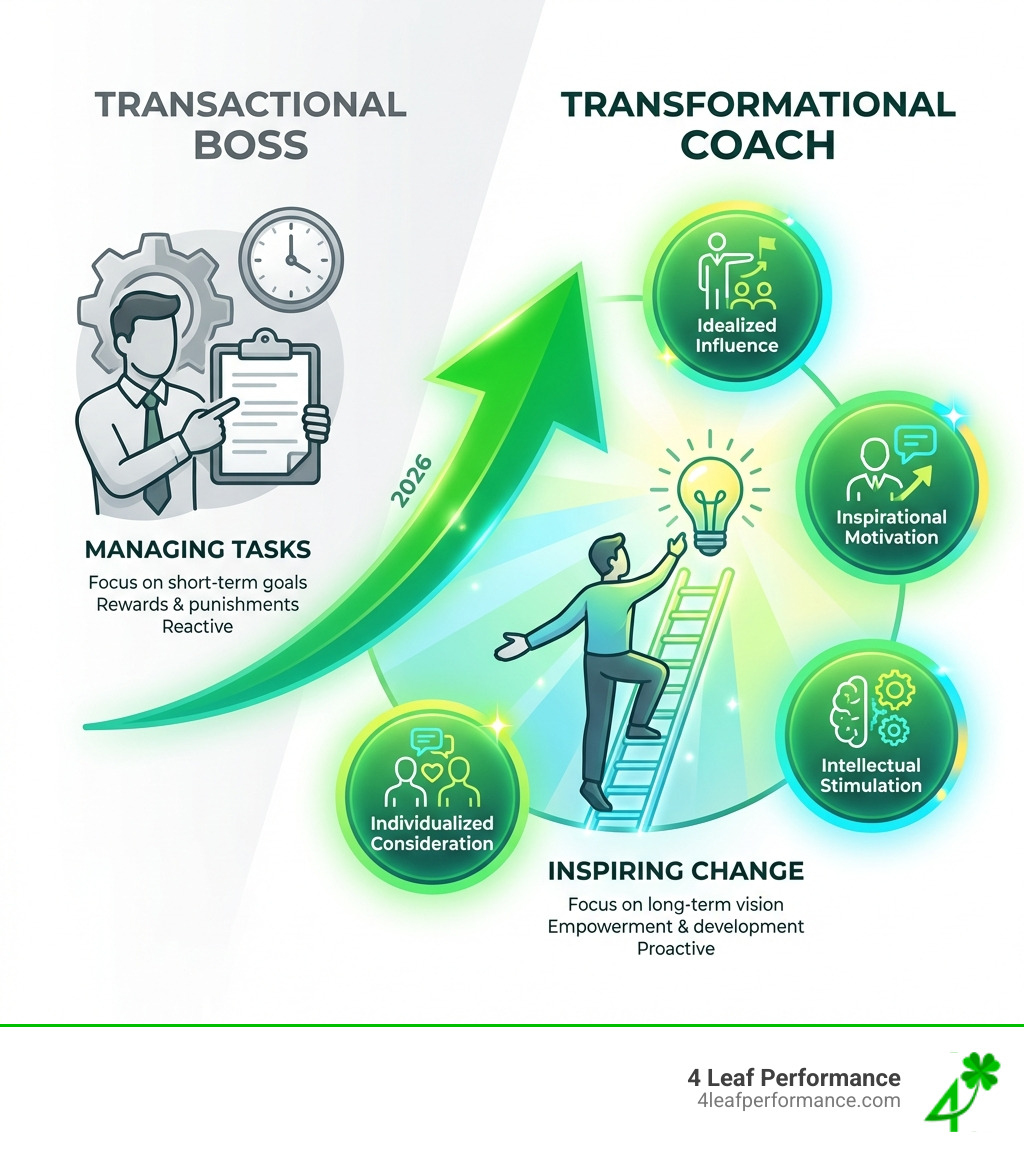
- Develops the 4 I’s: Idealized Influence, Inspirational Motivation, Intellectual Stimulation, and Individualized Consideration
- Works through reflective dialogue instead of advice-giving
- Delivers measurable ROI: Organizations investing in conscious leadership see up to 788% return on investment
Three out of four change initiatives fail. The biggest reason? Leadership behavior. Leaders often have the information they need but lack the sensemaking required to navigate complexity, inspire their teams, and turn strategy into sustainable action. Transformational coaching fills that gap by helping you examine and shift the invisible beliefs and assumptions driving your decisions.
I’m Andrew Lamb, and over 25 years in senior global leadership roles—including two decades at HP—I’ve seen what separates leaders who manage from leaders who truly transform organizations. Through Transformational leadership coaching at 4 Leaf Performance, we use the WHY.OS framework to help leaders understand themselves and their teams in minutes, creating the clarity and alignment that drives real results.
What is Transformational Leadership Coaching?
Think of a bridge builder. A bridge builder doesn’t just look at the water. They look at how to get people from one side to the other safely. Transformational leadership coaching is like being a bridge builder for your own life and career. It helps you cross over from “how things used to be” to “how they could be.”
Most coaching is about “doing.” It teaches you how to give a better speech or how to fix a schedule. But transformational coaching is about “being.” It looks at your mental models. These are the invisible maps in your head that tell you how the world works. If your map is old, you will get lost. This coaching helps you draw a new map.
It is a deep kind of growth. We don’t just want you to learn a new trick. We want you to see the world in a new way. Once you see it, you can’t “un-see” it. That is why we call it irreversible change. It’s the difference between business coaching services vs consulting. A consultant tells you what to do. A transformational coach helps you become the person who knows exactly what to do.
The 4 I’s of Transformational Leadership Coaching
To be a truly great leader, you need more than just a loud voice. You need the “4 I’s.” These are the four pillars that make this style of leadership work:
- Idealized Influence: This means you lead by example. You are someone people trust and want to follow. You walk the talk.
- Inspirational Motivation: You have a big vision. You don’t just tell people to work; you make them want to work because they believe in the goal.
- Intellectual Stimulation: You don’t want “yes-men.” You encourage your team to think for themselves, ask questions, and try new things.
- Individualized Consideration: You treat everyone like a real person. You know their strengths and their fears. You help them grow in their own way.
How it differs from other styles
Many bosses use “transactional leadership.” This is like a vending machine. You put in work, and you get a candy bar (a paycheck). If you do something wrong, you get a “punishment.” It is very simple, but it doesn’t inspire anyone.
Transformational leadership is different. It’s not about trading money for time. It’s about changing the heart and mind of the team.
| Feature | Transactional Leadership | Transformational Leadership |
|---|---|---|
| Main Goal | Keep things running as they are | Change things for the better |
| Motivation | Rewards and punishments | Vision and purpose |
| Focus | Short-term tasks | Long-term growth |
| Leader’s Role | The Boss / Overseer | The Coach / Visionary |
Why Leaders Need Transformation During Change
The world changes fast. New technology and new ways of working pop up every day. Sadly, scientific research on change failure shows that 75% of big changes in companies fail. Why? Usually, it is because the leaders didn’t change their own behavior.
When a company shifts, the leader must shift too. You can’t use old tools to build a new future. This is why moving from training to transformation is so important. Training gives you a manual. Transformation gives you a new brain.
Overcoming limiting beliefs
We all have “limiting beliefs.” These are little voices in our heads that say, “I can’t do that” or “My team won’t listen.” These beliefs are part of our mental models. If you believe you have to control everything, you will burn out.
Coaching helps you find these beliefs and kick them out. When you do, self-aware leadership wins. You stop reacting to stress and start choosing your actions. You become the pilot of the plane instead of just a passenger.
Starting Your Transformational Leadership Coaching Journey
How do you start? It usually begins with a mirror. We use something called 360-degree feedback. This means we ask your peers, your boss, and your team what they see in you. It can be scary, but it is very helpful!
In our sessions, we use powerful questions. We don’t give you the answers. We ask things like, “What are you assuming is true here?” or “What would you do if you weren’t afraid?” By mastering executive leadership development, you learn to listen to your own wisdom. You also learn active listening, which helps you hear what your team isn’t saying.

The Big Benefits for Your Team and Business
Is it worth the money? Yes! Research shows that organizations that focus on “we” instead of “me” get a 788% roi on executive coaching. That is a huge return!
But the benefits aren’t just about money. You get:
- Happier Employees: When people feel inspired, they work harder and stay longer.
- More Innovation: Your team will feel safe to share new ideas.
- Better Resilience: Your business can handle tough times because everyone knows the vision.
Building Emotional Intelligence and Better Decisions
Emotional Intelligence (or EQ) is a superpower. It means you can understand your own feelings and the feelings of others. Transformational coaching helps you build empathy. When you care about your team, they care about the work.
By leading by example, you show your team how to stay calm under pressure. These modern leadership qualities help you make better decisions. You stop making choices based on fear and start making them based on your goals.
Creating a ripple effect
When a leader transforms, it’s like dropping a stone in a pond. The ripples spread out. Your team starts to trust each other more. They start to talk more openly. This creates “psychological safety.” This is a fancy way of saying people feel safe to be themselves. When people feel safe, they do their best work. This leads to sustainable growth that lasts for years, not just weeks.
The Structure of the Coaching Process
What does a coaching engagement actually look like? It isn’t just a random chat. It has a structure:
- Initial Assessment: We find out where you are now. We look at your strengths and your “blind spots.”
- Goal Setting: We decide where you want to go. What kind of leader do you want to be in one year?
- Regular Sessions: We meet to talk, reflect, and plan.
- Follow-up: We check in to make sure the changes are sticking.
For more deep details, you can look at the Institute for Transformational Leadership.
Reflective discourse and critical reflection
We use something called Mezirow’s theory of transformative learning. It sounds complicated, but it’s actually simple. It says that for us to change, we have to look at our “frames of meaning.”
We use “premise reflection.” This means we don’t just ask what you did or how you did it. We ask why you thought that was the right way to do it. This happens in a “dialogue laboratory.” This is a safe space where you can test out new ways of thinking without anyone judging you. We even look at “edge emotions” like fear or shame. These emotions are actually clues that tell us where you need to grow!
Moving from insight to reflective action
Thinking is great, but you have to do something too. We design behavioral experiments. For example, if you struggle with micromanaging, your experiment might be: “This week, I will let my team handle the Tuesday meeting without me saying a word.”
Sometimes you will slip back into old habits. We call these “regressions.” We don’t get mad about them. We name them and learn from them. This is how you integrate your new skills into your real life.
Frequently Asked Questions about Leadership Coaching
Is this coaching only for CEOs?
No! While many CEOs use it, Transformational leadership coaching is great for anyone who leads others. This includes managers, high-potential employees who are moving up, and even whole teams. Everyone can benefit from being more self-aware.
How long does a typical engagement last?
It depends on your goals. Some people get what they need in a few weeks. Others work with a coach for a whole year. It depends on how deep you want to go and how much time you can invest.
How do I choose the right coach?
Chemistry is the most important thing! You need to trust your coach. Look for someone with real experience and a proven track record. You should feel safe talking to them, but they should also be able to challenge you when you need it.
Conclusion
At 4 Leaf Performance, we know that being a leader is hard. You are juggling a lot! But you don’t have to do it alone. Our WHY.OS framework helps you find your “Why” so you can lead with clarity.
Remember: Lead Better. Profit Smarter. You can have a business that grows without losing your sanity. It all starts with you.
Are you ready to stop just managing and start transforming?