
What Is Leadership Communication (And Why It Matters So Much)?
Leadership communication is how leaders share ideas, give direction, and inspire people to act — using words, body language, and active listening.
Here is a quick breakdown:
| Element | What It Means |
|---|---|
| Verbal cues | The words you choose and how you say them |
| Nonverbal cues | Body language, eye contact, facial expressions |
| Active listening | Truly hearing your team, not just waiting to talk |
| Moving people to action | Turning your message into motivation and results |
Think about the last time you felt lost at work. Chances are, someone up top was not communicating well.
Poor communication is not just uncomfortable. It is expensive. Research shows large companies lose an average of $64.2 million per year from communication breakdowns. Smaller businesses risk losing up to $420,000 annually.
But here is the good news: leadership communication is a skill you can learn. It is not something you are born with. The best leaders study it, practice it, and keep getting better at it.
When leaders communicate well, teams feel clear, confident, and motivated. When they do not, people feel confused, stressed, and disconnected.
The gap between a struggling team and a thriving one often comes down to how well the leader talks — and listens.
I’m Andrew Lamb, a leadership advisor and executive coach with over 25 years of senior global leadership experience, including two decades at HP, where I saw how leadership communication shapes whether teams succeed or quietly fall apart. In the sections below, we will walk through everything you need to know to communicate with clarity, purpose, and real impact.
What is Leadership Communication and Why is it Important?
At its heart, leadership communication is the tool we use to move people toward a shared goal. It is not just about giving orders. It is about building a bridge between your vision and the people who will help you reach it.
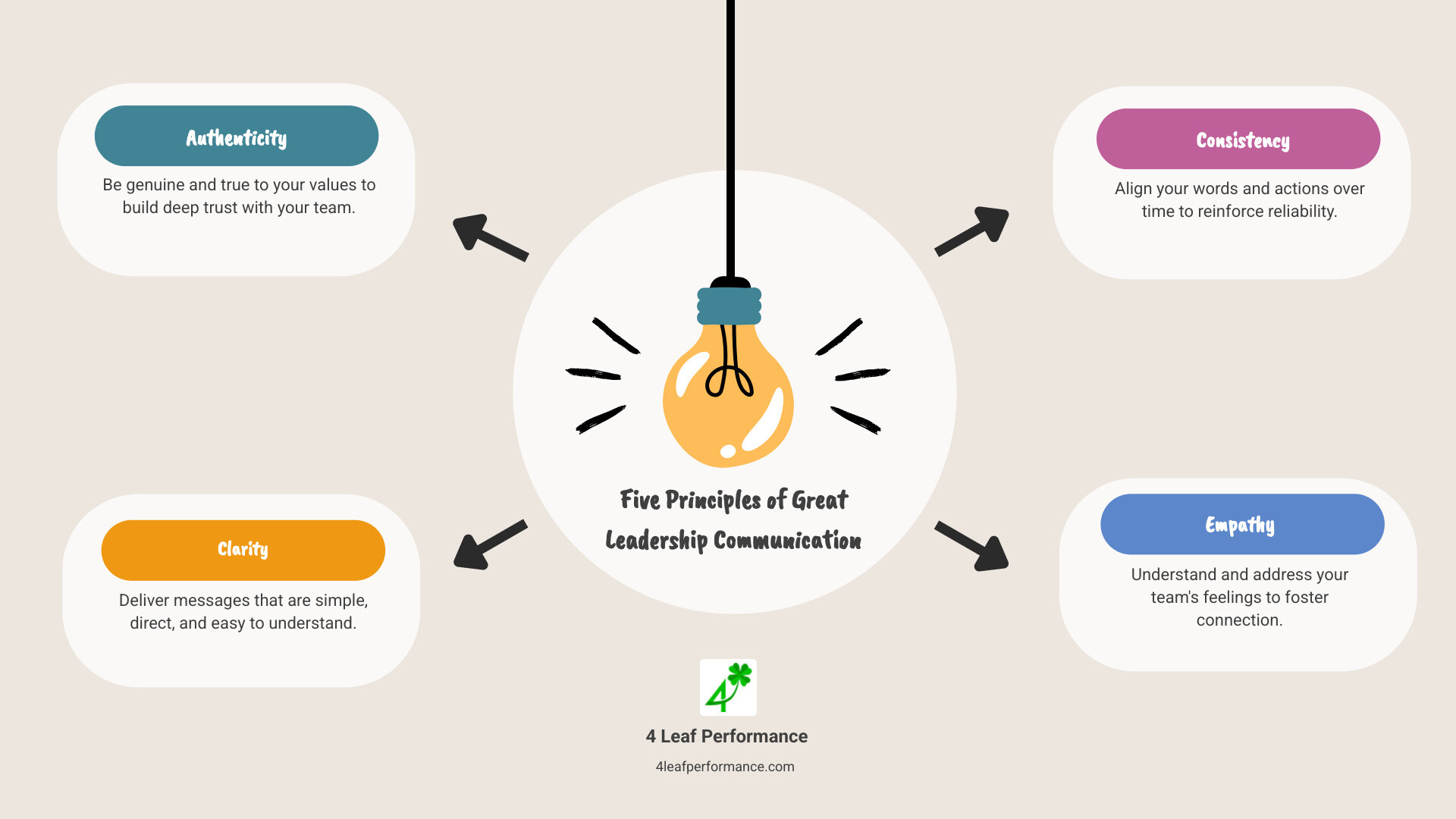
To do this well, we focus on five big pillars:
- Authenticity: This means being real. People can tell if you are faking it. If you are honest about what you know and what you don’t, your team will follow you.
- Clarity: If your team has to guess what you want, they will probably get it wrong. Use simple words.
- Consistency: You cannot say one thing on Monday and something else on Friday. This makes people feel unsafe.
- Empathy: You need to understand how your team feels. In fact, empathy is often ranked as the number one skill for success.
- Respect: When people feel respected, they work harder. It is that simple.
When we use these pillars, we create authentic leadership that feels good for everyone. It stops being about “bossing” and starts being about leading.
Why Leadership Communication is the Key to Trust
Trust is like the glue that holds a business together. Without it, everything falls apart. Leadership communication builds trust because it creates transparency.
When you are transparent, you tell your team the “why” behind your choices. We believe that knowing your why is the fastest way to get everyone on the same page. If people know why they are doing something, they don’t feel like robots. They feel like partners.
Trust also comes from being visible. If you only talk to your team when something is wrong, they will be scared every time you open your mouth. Good leaders talk often, even when things are going fine.
Being Real with Your Team
Being a leader does not mean you have to be perfect. It means you have to be human. Honesty and accessibility are more important than being the smartest person in the room.

Confidence is important, but don’t confuse it with being a “know-it-all.” True confidence is staying calm when things are hard and being open to new ideas. When you are real with your team, they feel like they can be real with you too. This stops small problems from turning into big disasters.
How Different Communication Styles Change Your Leadership
Not every leader talks the same way. Researchers have found that how we talk is closely linked to our leadership style. A study of 279 employees showed that our communication style explains a huge part of how people see us as leaders.
- Charismatic Leadership: These leaders use a lot of “assuredness” and “expressiveness.” They explain about 69% of why someone is seen as a charismatic leader through their talking style alone.
- Human-Oriented Leadership: This is all about being supportive. Communication styles explain about 79% of this style. If you are supportive, your team will be much more satisfied with your work.
- Task-Oriented Leadership: This style is more about the work and less about the feelings. Communication only explains about 30% of this style, which shows it is more about “managing” than “leading.”
You can read more about the science of communication styles to see how these numbers work.
| Style | Main Focus | Key Communication Trait |
|---|---|---|
| Supportive | People and feelings | Empathy and listening |
| Precise | Facts and results | Clarity and data |
Improving Leadership Communication Through Active Listening
Most people think communication is just about talking. But the best leaders know that listening is a leadership superpower.
We like to use the 80/20 rule. This means you should spend 80% of your time listening and only 20% of your time talking. When you listen first, you learn things you would have missed if you were just waiting for your turn to speak.
Next-level listening means:
- Stopping what you are doing.
- Looking the person in the eye.
- Asking questions like “Can you tell me more about that?”
- Not judging what they say right away.
Speaking with Precision and Power
While listening is key, you still have to speak! When you do, you should aim for preciseness. This means being very clear about what needs to happen.
Research shows that a leader’s “preciseness” is strongly linked to how well people think they are performing. If you speak plainly and avoid fancy “business talk” (jargon), people will trust you more.
Avoid being “verbally aggressive.” This means don’t attack people with your words. Instead, use “assuredness.” State your facts with confidence, but stay kind.
The Impact of Effective Leadership Communication on Your Team
When you get leadership communication right, the results are amazing. Your team stays happy, they don’t want to quit, and they work better together.
If communication is bad, the costs are high. According to the Society of Human Resource Management (SHRM), poor communication leads to:
- Low morale (people feeling sad or bored).
- Missed goals.
- Lost sales.
- Stress and burnout.
But when it is good, employee satisfaction goes up. In fact, communication and leadership styles together can explain 85% of why a team is happy with their leader.
Helping Your Team Share What They Know
A business is only as smart as the people in it. But if your team is afraid to talk, their good ideas stay stuck in their heads.
We talk about two things here: knowledge donating (people wanting to share ideas) and knowledge collecting (people asking others for help). Supportive communication makes people feel safe enough to do both. This is a big part of leading with purpose. When everyone shares what they know, the whole team wins.
Keeping Your Team Happy and Working Hard
A happy team is a productive team. Good communication lowers stress because people know exactly what their priorities are. They don’t have to guess if they are doing a good job.
High morale comes from feeling heard. When you take feedback seriously and actually change things based on what your team says, they feel valued. This makes them want to work harder for you.
Practical Ways to Improve Your Skills Today
You don’t need a fancy degree to be a better communicator. You just need to practice a few simple habits:
- Speak plainly: Don’t use big words to sound important. Use small words to be understood.
- Tailor your message: Talk to a new intern differently than you talk to a long-time manager. Think about what they care about.
- Give feedback often: Don’t wait for a once-a-year meeting. Tell people they are doing a good job today.
- Practice active listening: Use it to manage conflict before it gets out of hand.
Using Stories to Lead
Facts are boring. Stories are powerful. If you want to share your vision, tell a story. Stories help people remember why the work matters.
For example, instead of saying “We need to increase sales by 10%,” tell a story about a customer whose life was changed by your product. This builds trust and makes the goal feel real. It is also a great way to network and meet new people.
Handling Hard Conversations
Hard conversations are… well, hard! But smart leaders don’t run away from them. They embrace conflict because it helps the team grow.
When things get tough, use open-ended questions. These are questions that can’t be answered with just “yes” or “no.” A great trick is the TED acronym:
- T: “Tell me more…”
- E: “Explain what you mean…”
- D: “Define that for me…”
This keeps the conversation moving and stops people from getting angry.
Training Your Leaders to Talk and Listen Better
Organizations that invest in communication training see big benefits. This is especially true in places like healthcare. In a hospital, bad communication can lead to mistakes that hurt people.
Training helps leaders find their “professional identity.” It gives them a “toolbox” of evidence-based frameworks to use when things get stressful.
Whether you are a doctor, a manager, or a business owner, learning to be self-aware is the first step. When you know how you come across to others, you can change your style to get better results.
Frequently Asked Questions about Leadership Communication
How can leaders help teams when things are uncertain?
When things are changing fast, leaders need to talk more, not less. Even if you don’t have all the answers, be honest. Say, “Here is what I know, and here is what I am still working on.” This stops rumors from spreading and keeps people calm.
What are the best ways to talk to people in healthcare?
In healthcare, you must be very precise but also very empathetic. Use clear instructions so no mistakes happen, but also listen to the concerns of patients and staff. It is a balance of being a “scientist” and a “friend.”
How does body language change what people hear?
Research says that 93% of communication’s impact comes from nonverbal cues. If you say “I’m listening” while looking at your phone, your team knows you are lying. Open body language—like uncrossed arms and eye contact—makes people feel safe.
Conclusion
At 4 Leaf Performance, we know that being a great leader is about more than just knowing your numbers. It is about how you connect with your people. Our WHY.OS framework and Profit Accelerator program are designed to help you Lead Better and Profit Smarter.
By focusing on leadership communication, you can turn a chaotic office into a smooth-running machine. You can find hidden profits by simply listening to the people who do the work every day.
Don’t spend another year guessing what to do next. Start leading with intention. Your team—and your bank account—will thank you.
Ready to unlock your leadership potential? Let’s start your journey to better communication today. Reach out to us to see how we can help you find your “why” and lead your team to victory.