Why Understanding Behavior Modification Matters for Your Team
Behavior modification in organizational behavior is the systematic use of reinforcement strategies to shape employee actions and improve workplace performance. It’s based on operant conditioning principles developed by B.F. Skinner and focuses on observable, measurable behaviors rather than internal attitudes or feelings.
Key Elements of Behavior Modification:
- What it changes: Specific workplace behaviors like attendance, quality of work, safety practices, and customer interactions
- How it works: Uses positive reinforcement, negative reinforcement, punishment, and extinction to increase desired behaviors and reduce unwanted ones
- Why it matters: Research shows an average 17% performance improvement across organizations using these techniques
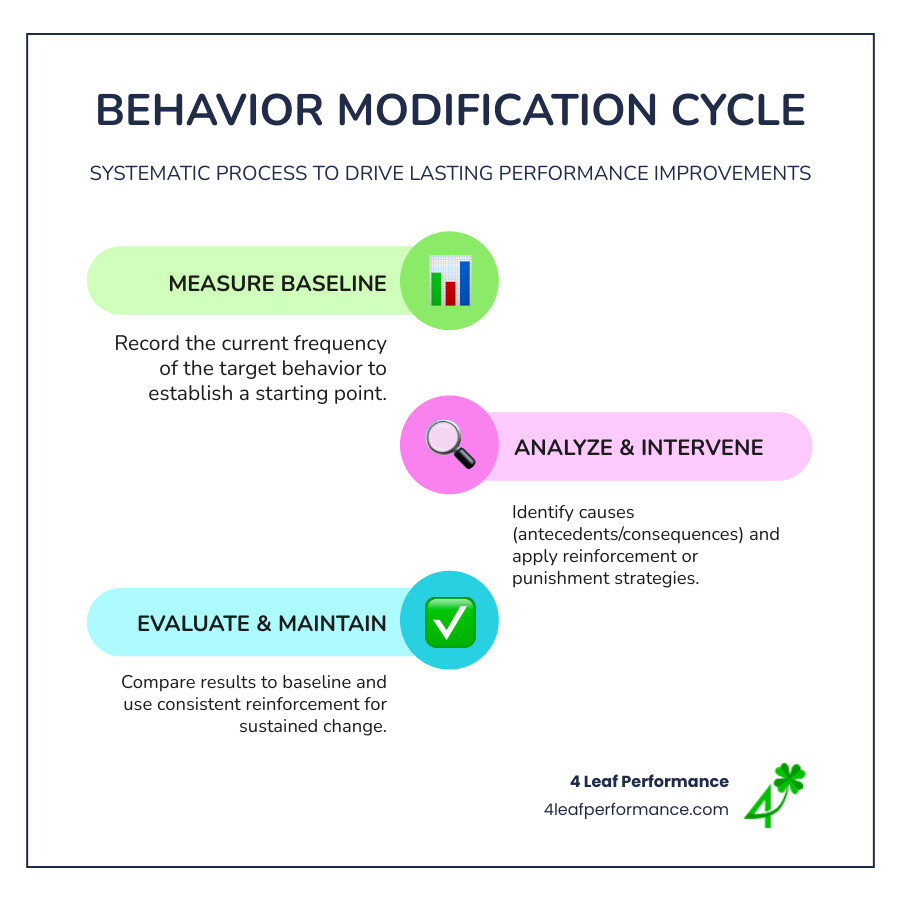
- The process: Identify critical behaviors → Measure baseline → Analyze causes → Apply interventions → Evaluate results
Most leaders feel stuck when their team struggles with the same issues week after week. You talk about punctuality, quality, or customer service—but nothing changes. The problem isn’t your people. It’s that behaviors don’t change through conversation alone. They change through systematic reinforcement.
Think about this: In one factory in Mexico, managers couldn’t get workers to show up on time. After implementing a simple positive reinforcement program—paying workers two pesos extra per day for arriving early—lateness dropped from 15% to just 2%. That’s the power of understanding how consequences shape behavior.
Here’s the challenge most business owners face: You’re managing daily chaos while trying to guide your team toward better habits. You need clarity on what behaviors matter most, how to measure them, and which reinforcement strategies actually work without draining your budget or your energy.
I’m Andrew Lamb, and over 25 years in leadership roles including two decades at HP, I’ve seen how behavior modification in organizational behavior transforms teams when applied with clarity and purpose. At 4 Leaf Performance, we help leaders systemize these principles so your team builds better habits without you micromanaging every step.
What is Behavior Modification in Organizational Behavior?
At its heart, behavior modification in organizational behavior (often called OB Mod) is a tool for managers. It helps them change how people act at work. Instead of guessing what people are thinking, managers look at what people are doing.
This method comes from a famous scientist named B.F. Skinner. He talked about something called “operant conditioning.” This is a fancy way of saying that people do things based on what happens next. If something good happens after an action, they will do it again. If something bad happens, they might stop.
Fred Luthans and Robert Kreitner took these ideas and brought them into the office. They showed that you can improve a company by rewarding the right actions. This is very different from just hoping people have a “good attitude.” You can’t see an attitude, but you can see if someone finishes their report on time.
If you want to help your team grow, you have to help them change their habits. You can learn more about how to build better habits at work to get started.
The Four Ways to Change Behavior
There are four main tools managers use to change habits. Think of these as the “rules of the game” for your office:
- Positive Reinforcement: This is the best tool. You give a reward when someone does something good. It could be a “thank you,” a bonus, or a high-five. This makes the person want to do that good thing again.
- Negative Reinforcement: This is not about being mean. It means taking away something “bad” when a person does something “good.” For example, if a team meets their goal, maybe they don’t have to do the boring Friday afternoon meeting. They work hard to avoid the meeting.
- Punishment: This is giving a bad consequence for a bad action. For example, if someone is late, they might get a formal warning. It’s meant to stop the behavior, but it can make people feel resentful.
- Extinction: This means you stop rewarding a behavior. If an employee tells a mean joke to get a laugh, and nobody laughs, they will eventually stop telling the joke. You are “starving” the behavior of attention.

Why Managers Use These Tools
Managers love OB Mod because it is easy to see if it’s working. You don’t have to be a mind reader. You just have to be a good observer. It helps with:
- Employee Development: It gives people a clear path to get better at their jobs.
- Easy Monitoring: You can count how many times a behavior happens.
- Clear Results: You can see if the work is getting better or if more items are being made.
To use these tools well, you need to understand your team. Every person is different! Learning about team behaviors can help you pick the right rewards for the right people.
The 5-Step Model for Better Performance
To make behavior modification in organizational behavior work, you need a plan. Luthans and Kreitner made a 5-step model that we use to help teams succeed.
- Identify: Find the “critical behaviors.” These are the actions that really matter for the job.
- Measure: How often is this happening right now? This is called your “baseline.”
- Analyze: What happens before the behavior (the trigger) and what happens after (the consequence)?
- Intervene: This is where you use your tools like positive reinforcement. You change the consequences to encourage the right actions.
- Evaluate: Did it work? You measure again and compare it to your baseline.
You can find more research on learning and reinforcement to see how these steps have helped other companies.
Identifying Critical Behaviors for Modification
You can’t change everything at once. You have to pick the behaviors that move the needle. These should be things you can see and count.
- Attendance: Is everyone at their desk by 9:00 AM?
- Safety: Are workers wearing their hard hats?
- Quality: How many mistakes are in the final product?
- Customer Service: Did the clerk say “hello” to the customer?
Choosing the right behaviors is part of being a great leader. Learning about your leadership style can help you decide which behaviors are most important for your specific team.
Using Schedules to Keep Progress Going
How often should you give rewards? This is called a “schedule of reinforcement.”
- Continuous: You give a reward every single time. This is great for learning a brand-new skill.
- Fixed-Ratio: You give a reward after a set number of times. For example, a “piece-rate” pay where a worker gets $5 for every 10 items they make.
- Variable-Ratio: This is the strongest one! The reward comes at random times. It’s like a slot machine. People keep working hard because they never know when the “jackpot” (praise or a bonus) is coming.
Real Examples of Behavior Change at Work
Does this actually work? Yes! Research shows that using these steps can lead to a 17% gain in performance.
In manufacturing, it works even better. One study showed that when supervisors were trained in OB Mod, complaints went down, and the quality of work went up. In the “Hell Camp” programs in Japan, over 50,000 managers have learned how to use these techniques to build strong, disciplined teams.
Companies like Boeing and Walmart have also used these ideas. Boeing used safety rewards to help workers stay safe. Walmart used “Associate of the Month” and bonuses to keep workers happy and productive.
Using Self-Management Strategies in Behavior Modification
Sometimes, the best person to change your behavior is you. This is called Behavioral Self-Management (BSM). Instead of a manager watching you, you watch yourself.
You can set your own goals and track your progress. For example, if you want to stop procrastinating, you can keep a log of how you spend your time. When you finish a big task, you can give yourself a reward, like a nice coffee or a short break.
Self-aware leadership is the first step to managing yourself. When you know your own personality, it is easier to pick the right goals.
The Role of Feedback and Culture
For behavior modification in organizational behavior to work, you must talk to your team. People need to know how they are doing!
- Clear Communication: Tell people exactly what you want to see.
- Graphic Feedback: Show them charts or graphs of their progress. People love seeing the “line go up.”
- Emotional Labor: Some jobs are hard on the heart. If your team works with angry customers, they need extra support and breaks so they don’t burn out.
Your company culture matters too. In a team that works together, group rewards are great. In a team where everyone competes, individual rewards might work better.
Solving Problems with Ethics and Motivation
Some people worry that OB Mod is “manipulation.” They think it’s like training a pet. But at 4 Leaf Performance, we believe it’s about helping people be their best.
It is important to be honest with your team. Tell them why you are using these tools. Make sure the rewards are fair. If you only use rewards to make people work more for less pay, they will feel cheated.
Common Criticisms of OBM
There are a few things to watch out for:
- Stifling Creativity: If you only reward one way of doing things, people might stop coming up with new ideas.
- Short-Term Focus: Sometimes people only do the good behavior when they know you are watching. You want to build habits that last forever.
- Intrinsic Motivation: Some people think that if you pay someone to do a job, they will stop loving the work for its own sake.
To avoid these problems, you need a balanced team. Balancing personalities helps ensure that your company stays creative and fair while still getting results.
Frequently Asked Questions about Behavior Modification
How long does it take to see results?
Most programs see a big change in just a few weeks. For example, the lateness study in Mexico saw results very quickly once the two-peso reward started.
Is positive reinforcement better than punishment?
Yes! Positive reinforcement builds trust and makes people happy. Punishment often makes people want to quit or hide their mistakes.
Can employees change their own behavior?
Absolutely. Using self-monitoring and personal rewards is a great way to grow without needing a manager to watch over your shoulder.
Conclusion
Mastering behavior modification in organizational behavior doesn’t have to be scary. It’s about being clear, being fair, and celebrating the wins. When you focus on what people do, you can help them do it better.
At 4 Leaf Performance, we want to help you Lead Better and Profit Smarter. Our Profit Accelerator Coaching Program is designed to help you find the hidden profits in your business by building better systems and stronger leaders. We use the WHY.OS framework to help you understand why your team does what they do, so you can help them reach their full potential.
Don’t spend another year guessing what to do. Start your journey to better leadership and change today. We are here to be the coach in your corner and provide the systems you need to succeed.