The Leaders Who Will Shape Your Organization’s Future
High potential coaching is a special way to help your best workers. It helps them grow fast. It helps them lead better and stay at your company longer.
If you want a quick look, here is what you need to know:
| Question | Quick Answer |
|---|---|
| What is it? | Coaching for your very best workers |
| Who is it for? | The top 20% of workers who do the most work |
| What does it do? | Builds skills, confidence, and big-picture thinking |
| How long does it take? | Usually 6 to 12 months |
| Why does it matter? | These stars are your future bosses |
Every company has a few people who stand out. They learn fast. They work hard. They fix problems without being told. We call these people high potentials or HiPos.
But there is a problem.
These stars are the most likely to get tired, quit, or stop caring. This happens if they feel like they aren’t growing.
Research shows this is true. About 86% of these top workers are at risk of burnout, according to reports from Harvard Business Review. Also, 25% of them leave their jobs every year. That is a big loss for your team.
High potential coaching changes this.
I am Andrew Lamb. I have been a leader for over 25 years. I worked at HP for a long time. I saw how helping top stars can change a company. Now, I use that experience at 4 Leaf Performance. I help leaders grow with a clear plan.
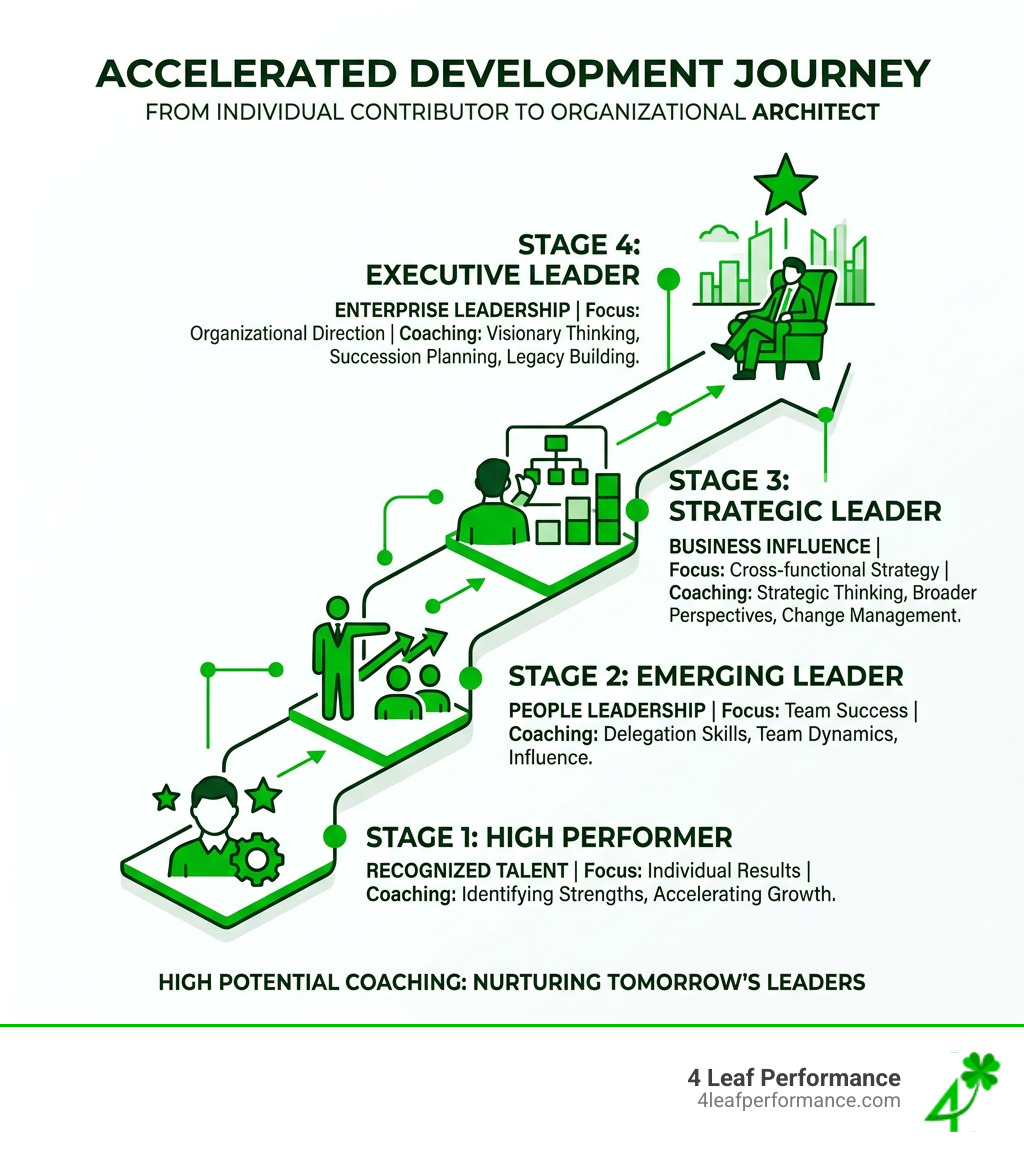
What is High Potential Coaching and Why It Matters

In business, we use the 80/20 rule. This means 20% of your workers do 80% of the big work. These people are your high potentials (HiPos). They are like race horses. If you want to win, you must take care of them.
High potential coaching is not just basic training. It helps these stars get ready for bigger jobs. These people will lead your company one day. Because they do so much, they feel a lot of stress.
Studies show that top workers do a lot of heavy lifting. Because of this, many of them (about 86%) might get too tired and quit. This is why we use leadership development to help them early.
Key Differences in High Potential Coaching
Most coaching is for fixing problems. But high potential coaching is about making strengths even better.
We don’t fix what is broken. We look at what is already great. We help these leaders use their talents to do more. We want them to run faster, not just work harder. This coaching looks at future jobs, not just the job they have now.
Why Ambitious Leaders Need Support
Being a top worker is hard. Everyone expects you to be perfect. You get the hardest tasks. This can lead to burnout. If you don’t help your stars, they might leave to work for someone else.
Research says 25% of top workers leave every year. That is a lot of talent walking away! By giving them a coach, you show them you care. This is a great way to keep top talent from walking away.
How to Spot Your Best Workers
How do you know who is a high potential? It isn’t always the person who hits their sales goals. Sometimes, a person is great at their current job but would be a bad boss. We look for people who have “potential.” This means they can grow into a much bigger role.
It can be hard for companies to keep their best workers happy and growing. Many find it tough to get good results from their efforts. Only about 11% of companies say they are very happy with how they find and grow top talent. To do better, we use tools like the 9-box grid. This chart looks at how well someone does their job (performance) and how much they can grow (potential).
Using Data to Find Talent
We don’t just guess who the stars are. We use real data. This includes:
- 360-degree feedback: Asking bosses, peers, and workers what they think.
- Calibration sessions: Managers meeting to talk about talent and make sure they are being fair.
- Cultural fit: Checking if the person lives the company’s values.
- Learning agility: Seeing how fast they learn new things when they are outside their comfort zone.
Using data helps us avoid making mistakes. It ensures we are looking at the whole person. For more on this, check out our guide on executive coaching for teams.
Best Ways to Help Leaders Grow
Once you find your stars, you have to help them grow. You can’t just put them in a classroom and talk at them. High potentials want to do things. They want “stretch assignments.” These are hard projects that push them to try new things.
We focus on “strength amplification.” This means making their best skills even stronger. If they are already good at talking to people, we help them become world-class at it. We also give them “critical experiences.” This might mean letting them lead a new team or work in a different country. This helps them learn how to create opportunities for professional growth.
Building a High Potential Coaching Plan
A good growth plan is co-created. This means the coach and the worker build it together. It isn’t a list of chores from the boss. It is a “growth blueprint.”
We start by finding their personal “Why.” At 4 Leaf Performance, we use the WHY.OS framework. This helps the leader understand why they do what they do. When a leader knows their purpose, they work with more energy and focus.
Learning Beyond the Classroom
Learning shouldn’t stop when the meeting ends. We use group coaching and mentoring to keep the growth going. In group coaching, HiPos can talk to each other. They realize they are not alone in their struggles. This builds a “mentoring culture” where everyone helps each other. This is why upskilling is crucial for organizational success.
Making the Coaching Program Work
For high potential coaching to work, we use a “triadic model.” This involves three people: the worker (HiPo), their manager, and the coach.
This model is great because it keeps everyone on the same page. The manager knows what the worker is learning. The coach helps the worker stay on track. This creates accountability. Everyone knows what the goals are and how we are measuring success. This is a key part of any leadership coaching program.
Tracking Progress and Results
We don’t just hope the coaching works. We track it! We look for two kinds of wins:
- Qualitative shifts: These are changes in how a person acts. Are they more confident? Do they listen better?
- Quantitative wins: These are hard numbers. Did they finish their project on time? Did their team’s sales go up?
By tracking these, we can see the ROI on executive coaching. It shows that the money spent on coaching is a good investment.
Avoiding Mistakes in Talent Development
Sometimes, companies make mistakes with their HiPos. One big risk is “entitlement.” If you tell someone they are a “high potential,” they might start thinking they are better than everyone else. They might stop working hard.
Another mistake is poor matching. If the coach and the worker don’t get along, nothing will happen. We make sure the match is perfect. We also make sure there is enough support. You can’t just give someone a coach and walk away. The whole company has to support their growth. If not, you might see some common leadership weaknesses start to pop up.
Keeping Your Best People Happy
To keep your stars, you have to offer more than just a paycheck. They want a clear career path. They want to know where they are going. They also need recognition. A simple “thank you” goes a long way.
Finally, don’t forget work-life balance. Even the best workers need a break. We help leaders learn how to manage their time and energy. This is part of cultivating emotional intelligence. It helps them stay happy and healthy for the long run.
Frequently Asked Questions
How is a HiPo different from a high-performer?
A high-performer is great at their current job. They hit their goals every month. A high-potential (HiPo) has the ability to do a much bigger job. They have the “motor” and the desire to grow into a top leader. Not all high-performers want to be bosses!
How long does a coaching program last?
Most programs last between 6 and 12 months. However, many top leaders keep their coaches for years. As you move up the ladder, the challenges get harder. Having a “thinking partner” in your corner is always helpful.
Can coaching help prevent leader burnout?
Yes! In fact, that is one of the main goals. By helping leaders focus on what matters and learn how to delegate, they can get more done with less stress. Coaching provides a safe place to talk about struggles before they become big problems.
Conclusion
At 4 Leaf Performance, we believe that every ambitious leader deserves a coach. We use our 25 years of global experience and the WHY.OS framework to help you discover your purpose.
Our goal is simple: we want to help you lead better and profit smarter. We don’t want you to just work harder. We want you to work with clarity. When you invest in high potential coaching, you aren’t just helping one person. You are building a stronger, more profitable future for your whole business.
Are you ready to see what your top talent can really do? Don’t let another year go by with long hours and tight margins. It is time to stop guessing and start leading.
Start Your Profit Accelerator and let us help you unlock the hidden potential in your business today. Profit freedom starts with clarity!