
Why Purpose-Driven Teams Matter More Than Ever
Purpose-driven teams are groups of people who connect their daily work to a bigger reason beyond just making money. They understand why their work matters and how it helps others. Here’s what makes them different:
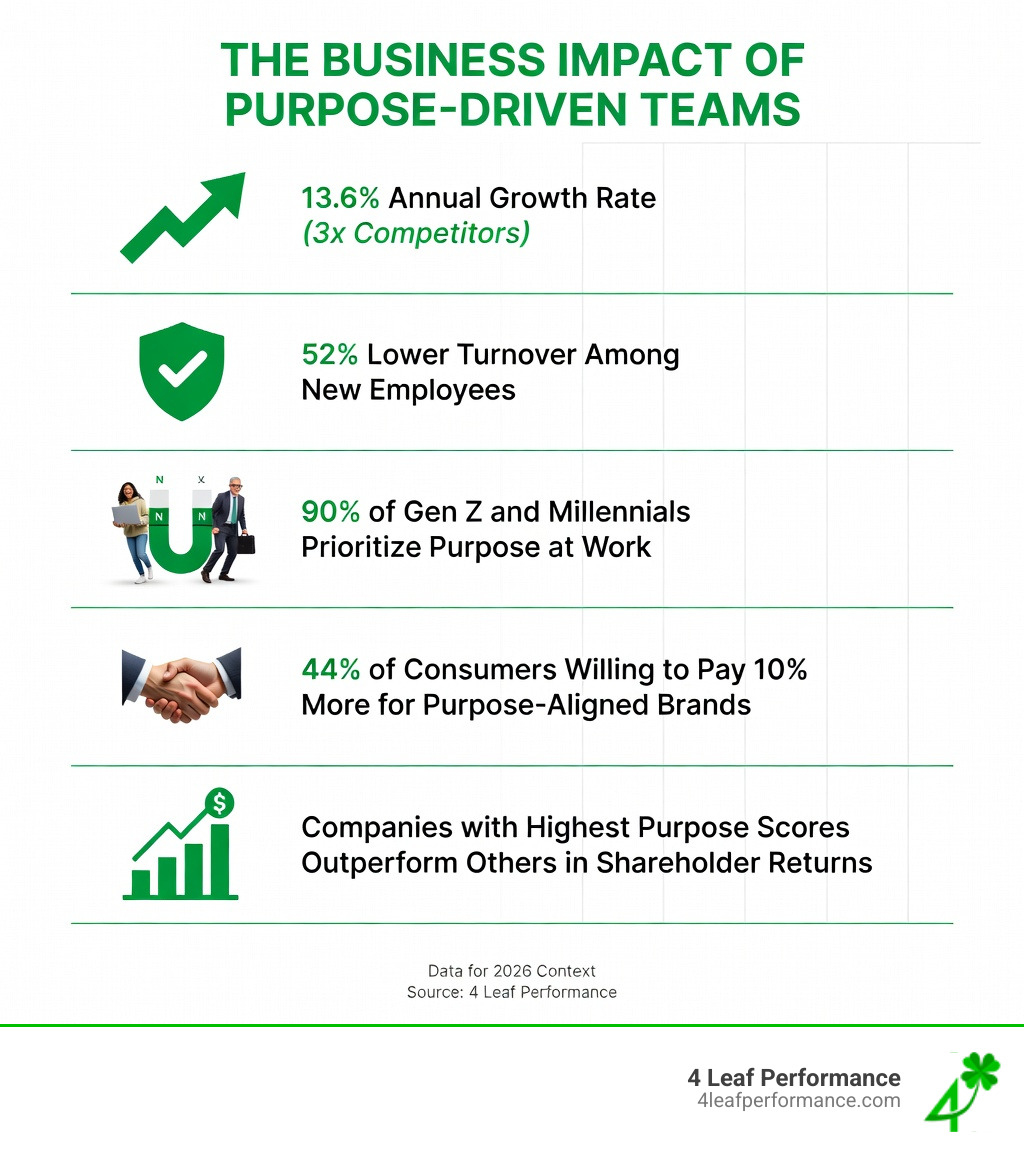
- They grow faster – Purpose-driven companies achieve 13.6% growth each year, three times more than competitors
- They keep people longer – 52% fewer new employees quit when they feel purpose in their work
- They attract better talent – 90% of younger workers say purpose matters for their job happiness
- They make smarter decisions – Teams with clear purpose align faster and waste less time
Most business owners I meet are exhausted. They’re working harder than ever, but their teams feel disconnected. People show up, do their jobs, and leave—nothing more. The problem isn’t effort. It’s that no one remembers why the work matters in the first place.
When Gerry Anderson became president of DTE Energy, he didn’t believe in organizational purpose. He thought it was soft stuff that distracted from real business. But after seeing teams transform when they connected to something bigger, he changed his mind completely. Purpose isn’t about feel-good posters on the wall. It’s about helping people see how their work creates real value for real people.
I’m Andrew Lamb, and I’ve spent over 25 years in global leadership roles watching teams either thrive or barely survive. Through my work at 4 Leaf Performance, I’ve seen that purpose-driven teams don’t happen by accident—they’re built through clear systems, honest conversations, and leaders who know how to connect vision to action.
Why Purpose-Driven Teams Are the Secret to Success
We all want to feel like our work matters. Imagine waking up excited because you know your job helps someone else. That is the power of purpose-driven teams thrive.
Research shows that companies with a strong “why” grow much faster. In fact, they see a 13.6% growth rate over 20 years. That is five times higher than the average company! This happens because when people have a reason to work hard, they do better work.
Younger workers, like Gen Z and Millennials, really care about this. About 90% of them say having a sense of purpose is a must-have for their job. If a company only cares about money, these talented people will leave. But if the company cares about a mission, they stay and help the business win. Scientific research on purpose and retention tells us that purpose is what keeps a team together when things get tough.
How Purpose Drives Performance and Retention
When you build a team that cares, they don’t just “do their time.” They take ownership. This leads to purpose powers performance.
One of the biggest problems for small businesses today is finding good people. About 75% of employers say it is hard to find skilled workers. However, purpose is a magnet for talent. When employees participate in purpose programs, there is 52% lower turnover among new hires.
Why does this happen? It’s because purpose makes work feel like more than just a list of tasks. It makes people feel proud. When you are proud of what you do, you stay longer and work smarter.
Real-World Examples of Purpose-Driven Teams
Many great companies use a “triple bottom line.” This means they look at three things: People, Planet, and Profit. This idea was started by entrepreneur and author John Elkington. It shows that you can make money while also doing good.
Look at Oatly. They want to make the world more sustainable by changing how we drink milk. They had to be brave and creative to challenge the old way of doing things. Another example is REI. They hold their partners to very high standards for the environment. They even work with companies like La Colombe Coffee Roasters because they share the same values.
Even Blue Bottle Coffee showed purpose by making oat milk its default. They knew dairy was a contributor to greenhouse gas emissions. By making this change, they showed their team and customers that they stand for something.
The Leader’s Role in Creating Purpose-Driven Teams
To make this work, leaders have to be the bridge. You can’t just shout a mission statement from the top and hope people listen. You need to have a “purpose dialogue.” This means talking with your team about how their daily tasks help reach the big goal.
Research on purpose dialogue and commitment shows that when leaders talk about purpose regularly, employees become much more committed. It’s about taking a big, scary vision and making it make sense for the person doing the work today. This is how you keep purpose in motion culture drives performance.
Balancing Pragmatism and Idealism in Your Team Purpose
When you create a purpose statement, you need to balance two things: big dreams (idealism) and real-world goals (pragmatism).
If your purpose is too “lofty” and “out there,” people won’t believe it. If it’s too boring and just about numbers, people won’t care. You have to find the sweet spot. A good purpose should be demanding but clear. It should help your team know what to say “yes” to and what to say “no” to every day.
Learning how every purpose-driven business needs a north star helps you stay on track. You can find more tips on this in the article To Craft a Purpose That Motivates Your Team, Balance Pragmatism and Idealism.
Using the Human Deal to Connect with Your People

The “Human Deal” is a new way to look at work. It means the importance of seeing employees as people, not just workers.
People want to be seen as whole humans. They want radical flexibility and to feel like their boss actually cares about their life outside of work. When you treat people with respect and give them autonomy (the freedom to do their job their way), they give back much more to the company. It’s not just about a paycheck anymore; it’s about “relational wealth.”
Practical Steps to Build Your Own Purpose-Driven Team
Ready to start? You don’t need a huge budget to build Purpose-driven teams. You just need a plan.
- Go Off-Site: Take your team to a neutral place away from the office. This helps everyone think more creatively.
- Set Ground Rules: Make sure everyone has an equal voice. No one is the “boss” during this meeting.
- Align with the Big Goal: Your team’s purpose must fit under the company’s main mission.
- Write It Down: Let the team use their own words to write a purpose statement.
- Make It Visible: Post the statement where everyone can see it every day.
purpose-powered teams start with you. If you show you care, they will too. You can also look into leveraging WHY.OS how finding your purpose can attract top talent to see how your own personal “why” helps the team.
Making Work Matter Every Day
Once you have a purpose, you have to live it. You can’t just put it in a drawer. You need to support purpose-driven work every single day.
- Celebrate Wins: When someone does something that fits the purpose, tell everyone!
- Give Growth Opportunities: Help your people learn new skills that align with their personal goals.
- Involve Them in Decisions: When people help make the plan, they are more likely to follow it.
Avoiding Common Pitfalls in Purpose-Driven Leadership
Be careful of “purpose washing.” This is when a company says they care about something just to look good, but they don’t actually do anything about it. People can see through this very quickly.
Another mistake is “dictating meaning.” You can’t tell someone what their purpose should be. One study on why telling people what to value backfires showed that when students were told why a math trick was useful, they actually liked it less! Instead, let your team find their own meaning.
If you want to stop losing your best people, discover the power of purpose by being honest and real.
Frequently Asked Questions about Purpose-Driven Teams
What is an example of a purpose at work?
Purpose looks different for everyone. For a nurse, it might be helping patients heal. For a teacher, it’s inspiring the next generation. For a software team, it might be making life easier for their users. When work has meaning, it is leading to increased presence and productivity.
How do you balance profit and purpose?
You don’t have to choose one or the other! Using a “good jobs system” means you simplify work so people can do it well. You can read more in The Case for Good Jobs: How Great Companies Bring Dignity, Pay, and Meaning to Everyone’s Work. When you treat people well and have a clear focus, profit follows naturally.
Can any team become purpose-driven?
Yes! Whether you are in a big factory or a small office, any team can find its “why.” It starts with active listening and giving people autonomy. When a team has shared goals, they become unstoppable. Check out the power of purpose with WHY.OS and leadership to see how we help teams like yours.
Conclusion
Building Purpose-driven teams isn’t just a “nice” thing to do. It is the smartest way to run a business in today’s world. At 4 Leaf Performance, we use the WHY.OS framework to help you find that hidden spark in your team.
Stop working in your business and start leading it. Growth should not cost your sanity. We offer affordable, actionable, and accountable coaching to help you lead better and profit smarter.
Ready to find your team’s North Star? Learn more about the WHY.OS framework here. Let’s build a business that grows without consuming your life.