Why Team Purpose Changes Everything
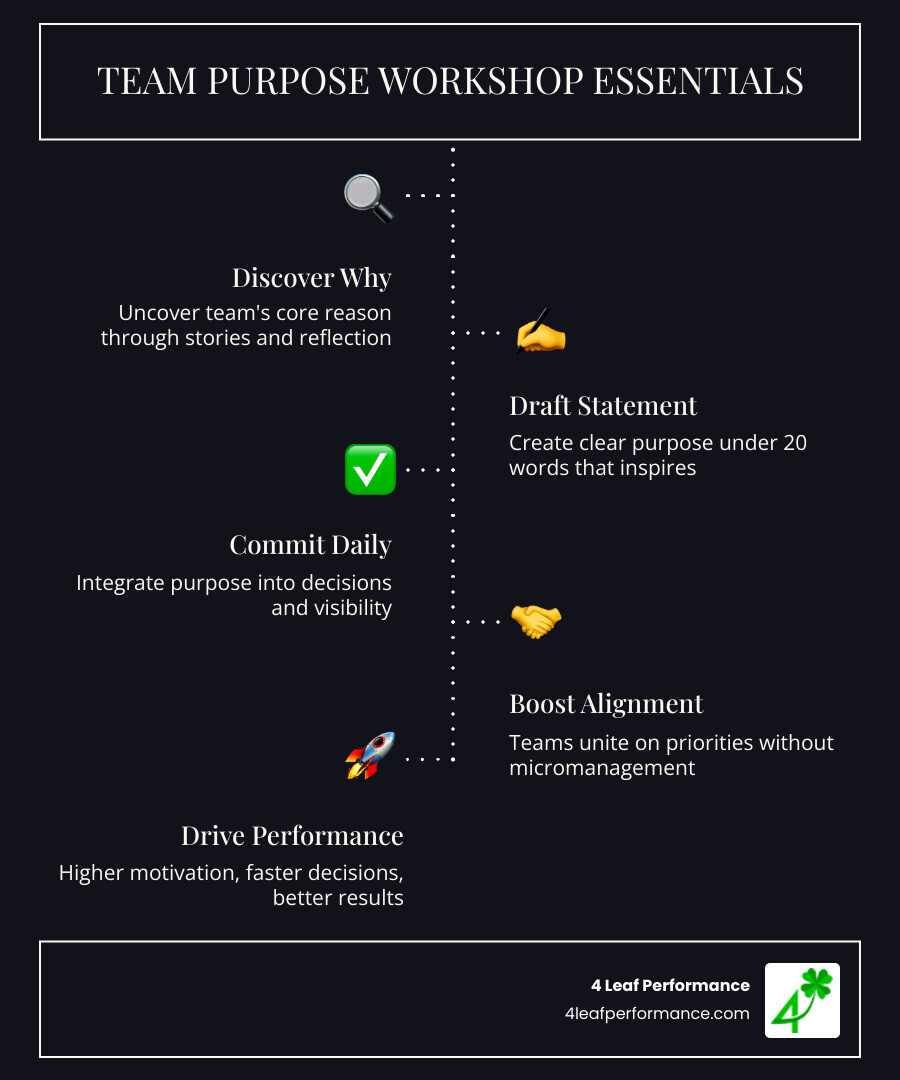
A team purpose workshop is a facilitated session where teams discover and define their collective “why”—the fundamental reason they exist and the impact they aim to create. Here’s what you need to know:
Quick Overview:
- What it is: A structured 2–3 hour session where teams craft a shared purpose statement
- When to run one: New teams, during transitions, or when alignment feels off
- Key outcome: A clear, actionable purpose (typically under 20 words) that guides decisions and motivates action
- Who should attend: 2–12 team members, plus a facilitator
- Core benefit: Teams with defined purpose show higher motivation, better alignment, and faster decision-making
Most teams don’t spend time creating their own purpose. They rely on generic corporate statements that feel distant from daily work. But research shows 76% of employees crave a sense of purpose, and teams that define their own collective “why” consistently outperform those that don’t.
The problem is simple: without a clear purpose, your team is just a group of people doing tasks. With purpose, they become a united force working toward something meaningful.
Teams without purpose struggle with:
- Making decisions when priorities conflict
- Staying motivated during tough stretches
- Understanding how their work connects to bigger goals
- Onboarding new members effectively
Teams with purpose gain:
- A north star for every choice they make
- Shared language that builds belonging
- Clearer focus on what matters most
- Natural alignment without micromanagement
The good news? You don’t need expensive consultants or days of meetings. A well-run team purpose workshop can transform confusion into clarity in just a few hours.
I’m Andrew Lamb, and I’ve spent over 25 years in senior leadership roles helping teams align around what truly matters, including running dozens of team purpose workshops using the WHY.os framework at 4 Leaf Performance. The process I’ll share below works whether you’re leading a new team, realigning after change, or simply tired of meetings that go nowhere.
Why Your Business Needs a Team Purpose Workshop
Have you ever felt like your team is rowing in different directions? One person thinks the goal is speed. Another thinks it is quality. A third just wants to get through the day. This happens because most teams lack a shared “Why.”
A team purpose workshop helps fix this. It is not just a “feel-good” meeting. It is a business tool that makes everything run smoother. When people know why they show up, they work harder and stay longer. In fact, 76% of employees crave a sense of purpose in their work. If you don’t give it to them, they might look for it somewhere else.
We often see leaders get confused between Purpose, Vision, and Strategy. Here is a simple way to look at it:
| Feature | Purpose (The Why) | Vision (The Where) | Strategy (The How) |
|---|---|---|---|
| Question | Why do we exist? | Where are we going? | How do we get there? |
| Focus | Meaning and Impact | The Future State | Plans and Actions |
| Timeline | Forever | 3-5 Years | 1 Year or less |
When we run these sessions, we see a big jump in motivation. People stop saying “That’s not my job” and start saying “How can I help us reach our goal?” This is because purpose-driven teams thrive even when things get messy. They have an anchor that keeps them steady when the business world gets wavy.
At 4 Leaf Performance, we believe that improving your team culture can actually drive results faster than trying to fix the whole big company culture at once. Your team is where the real work happens. When you build a strong “subculture” with a clear purpose, you create a pocket of excellence that can inspire everyone else.
Preparing for Your Session
You can’t just walk into a room and shout, “What is our purpose?” and expect a good answer. You need a plan. Preparation is the secret sauce that makes a team purpose workshop work.
First, think about the materials. You will need:
- Lots of sticky notes (different colors are fun!)
- Sharpies or markers
- A big whiteboard or wall space
- A timer (to keep things moving)
- Snacks (hungry teams are grumpy teams)
If you are working with a remote team, don’t worry! You can use tools like Miro or Google Docs. These digital whiteboards let everyone move “sticky notes” around just like they would in a real room.
Before the meeting, we suggest giving your team some “pre-work.” Ask them to think about a time they felt really proud to be on the team. This gets their brains ready for deep thinking. You might also want to share a few examples of great purpose statements. For example, Airbnb’s purpose is “To create a world where anyone can belong anywhere.” That is much more exciting than “We rent out rooms,” isn’t it?
If you feel stuck or overwhelmed, you can always Book a call for culture help. We love helping leaders get their teams on the right track because we know that purpose powers performance.
The ideal team size for these workshops is 2 to 12 people. If your team is bigger, you might want to split into smaller groups and then come back together to share. This ensures everyone gets a voice. Nobody should feel like a wallflower during this process!
The 7 Steps to Run a Great Workshop
Ready to start? Here is our step-by-step guide to running a team purpose workshop that actually sticks.
Step 1: Set the Stage for Your Team Purpose Workshop
Start by explaining what a purpose is and what it isn’t. We like to use Simon Sinek’s “Golden Circle.” He says most people know what they do and how they do it, but very few know why.
We often show the Simon Sinek TED Talk to get the team inspired. It helps everyone understand that people don’t buy what you do; they buy why you do it. This “Why” becomes your “North Star.” Why every business needs a North Star is a big topic because it gives you a direction to follow when you are lost in the fog of daily tasks.
Step 2: Share Stories to Find What Matters
Purpose isn’t something you make up; it’s something you find. We find it by looking at our history. Ask your team to share “Pride Stories.”
- When did we do something that made us feel great?
- Who did we help?
- What was the impact?
When team members listen to each other’s stories, it encourages genuine interactions. People start to see that they aren’t just working for a paycheck; they are working to make a difference for a customer, a coworker, or the world. Write down the “action verbs” from these stories on sticky notes. Words like protect, inspire, simplify, or build will help you later.
Step 3: Draft Your Team Purpose Workshop Statement
Now it’s time to take all those sticky notes and turn them into a sentence. We use two fun tricks here: Mad Libs and the 20×20 rule.
The Mad Libs format looks like this: “Our team exists to [Action Verb] for [Stakeholder] so that [Impact].”
For example: “Our team exists to simplify technology for small business owners so that they can grow without stress.”
The 20×20 rule means you try to write a statement that is under 20 words in under 20 minutes. This keeps the team from overthinking. You can even use a tool like the Team Purpose Canvas to help organize your thoughts.
Step 4: Refine the Statement
Once you have a draft, look at it closely. Is it clear? Is it exciting? Does it sound like your team? Sometimes statements can sound a bit “fake” or too corporate. We want something that feels real. If it sounds like something a robot would say, throw it out and try again! Ask the team, “Does this make you want to get out of bed in the morning?”
Step 5: Get Buy-In and Ownership
A purpose statement is useless if the boss just hands it to the team. Everyone needs to feel like they helped build it. Ask every person, “Can you live by this?” If someone says no, find out why. Maybe a word is wrong, or maybe they see the team’s job differently. This is the time to talk it out. When everyone agrees, they “own” it. They aren’t just following a rule; they are living a promise they made to each other.
Step 6: Commit to Action
A purpose without action is just a nice sentence on a wall. Ask the team: “If this is our purpose, how should we change how we work tomorrow?”
- Does it change how we answer the phone?
- Does it change which projects we say “yes” to?
- Does it change how we treat each other?
Make a list of 3 small things you will do differently starting now. This turns the workshop into a real-life change.
Step 7: Close the Session
End on a high note! Celebrate what you have done. You have just given your team a reason for being. Take a photo of the team with your new purpose statement. Tell them how much you appreciate their hard work and their honesty. A great workshop should end with everyone feeling a bit tired but very excited.
How to Handle Disagreements and Groupthink
Sometimes, a team purpose workshop can get bumpy. That is okay! In fact, it’s normal. If everyone agrees on everything right away, you might be suffering from “groupthink.” This is when people just nod their heads because they are afraid to speak up.
To avoid this, we use silent thinking. Before anyone talks, give everyone 5 minutes to write their own ideas on sticky notes. This lets the quiet people have a voice. It stops the loudest person in the room from making all the choices.
If people disagree, don’t panic. Disagreement is just a sign that people care. As a facilitator, you can use probing questions to dig deeper. Ask things like:
- “Can you tell me more about why that word feels wrong?”
- “How would this purpose help our customers?”
- “What is the one thing we absolutely cannot stop doing?”
improving team culture takes time. It’s okay if you don’t find the “perfect” words in the first hour. The conversation is often more important than the final sentence.

Keeping the Purpose Alive Every Day
Once the workshop is over, the real work begins. You have to make sure the purpose doesn’t just end up in a drawer.
Make it Visible: Put the purpose statement where everyone can see it. Put it on the wall, in your email signatures, or at the top of your meeting agendas. We want it to be part of the furniture.
Use it for Decisions: When you have a tough choice to make, ask, “Which option fits our purpose best?” If a project doesn’t fit your “Why,” maybe you shouldn’t be doing it. This is how purpose-powered teams stay focused. They don’t waste time on things that don’t matter.
Celebrate It: When you see someone living the purpose, call it out! “Hey Sarah, the way you helped that customer really showed our purpose of simplifying the journey.” This makes the purpose feel real and rewarding.
We know that culture drives results. By keeping your purpose alive, you are building a team that is resilient, happy, and very productive.
Frequently Asked Questions about Team Purpose
How long does a workshop take?
A good team purpose workshop usually takes about 2 to 3 hours. If you have a very large team or a lot of history to work through, you might want to break it into two sessions. But don’t let it drag on for days. You want to keep the energy high!
What is the best team size?
We find that 2 to 12 people is the “sweet spot.” This size allows everyone to talk and share stories without the meeting taking forever. If your team is larger than 12, use “breakout groups” to do the brainstorming and then bring everyone back together for the final drafting.
When is the best time to run one?
The best time is now, but it is especially helpful when:
- You have a brand new team.
- You have a new leader.
- The team feels burned out or bored.
- The company is going through big changes.
- You are starting a big, new project.
We also recommend revisiting your purpose once a year. Teams change, and your “Why” might grow as you do.
Conclusion
Running a team purpose workshop is one of the best things you can do for your business. It turns a group of workers into a team of believers. It gives people a reason to care, a way to decide, and a sense of belonging.
At 4 Leaf Performance, we are experts at this. We use the WHY.OS framework to help you and your team find your unique “Why,” “How,” and “What.” With over 25 years of experience, we know how to lead you through the messy parts to find the gold underneath.
Don’t let another year go by with your team just “getting by.” Give them the gift of purpose. You will see better results, more profit, and—most importantly—a team that loves what they do.
Ready to transform your team? Start Your Workshop Today and let us help you Lead Better and Profit Smarter. We are here to be the coach in your corner and provide the systems you need to grow without losing your sanity.
Remember: Growth should not cost your sanity. It starts with clarity. It starts with purpose. Let’s get to work!