
Why Your Cultural Change Strategy Matters Now
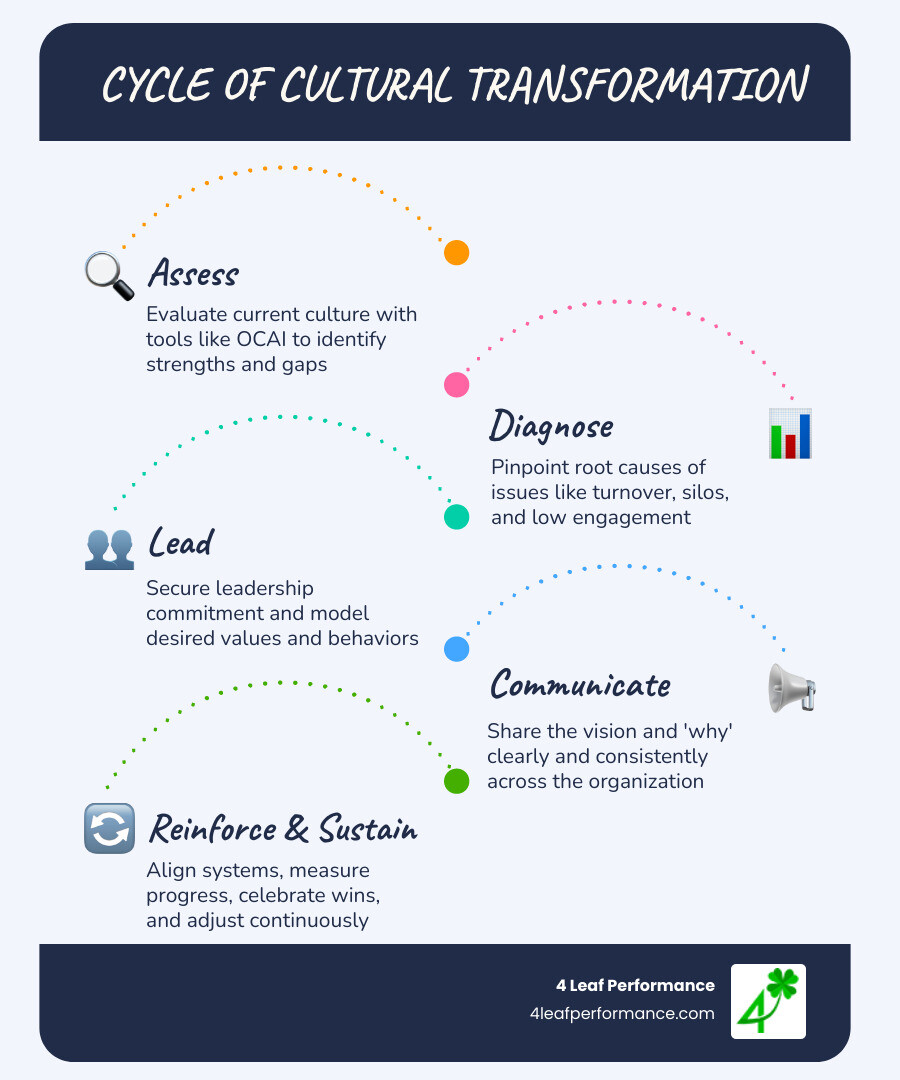
A cultural change strategy is your roadmap for changing the values, behaviors, and systems that shape how your team works together. Here’s what a complete strategy includes:
- Assessment – Understand your current culture using tools like the OCAI framework
- Vision – Define the values and behaviors you want to see
- Leadership commitment – Get your leaders to model the change first
- Systems alignment – Update hiring, rewards, and training to support new behaviors
- Communication – Share the “why” clearly and often
- Measurement – Track engagement, turnover, and performance over time
- Reinforcement – Celebrate wins and adjust as you learn
When executives talk about what slows down growth, they rarely point to strategy. They point to culture. The shared beliefs, unspoken rules, and daily habits that define “how we do things around here” can either propel your business forward or quietly hold it back. In fact, companies that actively shape their culture are five times more likely to achieve breakthrough performance and succeed during change.
Yet most leaders struggle to translate that insight into action. Culture feels invisible, hard to measure, and even harder to change. You see the symptoms—high turnover, missed deadlines, silos between teams—but you don’t always see the root cause. And without a clear plan, efforts to shift culture often fizzle out after a few months.
The good news? Culture change is possible. It’s not magic, and it’s not guesswork. It follows patterns. Research from organizations like Prosci, McKinsey, and Gallup shows that the right strategy, applied consistently, can open up higher engagement, faster decision-making, and stronger results. Employees who feel deeply connected to their workplace culture are 3.7 times more likely to be engaged and 5.2 times more likely to recommend their organization as a great place to work.
I’m Andrew Lamb, and over 25 years in leadership roles—including two decades at HP and work across M&A integration—I’ve seen how cultural change strategy determines whether change sticks or stalls. At 4 Leaf Performance, I help leaders use frameworks like WHY.OS to align teams fast and build cultures that support real growth.
Why You Need a Cultural Change Strategy
Think of your culture as the wind. If it is blowing behind you, you move fast and easy. If it is blowing against you, every step feels like a giant struggle. A good cultural change strategy makes sure the wind is at your back.
When we talk about culture, we mean the personality of your business. It is how people act when the boss isn’t looking. Gallup research on culture and engagement shows that when workers feel connected to this personality, they do much better work.
In fact, culture acts as a business compass. It helps your team know which way to go when things get confusing. If your culture is strong, your team stays together. If it is weak, people leave. Scientific research on workplace connection says that people who feel connected to their culture are 43% less likely to look for a new job. That saves you a lot of money and time!
Signs Your Culture Needs a Reset
How do you know if your culture is “broken”? You might notice culture cracks appearing in your daily work. Here are some big signs:
- High turnover: Good people keep quitting.
- Slow decisions: It takes forever to get anything done because everyone is afraid to make a mistake.
- Office silos: Teams don’t talk to each other. They act like they are on different planets.
- Low innovation: No one has new ideas because they are just trying to survive the day.
The Power of Aligned Values
When your team’s personal “why” matches the company’s mission, magic happens. This is called purpose in motion.
If you boost the link between an employee’s purpose and the company’s mission by just 10%, you can cut turnover by 8%. Even better, your profit can go up by more than 4%. A strong culture isn’t just a “nice to have” thing. It is a “must have” for making money and keeping your sanity.
The LEASH Model: A Proven Cultural Change Strategy
To change a culture, you need a plan that touches everything. We like to use the LEASH Model. It was made by experts to help leaders pull the right levers for change.
The LEASH Model has five parts:
- Leader Actions: What you do matters more than what you say.
- Employee Involvement: Getting everyone to help build the new culture.
- Aligned Rewards: Giving prizes for the right behaviors.
- Signals and Stories: Using symbols to show what is important.
- HR Systems: Making sure hiring and training match the new way.
When you use these five gears together, you start creating a positive workplace culture that actually lasts.
Using Signals and Symbols to Lead
Culture is often built on small things. The way your office is set up or the stories you tell at meetings send big signals. For example, if you want a culture of creative thinking, you might get rid of big executive offices and sit with your team.
You can also use:
- Daily rituals: A quick “huddle” every morning to share one win.
- Public praise: Giving a “shout-out” to someone who lived a company value.
- Storytelling: Sharing the story of a time a team member went above and beyond for a customer.
Aligning Your HR Systems
Your HR systems are the “bones” of your culture. If you say you value teamwork but only give bonuses to individuals, your culture will stay competitive and lonely.
You need to look at:
- Hiring practices: Don’t just hire for skills. Hire for “culture fit.”
- Onboarding: Use onboarding to build a strong foundation from day one.
- Training programs: Teach people the specific behaviors you want to see.
- Performance reviews: Grade people on their values, not just their numbers.
How Leaders Drive Lasting Change
You cannot delegate culture. You can’t just tell HR to “fix it.” As a leader, you are the chief culture officer.
McKinsey research says that change is four times more likely to work when leaders model the change themselves. If you want people to be honest, you have to be honest. If you want them to be on time, you have to be on time.
This is part of a culture that serves. It builds trust and “psychological safety.” That is a fancy way of saying people feel safe to speak up without getting in trouble. When people feel safe, they take ownership of their work.
Building a Change-Seeking Mindset
The world moves fast. Your culture needs to be ready to move too. This means rethinking workplace culture to focus on learning.
A “change-seeking” culture values:
- Curiosity: Asking “Why do we do it this way?”
- Empathy: Understanding how others feel during big changes.
- Adaptability: Being okay with trying new things, even if they don’t work the first time.
A 9-Step Process for Your Cultural Change Strategy
Ready to start? Here is a simple roadmap to follow.
- Assess the Culture: Use a tool like the OCAI (Organizational Culture Assessment Instrument) to see where you are now.
- Define the Future: What do you want your culture to look like in two years?
- Get Leadership Commitment: Make sure all bosses are on the same page.
- Identify Behavioral Shifts: Don’t just list “values.” List “actions.” (Example: Instead of “Respect,” use “Listen without interrupting.”)
- Handle the “Toxic” Stuff: You must deal with toxic culture immediately. One “bad apple” can ruin the whole bunch.
- Communicate the Plan: Tell everyone what is happening and why.
- Empower Your Team: Give people the tools they need to act in the new way.
- Celebrate Short-Term Wins: Find small successes and make a big deal out of them.
- Reinforce and Sustain: Keep going! Culture change takes 18 to 36 months to really stick.
Measuring Your Cultural Change Strategy
How do you know if it’s working? You can’t just “feel” it. You need data. You should watch out for the silent culture killer—which is when people say they agree but don’t change their habits.
Watch these numbers:
- Turnover rates: Are fewer people quitting?
- Pulse surveys: Short, frequent surveys to see how people feel.
- Productivity metrics: Is more work getting done?
- Employee feedback: What are people saying in the breakroom?
Overcoming Barriers and Using AI for Growth
Change is hard. People will resist it. They might be afraid of losing their jobs or having to learn new things. This is especially true with new technology like AI.
To succeed, you must keep your cultural change strategy human-centered. AI should be a tool that helps people, not a robot that replaces them. Sometimes, a team looks like it is doing great, but it is actually toxic in disguise. They might have high numbers but everyone is burnt out and angry.
Using “human-centric leadership” makes your change 12 times more likely to succeed. This means listening to fears and helping people learn new skills. 40% of the skills people use today will be old news by 2030. Your culture must be a place where learning is part of the job.
Frequently Asked Questions about Cultural Change
What are the first signs that our culture is broken?
The biggest signs are high turnover and a “hush-hush” environment. If people are afraid to tell the truth or if your best workers are leaving for your competitors, you have a culture problem.
How long does it take to see real results from a new strategy?
You will see small changes in a few months, like better moods in meetings. But a total shift usually takes 1 to 3 years. It is a marathon, not a sprint!
What is the biggest mistake leaders make during a culture shift?
The biggest mistake is “Do as I say, not as I do.” If a leader tells everyone to be frugal but flies first class, the team will stop trusting the change. You have to walk the talk.
Conclusion
Building a great culture doesn’t happen by accident. It takes a clear cultural change strategy and a leader who cares. At 4 Leaf Performance, we know that when you lead better, you profit smarter. We use the WHY.OS framework to help you find your purpose and get your team moving in the right direction.
Don’t spend another year struggling with a team that isn’t aligned. You can get the systems, leadership skills, and profit insights you need to grow without burning out.
Start Your Profit Accelerator for $499 per month and turn your culture into your greatest strength. Profit freedom starts with clarity—let’s find yours today.