Why Team Performance Improvement Matters More Than Ever
Team performance improvement isn’t just a nice-to-have anymore—it’s the difference between a business that thrives and one that barely survives. Here’s what actually works:
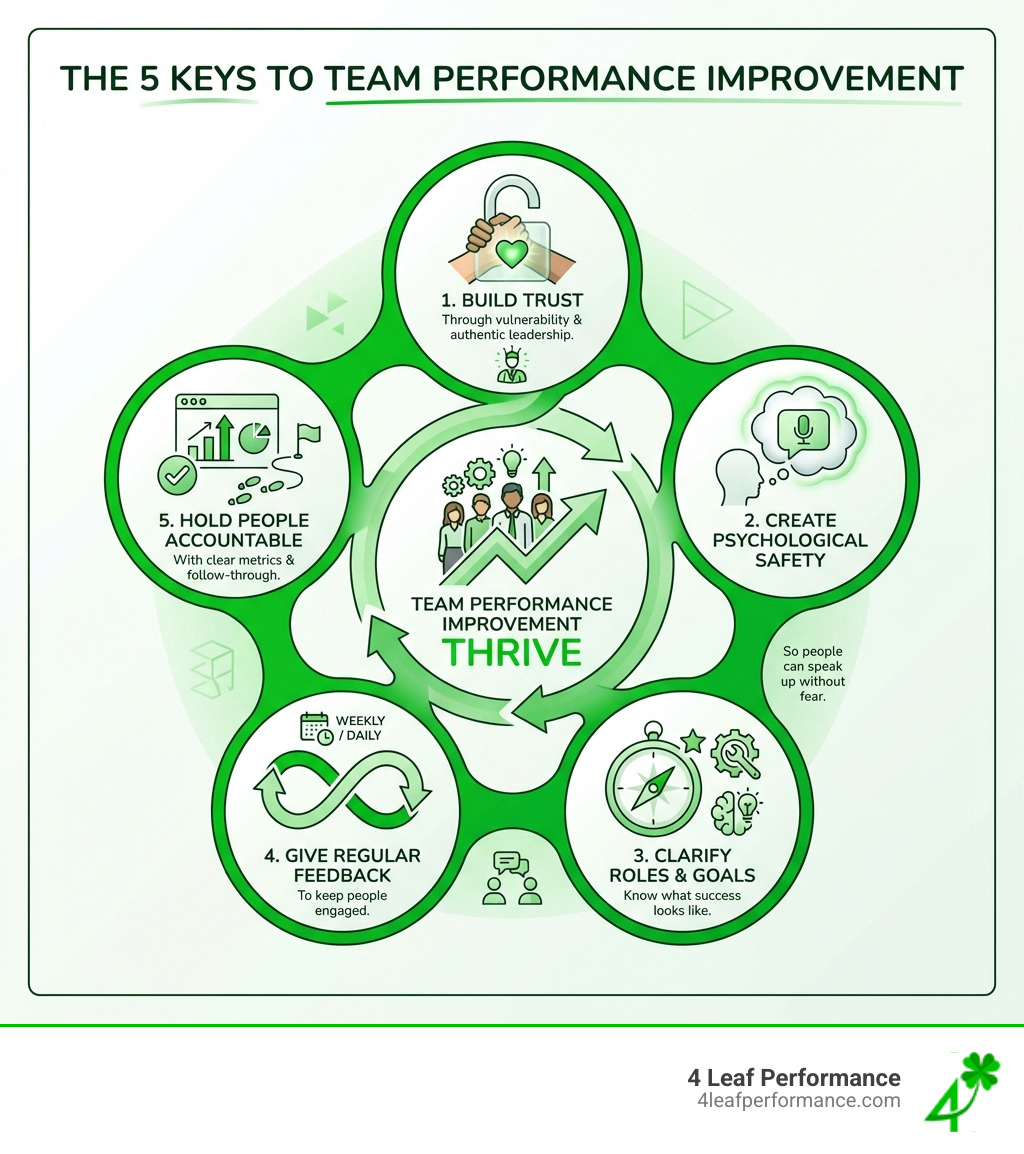
The 5 Keys to Effective Team Performance Improvement:
- Build trust – Teams with high trust are 3.3 times more efficient and 5.1 times more likely to deliver results
- Create psychological safety – When people feel safe to speak up, innovation jumps by 2.8 times
- Clarify roles and goals – Only 46% of teams actually agree on what they’re supposed to do
- Give regular feedback – 80% of employees who get weekly feedback are fully engaged
- Hold people accountable – But remember, 82% of managers struggle with this
The hard truth? Most teams aren’t performing anywhere near their potential.
Nearly 80% of employees worldwide are disengaged or actively checked out. That costs companies $1.9 trillion in lost productivity every year. Three out of four cross-functional teams underperform on their key metrics. And 64% of workers lose at least three hours every week just because their team can’t collaborate properly.
But here’s the good news: team performance improvement is more science than art. Research shows that 17 specific health drivers explain up to 76% of the difference between low-performing and high-performing teams. The top four? Trust, communication, innovative thinking, and decision making.
When you get these right, everything changes. Companies with aligned leadership teams are almost twice as likely to have above-median financial performance. Teams that shift to better structures see performance jumps of 53%. And ideas developed by teams have 156% greater appeal to customers than ideas from individuals.
The problem isn’t that your people are lazy or incompetent. The problem is usually unclear roles, missing feedback loops, broken trust, or goals that don’t align. Most leaders are trying to fix individual performance when the real issue is how the team works together.
This guide will show you exactly how to diagnose what’s broken, what drives high performance, and the practical steps you can take starting today. You’ll learn about team archetypes (cycling, relay, and rowing teams need totally different approaches), how to build psychological safety, what metrics actually matter, and how to spot systemic issues before half your team ends up on performance improvement plans.
I’m Andrew Lamb, and I’ve spent over 25 years in senior global leadership roles helping teams move through chaos to clarity, including two decades at HP where I saw what makes teams succeed and what quietly destroys them from the inside. Through my work with 4 Leaf Performance, I’ve helped countless leaders master team performance improvement by aligning people, systems, and purpose—not just pushing harder for better numbers.
Let’s get your team back on track.
Why Teams Struggle and How to Fix It

Have you ever felt like your team is running in circles? You aren’t alone. Most teams struggle because they lose focus on the basics. When we talk about team performance improvement, we have to look at why things go wrong in the first place.
One of the biggest problems is disengagement. Did you know that unhappy workers cost the world $1.9 trillion in lost productivity? That is a lot of money! When people don’t care about their work, they don’t do their best. This often happens because they don’t feel like they belong or they don’t see why their work matters. We call this the-key-to-keeping-your-best-people—making sure they feel valued and connected to a bigger goal.
Another huge issue is poor communication. In fact, 64% of workers report losing at least three hours of work every week because people don’t collaborate well. That’s almost half a day gone! Imagine what your team could do with three extra hours of high-quality work every week.
Teams also struggle with role confusion. If people don’t know exactly what they are supposed to do, they step on each other’s toes. Or worse, important tasks fall through the cracks. This leads to a lack of trust. If you can’t count on your teammate to do their part, the whole system breaks down.
To fix this, we have to stop guessing and start leading. At 4 Leaf Performance, we believe that profit freedom starts with clarity. You have to see your numbers and your people differently to open up the hidden potential in your business.
The Science of Team Performance Improvement
Improving a team isn’t just about being nice. It is actually a science. Research from experts like McKinsey and Google shows that high-performing teams follow specific patterns.
One of the most important parts of this science is “psychological safety.” This is a fancy way of saying that people feel safe to take risks. They aren’t afraid of being teased or punished if they make a mistake. According to a Guide: Understand team effectiveness, this is the number one thing that makes a team successful.
We also use tools like the DISC framework to understand how different people work. Some people are very direct (D), while others are great at inspiring people (I), keeping things steady (S), or focusing on the details (C). When you learn how-to-build-a-high-performing-team-using-the-disc-framework, you can put people in the right spots to win.
High-performing teams are also better at making decisions and thinking of new ideas. They don’t just wait for the boss to tell them what to do. They work together to find the best way forward.
Using Archetypes for Team Performance Improvement
Not every team works the same way. Think about sports. A cycling team, a relay team, and a rowing team all work differently.
- Cycling Teams: These teams have individuals who work mostly on their own but come together to help the leader win.
- Relay Teams: These teams depend on “passing the baton.” If one person misses the pass, the whole team loses. This is like a sales team passing a lead to the service team.
- Rowing Teams: Everyone has to do the exact same thing at the exact same time. If one person is out of sync, the boat goes in circles.
When you want-a-team-that-just-clicks-start-with-disc, you have to know which type of team you are. Does everyone need to be in perfect sync (rowing), or do you just need good hand-offs (relay)? Having a shared vision is what keeps everyone moving toward the same finish line.
Boosting Team Performance Improvement with Trust
Trust is the glue that holds everything together. But trust doesn’t just happen by doing trust falls at a retreat. It comes from “vulnerability.” This means leaders being honest when they don’t have all the answers.
We know that trust-builds-retention-from-the-inside-out. When people trust their leader, they stay at the company longer. A study published in the Leadership and Organization Development Journal found that authentic leadership—being real and honest—is the best way to make employees happy.
To build trust, you need:
- Honest talk: No more hiding bad news.
- Safety to fail: Let people try new things without fear.
- Consistency: Do what you say you are going to do.
Practical Steps to Build a Stronger Team
Now that we know the science, how do we actually do it? Team performance improvement requires taking real steps every day.
First, you must get clear on roles. We use DISC to help with aligning-team-roles-with-disc-profiles-for-maximum-productivity. If you have a person who loves details doing a job that requires lots of talking to strangers, they might get stressed. If you put them in a role where they can use their strengths, they will fly!
Second, give regular feedback. Gallup found that 80% of employees who get feedback once a week are way more engaged. You don’t have to wait for a big yearly review. Just a quick “hey, you did a great job on that report” or “let’s try to fix this part next time” makes a huge difference.
Third, use 3-essential-strategies-to-boost-team-productivity:
- Delegate: Don’t try to do everything yourself. Trust your team with important work.
- Set Clear Goals: Use the “Wildly Important Goals” (WIGs) method. Pick one or two things that matter most and focus on them.
- Celebrate: Recognize when people do well. A little “thank you” goes a long way.
Tools and Metrics for Long-Term Success
You can’t improve what you don’t measure. But many leaders measure the wrong things. They look at how many hours people sit in their chairs instead of what they actually get done.
| Metric Type | Individual Metrics | Team Metrics |
|---|---|---|
| Focus | Personal task completion | Shared goal achievement |
| Growth | New skills learned | Knowledge sharing rate |
| Health | Personal attendance | Team retention and trust scores |
| Speed | Individual work time | Project cycle time |
One of the best tools we use is the 4DX framework (The 4 Disciplines of Execution). It helps teams stay focused on what really moves the needle. We also teach the 5 Choices to help people manage their time so they don’t burn out.
You also need to master kpi-metrics-mastering-the-art-of-team-data-measurement. Look at things like task completion rates and how long projects take. But don’t forget the “human” metrics like how happy the team is.
HBR reports that we are in an “accountability crisis.” Most managers don’t know how to hold people accountable without being mean. The secret is to have a “compelling scoreboard.” When the team can see if they are winning or losing in real-time, they hold themselves accountable.
Solving Systemic Issues and High Turnover
What if your team is really struggling? Sometimes, it’s not just one person—it’s the whole system.
If you see that half your team is on a Performance Improvement Plan (PIP), that is a huge red flag. It usually means the problem is the leadership or the culture, not the workers. If “half the class is failing,” we have to look at the teacher!
Common systemic issues include:
- Burnout: People are working too hard for too long.
- Toxic Culture: People are afraid to speak up or they are being bullied.
- Leadership Gaps: Managers aren’t giving the support the team needs.
We help leaders learn how-to-keep-top-talent-from-walking-away. Usually, retaining-top-talent-starts-with-a-clear-path-forward. People stay when they see a future for themselves and when they feel like they are part of a winning team.
Frequently Asked Questions about Team Performance
What are the main causes of poor team performance?
The biggest causes are a lack of trust and unclear goals. If people don’t know what they are working toward, they get frustrated. Employee disengagement and attrition also play a huge role. When people don’t feel connected to the company’s purpose, they stop trying.
How do you measure team productivity?
Don’t just count hours! Look at task completion, project speed, and quality scores. You can also use kpi-metrics-mastering-the-art-of-team-data-measurement to see how well the team is collaborating. A productive team isn’t just fast; they are effective.
Why do most engagement plans fail?
Most plans fail because they are “an HR thing” instead of a “leadership thing.” If the boss doesn’t believe in it, the team won’t either. According to a report by the Economist Intelligence Unit, poor communication and a lack of follow-through are the main reasons these programs die. You have to keep your promises!
Conclusion
Improving your team doesn’t have to be a mystery. It takes the right systems, a clear purpose, and a leader who is willing to grow. At 4 Leaf Performance, we use our 25 years of global experience to help you lead better and profit smarter.
We use the WHY.OS framework to help you and your team find your “Why, How, and What.” When everyone knows their purpose, work becomes more than just a paycheck. It becomes a mission. Our Profit Accelerator program is designed for small business owners who are tired of working harder for the same results. We help you find the hidden profits sitting in your business by fixing your systems and your leadership.
Don’t spend another year guessing what to do next. Growth should not cost your sanity. Whether you are in Houston, Texas, or anywhere else in the world, we are here to be the coach in your corner.
Ready to see your business differently? Start your journey with WHY.OS today.
Lead Better. Profit Smarter. Your team is waiting for you to show them the way.