Why Leadership Assessment Tools Matter for Your Business
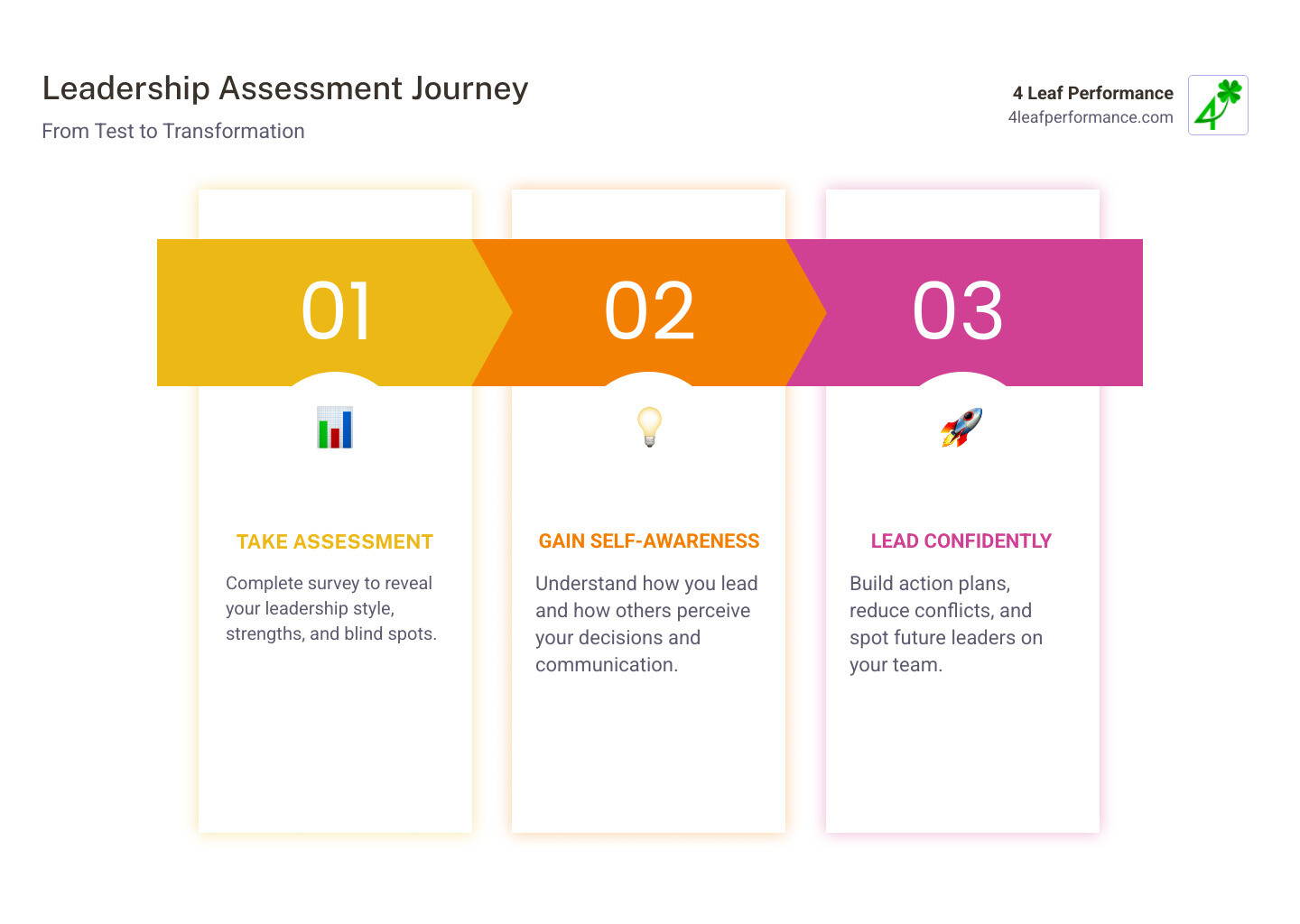
Leadership assessment tools are structured tests or surveys that measure your leadership style, personality, strengths, and blind spots. They help you understand how you lead, how others see you, and where you can grow.
Common types of leadership assessment tools include:
- Style assessments (DISC, Situational Leadership) – Show how you communicate and make decisions
- 360-degree feedback – Gather input from your team, peers, and manager
- Strengths assessments (CliftonStrengths) – Identify your natural talents
- Personality and emotional intelligence scales (Hogan, MBTI, MSCEIT) – Measure traits and self-awareness
Why they matter:
- Gain self-awareness about your strengths and weaknesses
- Spot future leaders on your team
- Understand team dynamics and reduce conflict
- Build a coaching plan based on real data
If you’re a business owner or leader feeling stuck, these tools give you a clear starting point. They turn guesswork into insight.
One career leader in the Department of Defense said it best: “I suffer from imposter syndrome and often doubt my leadership abilities, but the 360 evaluation increased my self-awareness and helped me to see myself as others see me—as a strong, action-oriented, innovative leader who gets results.”
I’m Andrew Lamb, and I’ve spent over 25 years in senior leadership roles where I’ve used leadership assessment tools like DISC and WHY.OS to help teams align, grow, and execute with clarity. In this guide, I’ll walk you through the tools that work, how to pick the right one, and how to turn your results into real growth.
Why Small Businesses Use Leadership Assessment Tools
Running a small business can feel like juggling too many balls at once. You are trying to grow sales, keep customers happy, and lead your people. Sometimes, it feels like chaos. This is where leadership assessment tools come in to save the day. They help you stop guessing and start leading with intention.
One of the biggest jobs you have is spotting future leaders. You can’t do everything yourself forever. You need to know who on your team has the potential to step up. Assessments help you see these hidden talents before you promote the wrong person. They also help you identify common leadership weaknesses so you can fix them early.
These tools also help with team dynamics. Have you ever had a team that just couldn’t get along? Usually, it is because they don’t understand each other. When you use these tools, you learn how to handle conflict better. You learn that people aren’t being “difficult” on purpose; they just have a different way of seeing the world. Self-aware leadership starts with knowing your personality type, and once you know yours, you can help your team find theirs too.
Gaining Self-Awareness
Self-awareness is like having a map of your own brain. Without it, you are just wandering in the dark. Leadership assessment tools shine a light on your strengths so you can use them more often. They also show you your weaknesses. We all have them! Knowing them means they won’t surprise you anymore.
When you know your communication style, you can change how you talk to fit the person in front of you. This is a superpower for leaders. For example, you can learn how to tailor your leadership style using DISC insights. If you know a team member needs lots of details, you can give them those details instead of just a quick “hello.” This builds trust and gets work done faster.
Building High-Performing Teams
A high-performing team is like a well-oiled machine. Every part knows its job and works with the other parts. Assessments help you create “psychological safety.” This is a fancy way of saying people feel safe to speak up and take risks. When everyone knows each other’s styles, they stop judging and start helping.
You can use these tools to set team norms. These are the “rules of the road” for how you work together. If you want a team that just clicks, you should start with DISC. It helps everyone see that a mix of different personalities is actually a good thing. You need the “drivers” to get things done, but you also need the “supporters” to keep the team happy.
Types of Leadership Assessment Tools
There are many different types of tools out there. It can be confusing! Think of them like tools in a toolbox. You wouldn’t use a hammer to turn a screw. You have to pick the right tool for the job.

At 4 Leaf Performance, we focus on tools that give you real answers you can use right away. You can see some of our favorites on our leadership assessments page.
Style and Personality Assessments
These are some of the most popular leadership assessment tools. They look at how you naturally behave.
- DISC Assessment: This is a big one for us. It looks at four main traits: Dominance, Influence, Steadiness, and Conscientiousness. It is great for the workplace because it is easy to understand. You can learn what the DISC assessment is and how it benefits the workplace to see why so many businesses love it.
- DISC Personality Types: There are different “blends” of these traits. Knowing the different DISC personality types helps you see why some people love change while others like a steady routine.
- MBTI (Myers-Briggs): This is a very famous tool. While some experts say it isn’t as “scientific” as others, it is still used by millions of people to understand their basic personality preferences.
Feedback and Strengths Tools
These tools look at what you are good at and how others see you.
- 360-Degree Feedback: This is like looking in a mirror that shows you from every angle. You get feedback from your boss, your peers, and the people who work for you. It gives you a very full picture of how you show up at work.
- CliftonStrengths: Over 32 million people have used this! It focuses on what you are naturally good at. Instead of trying to fix all your flaws, it teaches you to lean into your talents.
- Hogan Assessments: These are often used for high-level leaders. They look at your “bright side” (how you lead on a good day) and your “dark side” (how you react under stress).
How to Choose the Right Leadership Assessment Tools
Choosing a tool is a big deal. You don’t want to waste money or time. You also don’t want to give your team “assessment fatigue.” That is when people get tired of taking tests and stop giving honest answers.
To pick the right one, look for validity and reliability. Validity means the test actually measures what it says it measures. Reliability means if you took the test again in a month, you would get similar results. You also want a tool that is easy to use and doesn’t cost a fortune.
| Tool Type | Best For… | Main Benefit |
|---|---|---|
| Personality Tests (DISC, MBTI) | Understanding “Who am I?” | Better communication and less conflict |
| Feedback Tools (360-Degree) | Understanding “How do others see me?” | Finding blind spots you didn’t know you had |
| Strengths Tools (CliftonStrengths) | Understanding “What am I best at?” | Higher engagement and better performance |
Matching the Tool to Your Purpose
What are you trying to do? If you are hiring, you need a tool that is very accurate and fair. You don’t want to lose a great candidate because of a bad test. If you are just doing a fun team-building day, you might pick something simpler.
Using DISC team building to hire, lead, and grow more effectively is a great way to make sure you have the right people in the right seats. When the person’s natural style matches their job, they are much happier and do better work.
Evaluating Practicality and Accuracy
A good tool should be “benchmarked.” This means your results are compared to thousands of other leaders. For example, the Leadership Development Index is benchmarked with 600,000 participants! This helps you see where you stand compared to others in your field.
You also want tools that are “bias-blind.” This means they are fair to everyone, no matter their race, gender, or background. At 4 Leaf Performance, we only use management and leadership assessments that provide clear, honest results without the fluff.
How to Use Your Results for Real Growth
Taking the test is only the first step. The real magic happens when you use the data to change. If you just read the report and put it in a drawer, nothing will get better. You need a plan.
The 5-Step Facilitation Model
We suggest using a 5-step model to handle assessment results. This makes sure you don’t get overwhelmed.
- Step 1: Set the context – Why are we doing this? What is the goal?
- Step 2: Gather more information – Take the assessment and read the results carefully.
- Step 3: Analyze the data – Look for patterns. What keeps coming up?
- Step 4: Address the gaps – Where are you missing skills? What needs to change?
- Step 5: Narrow the focus – Pick one or two things to work on first. Don’t try to change everything at once!
Turning Data into Action
Once you have your focus, you need to set goals. Use a digital tool or a coach to keep you on track. Many leaders find that having someone to talk to makes a huge difference. You might wonder, does leadership mentoring actually work? The answer is yes, because it provides accountability.
You can even sign in to purchase specific tools that help you track your progress over time. Seeing your scores go up as you learn new skills is a great way to stay motivated.
Frequently Asked Questions about Leadership Assessment Tools
Are these tools scientifically valid?
Most of the top tools, like DISC or Hogan, have years of research behind them. They are tested to make sure they are accurate. However, some “fun” quizzes you find online are not scientific. Always check if the tool has been benchmarked against a large group of people.
How often should a leader take an assessment?
It depends on the tool. Personality doesn’t change much, so you might only take a personality test every few years. However, 360-degree feedback is great to do once a year. It helps you see if the changes you are making are actually being noticed by your team.
Can small businesses afford these tools?
Yes! While some enterprise tools are expensive, many are very affordable. At 4 Leaf Performance, we believe high-end coaching and tools should be available to small business owners too. You don’t need a massive budget to start getting clarity on your leadership.
Conclusion
Leadership assessment tools are not just “tests.” They are the keys to open uping the hidden profits and potential in your business. When you lead better, you profit smarter. You stop working in the chaos and start leading through it.
At 4 Leaf Performance, we use our 25 years of experience and the WHY.OS framework to help you find your purpose. We want you to have the confidence and freedom that comes from a well-run business.
Don’t leave your growth to chance. If you are ready to see your numbers differently and lead with intention, we are here to help. Start your Profit Accelerator journey today and let’s build a business that grows without consuming your life.