Why Continuous Improvement Drives Team Success
Areas of improvement for team members are specific skills, behaviors, or competencies that employees can develop to improve their workplace performance, contribute more effectively to their team, and advance their careers. These areas fall into three main categories:
1. Planning and Organizational Skills
- Time management and prioritization
- Strategic thinking and goal setting
- Organization and project management
2. Leadership and Management Skills
- Conflict resolution and problem-solving
- Delegation and decision-making
- Empathy and emotional intelligence
3. Communication and Interpersonal Skills
- Active listening and verbal communication
- Written communication and collaboration
- Giving and receiving constructive feedback
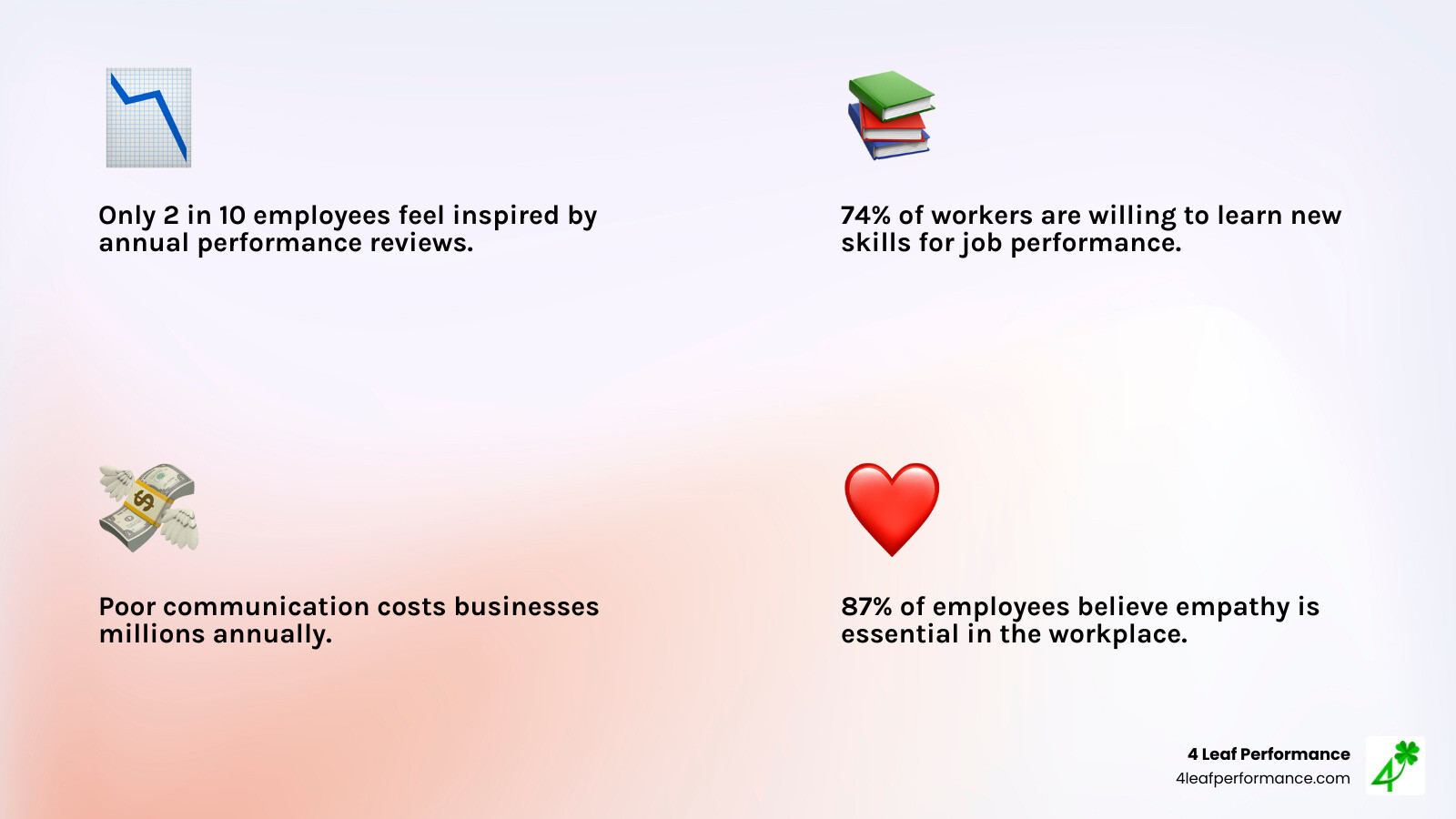
Research shows that only two in ten employees feel their annual performance reviews actually inspire them to improve. Yet the hunger for growth is real—74% of workers are willing to learn new skills outside of work hours to boost their job performance.
Here’s the disconnect: employees want to grow, but many organizations still rely on outdated feedback systems that fail to inspire real change.
The stakes are high. Poor communication alone can cost businesses millions. Meanwhile, 87% of employees believe empathy is essential to an inclusive workplace, yet many teams struggle with basic interpersonal dynamics. And when employees can’t achieve work-life balance, 44% will leave their companies entirely.
The good news? When you create a clear path for improvement—one that combines specific development goals with genuine support—everyone wins. Employees gain confidence and capability. Teams become more cohesive and productive. Leaders can focus on strategy instead of constantly putting out fires.
This isn’t about fixing weaknesses. It’s about building strength, clarity, and momentum. Whether you’re an employee looking to accelerate your career or a leader working to lift your team, understanding these core improvement areas is your starting point.
The 3 Pillars of Employee Improvement
Knowing what areas of improvement for team members to focus on can feel overwhelming. To simplify, we group these opportunities into three core pillars: Planning and Organizational Skills, Leadership and Management Skills, and Communication and Interpersonal Skills. Each pillar offers specific avenues for growth that directly impact individual performance and team success.
Planning and Organizational Skills
This pillar focuses on how effectively team members manage their tasks, time, and resources. Strong planning and organizational skills are the bedrock of productivity and efficiency.
-
Time Management: This is a critical skill for any employee. It’s about more than just getting things done; it’s about doing the right things at the right time. Effective time management helps us ensure we reach our daily objectives and complete critical tasks, avoiding the stress that 44% of employees report feeling. Strategies like using a daily schedule, prioritizing tasks with to-do lists, and setting long-term goals with short-term objectives are fundamental. We can also explore techniques like the Pomodoro Technique, which involves working in focused 25-minute intervals, or time-blocking to dedicate specific periods to high-priority tasks. People exist on a broad spectrum when it comes to time and energy management. For instance, some individuals may struggle with time perception, which means they might have trouble estimating how long it takes to complete a task. Understanding these nuances can help us tailor our approach. For more on this, explore Time Management for Leaders.
-
Organization: Beyond time, physical and digital organization are crucial. This means arranging our workspace and materials so that we can access what we need easily. Think about standardizing how you file documents—by project, customer, or date—using clear labeling conventions (e.g., “ProjectCategoryCustomerName_Year.doc”). An organized environment reduces wasted time and mental clutter.
-
Prioritization: With countless tasks vying for our attention, knowing what to tackle first is a superpower. A McKinsey survey identified prioritization as one of the top five capability areas differentiating top- and bottom-performing companies. Techniques like The Eisenhower Matrix (urgent/important quadrants) or Warren Buffett’s Two-List Strategy (focus on top 5, avoid the rest) can be game-changers. Procrastination, the habit of avoiding complex or unpleasant tasks, can be mitigated by establishing defined employee goals and guidelines.
-
Strategic Thinking: This involves seeing the bigger picture and understanding how our daily tasks contribute to larger organizational goals. Successful entrepreneurs, for instance, score 30% higher in their capacity for big-picture thinking compared to the general working population. This skill allows us to anticipate challenges, innovate solutions, and make decisions that align with our “why.”

Leadership and Management Skills
Whether we hold a formal leadership title or not, developing these skills empowers us to take initiative, inspire others, and steer complex situations. Leadership is an in-demand skill that benefits everyone.
-
Conflict Resolution: Conflict is an inevitability in human relationships and in the workplace. Learning how to manage conflict is essential to maintaining team harmony and good customer service. A 2023 survey by Innerbody cited work ethic disparity, competition, and inappropriate boundaries as common causes. Rather than avoiding conflict, we can learn to steer it healthily, understanding that “conflict is the friction needed in relationships and organizations to move things forward.” The Thomas-Kilmann Conflict Mode Instrument (TKI) provides a useful framework, outlining five styles: competing, collaborating, compromising, avoiding, and accommodating. Mastering communication, particularly through Active Listening Skills Are Key to Conflict Management in the Workplace, is crucial here.
-
Problem-Solving: When roadblocks appear, effective problem-solving is key. This involves identifying the root cause of an issue, brainstorming potential solutions, selecting and applying the best one, and then evaluating its effectiveness. As Deloitte points out, if you don’t know a problem’s cause, you’ll be hard-pressed to find the right solution. This skill is critical for navigating challenges and driving innovation.
-
Delegation: For those in managerial or team lead roles, effective delegation is vital. It’s about assigning tasks appropriately to others who are better suited for them, explaining tasks thoroughly, and then following up. Delegating not only frees up our own time but also empowers team members, builds their skills, and fosters trust.
-
Empathy: This is the ability to understand and share the feelings of another. About 87% of employees believe empathy is essential to an inclusive workplace. It’s more than just sympathy; it involves taking the unique perspective of others to understand how they think and feel. Cultivating empathy can be done by asking open-ended questions, identifying commonalities, and practicing a growth mindset. Tools like Empathy Mapping, borrowed from design thinking, can help us visualize and understand others’ perspectives. Learn more about improving empathy.

Communication and Interpersonal Skills
This pillar encompasses how we interact with others—how we convey information, listen, and build relationships. These are consistently among the most in-demand skills employers seek.
-
Active Listening: This goes beyond simply hearing words; it means consciously trying to understand the message in its totality. Strategies for active listening include asking clarifying questions and verifying what the other person has said. When we actively listen, we’re more likely to understand and act upon information efficiently. Sadly, about 75% of employees don’t feel heard about certain areas, which can lead to breakdowns in trust, engagement, and job performance.
-
Verbal Communication: This refers to how clearly and effectively we speak in meetings, one-on-one conversations, and presentations. Thinking before we speak, using clear and concise language, and being aware of cultural differences (e.g., maintaining eye contact is valued in some cultures but not others) are crucial.
-
Written Communication: In today’s hybrid and remote environments, written communication (emails, reports, chat messages) is more important than ever. It influences how others perceive our abilities. We can improve by using grammar and proofreading tools, reading our work aloud, and monitoring our tone to ensure clarity and professionalism.
-
Collaboration: Working effectively with others is fundamental to modern workplaces. A 2022 study on workplace collaboration found people spend an average of 3.2 hours collaborating daily. Poor collaboration can choke project processes and stretch timelines. Developing strong collaborative skills means fostering an environment where team members can work together efficiently, share ideas, and leverage collective strengths.
-
Giving and Receiving Feedback: This is a two-way street. We need to be able to provide constructive feedback that is specific, actionable, and delivered with respect. Equally important is our ability to receive feedback with an open mind, ready to address both positive and negative aspects. The American Psychological Association (APA) highlights that people underestimate how much others want to receive constructive feedback. Effective communication boosts job satisfaction and connections with colleagues, especially when feedback is handled well. Kim Scott’s concept of “Radical Candor” (caring personally while challenging directly) offers a powerful framework for this.
Strategies for Successfully Implementing Improvements
Identifying areas of improvement for team members is just the beginning. The real magic happens when we turn intention into action. Here’s how to successfully implement these improvements and sustain growth.
Set SMART Goals and Build Systems
Without external goals, even intrinsically motivated workers perform below their abilities. Goals act as guideposts for behavior change, creating more engaged teams and driving business success.
-
Goal Setting: The most effective way to improve is by setting clear, specific goals. We recommend using the SMART framework: Specific, Measurable, Achievable, Relevant, and Time-bound. For instance, instead of “improve communication,” a SMART goal might be “complete an active listening course and apply three new techniques in team meetings over the next month, tracking peer feedback.” This clarity provides a roadmap for progress. For guidance on defining these, see How to Set Achievable Objectives: The Science of Business Goal Setting.
-
Building Systems: As James Clear wrote in his best-selling book, Atomic Habits, “You do not rise to the level of your goals. You fall to the level of your systems.” Once a goal is set, the next step is to create a system that supports its achievement. If the goal is to improve time management, the system might involve dedicating 15 minutes each morning to planning the day’s priorities, using a specific project management tool, or adopting a “no-email-before-10 AM” rule. This consistent routine makes improvement a habit, not just a one-time effort. Explore 3 Habit Hacks to Form Habits Easier for more.
Commit to Professional Development
The world of work is constantly evolving, especially with advancements like AI. Therefore, continuous learning is no longer a luxury but a necessity.
-
Upskilling and Lifelong Learning: This involves acquiring new skills or enhancing existing ones to stay relevant and competitive. We know that 74% of workers are willing to learn new skills outside of work hours to improve their job performance. This commitment to lifelong learning is a powerful driver of personal and professional growth. With 60% of executives expecting AI to disrupt core business operations, upskilling in AI is crucial for many of us. As AI advocate Lauren Romero puts it, there’s never been a better time to help employees become less “hyper-specialized” and gain exposure across disciplines. This broadens our strategic thinking. Learn more about Why Upskilling Is Crucial for Organizational Success and Invest in Yourself: Gain Personal Growth Through Lifelong Learning.
-
Mentorship and Certifications: Beyond formal courses, seeking out a mentor can provide invaluable guidance and insights. Certifications in specific software, methodologies (like Agile), or leadership programs can also validate expertise and open new doors. These opportunities for professional growth are highly valued, especially by younger generations; 67% of Gen Z employees prioritize career development.
Maintain a Healthy Work-Life Balance
While dedication to improvement is admirable, it’s crucial not to neglect our well-being. Burnout is a real threat, with 44% of employees reporting being stressed.
-
Stress Management and Boundaries: Engaged employees are better at managing stress. Establishing clear boundaries between work and personal life—like consistent start and stop times, taking regular breaks, and fully utilizing vacation days—is essential. It’s about protecting our mental and physical health.
-
Employee Well-being: Prioritizing self-care through a healthy diet, regular exercise, and addressing mental health needs directly contributes to our capacity for growth. When we are well-rested and balanced, we have more energy and focus to dedicate to learning and improving. The fact that 44% of employees leave companies if they can’t achieve this balance underscores its importance. A healthy work-life balance isn’t just good for us; it’s good for business. Learn how to prevent burnout and take action in From Burnout to Work-Life Balance: Recognizing the Signs and Taking Action.
A Manager’s Guide to Supporting Areas of Improvement for Team Members
Effective leaders are coaches who empower their teams to grow. This guide offers practical advice for managers on fostering a culture of development and support for areas of improvement for team members.
Master the Art of Constructive Feedback
Feedback is the compass that guides improvement. However, its delivery and reception can make all the difference.
-
Continuous Feedback, Not Just Annual Reviews: We’ve seen that only two in ten employees feel inspired by annual performance reviews. The majority, 94% of workers, actually prefer real-time feedback. This highlights a significant disconnect. Instead of a single, high-stakes annual event, a continuous feedback loop with frequent, informal check-ins can be far more effective. Research shows that people underestimate how much others want to receive constructive feedback. Effective feedback provides immediate, actionable takeaways.
-
Psychological Safety: Creating an environment where employees feel safe to receive and act on feedback is paramount. This means delivering constructive criticism in private settings, focusing on specific behaviors and their impact rather than personal traits, and always offering solutions or support. As Tim Elliott, founder of Mr. Moxey’s, puts it, providing areas of improvement is a “call to action” for leaders to provide support. When employees feel heard and supported, trust is built, and engagement increases. For more, explore Modern Employee Performance Review Methods for Modern Teams.
How to identify the right areas of improvement for team members
Identifying the most impactful areas of improvement for team members requires a thoughtful and multi-faceted approach.
-
Leverage Performance Data and 1-on-1 Meetings: Data from performance reviews, 360-degree feedback, and self-evaluations can reveal patterns and skill gaps. However, these quantitative measures should always be complemented by qualitative insights from regular 1-on-1 meetings. These conversations provide a deeper understanding of an employee’s challenges, aspirations, and motivations.
-
Align with Career Pathing and Individual Development Plans (IDPs): The most effective areas of improvement are those that align with an employee’s long-term career goals and the organization’s strategic needs. Managers should help employees articulate their career aspirations and then co-create IDPs that outline specific skills to develop, resources needed, and measurable milestones. This personalization is key, as Gen Z, for example, strongly prioritizes career development. We can help identify and address skills gaps with our insights on Identifying and Assessing Employee Skills Gap.
How to support your team’s areas of improvement for team members
Once areas for improvement are identified, the manager’s role shifts to providing robust support.
-
Provide Resources and Opportunities: This includes offering access to training courses, workshops, relevant books, and online learning platforms. It also means creating opportunities for employees to apply new skills through special projects, shadowing experiences, or cross-functional team assignments.
-
Coaching and Mentorship: Managers can act as coaches, guiding employees through their development journey. This involves asking probing questions, offering encouragement, and providing ongoing feedback. Connecting employees with experienced mentors, either internal or external, can also provide invaluable perspective and support. As HR consultant Bryan Driscoll notes, employees who feel valued and see a clear path for growth are more likely to innovate and commit to the organization’s success. This is where executive coaching can play a pivotal role.
-
Lead by Example: Managers who openly discuss their own areas of improvement for team members and demonstrate a commitment to continuous learning foster a culture where growth is celebrated. This authenticity builds trust and encourages team members to accept their own development journeys. Creating a positive workplace culture is fundamental to this process.
Frequently Asked Questions about Employee Improvement
What are the main categories of areas for improvement for employees?
The main categories are Planning and Organizational Skills (like time management and prioritization), Leadership and Management Skills (like delegation and conflict resolution), and Communication and Interpersonal Skills (like active listening and collaboration). These three pillars cover the majority of competencies crucial for individual and team success in any modern workplace.
How can managers effectively support their employees’ areas of improvement?
Managers can provide support by offering regular, constructive feedback, co-creating Individual Development Plans (IDPs), providing access to resources and training, and fostering a culture of psychological safety where growth is encouraged and mistakes are seen as learning opportunities. Open communication and leading by example are also vital.
What are the benefits of focusing on areas of improvement?
For employees, benefits include improved skills, greater job satisfaction, accelerated career growth, and increased confidence. For employers, the benefits are a more productive and innovative workforce, higher employee engagement, improved retention rates (as 44% of employees leave due to lack of work-life balance, which improvement efforts can address), and a stronger, more adaptable organizational culture.
Conclusion
Investing in the areas of improvement for team members is not just about fixing perceived shortcomings; it’s about open uping potential, fostering engagement, and building a resilient, high-performing workforce. For us at 4 Leaf Performance, we see it as a continuous journey, a rhythm of growth that benefits both the individual and the organization.
When team members are empowered to develop their planning, leadership, and communication skills, they become more effective, more satisfied, and more committed. When managers actively support this growth through constructive feedback, personalized development plans, and mentorship, they cultivate a thriving culture of continuous improvement. The mutual benefits are clear: employees achieve greater career fulfillment, and organizations gain a competitive edge through improved productivity and innovation.
Fostering a culture of continuous improvement is the cornerstone of building resilient, high-performing teams. By identifying and nurturing these key areas, both individuals and organizations can open up their full potential. Ready to build a rhythm of growth and accountability in your business? Explore our monthly business coaching program.