Why You Need to Develop Communication Skills Today
Develop communication skills and you open up every door in your career. Whether you’re pitching an idea, leading a team, or just trying to get your point across in a meeting, how you communicate determines how far you go.
Here’s how to develop communication skills fast:
- Listen first – Give full attention, paraphrase what you hear, ask open questions
- Match your words and body – Eye contact, posture, and tone matter more than you think (65-93% more impact than words alone)
- Get to the point – Start with your answer, then explain (the Pyramid Principle)
- Practice out loud – Record yourself, eliminate filler words, try the 20-word challenge
- Build emotional awareness – Read the room, show empathy, manage stress before you speak
The payoff is real. Strong communicators get promoted faster, build better teams, and waste less time in meetings. Poor communication costs businesses employees (35% cite it as why they left) and productivity (95% of workers say their company could improve).
The problem? Most of us never learned how to communicate. We just started talking and hoped for the best. But communication is a skill you can practice and improve, just like leadership or sales.
I’m Andrew Lamb, and over 25 years in senior leadership roles at HP and as a leadership advisor, I’ve seen how developing communication skills transforms teams, closes deals, and turns reactive managers into intentional leaders. That’s why at 4 Leaf Performance, we use frameworks like WHY.OS to help leaders understand themselves and their teams in minutes, creating the clarity and alignment that drives real execution.

Talking well is more than just being “nice.” It is the secret to getting things done. Since the pandemic, many of us work from home. Research shows that 33% of employees now find communication a bigger struggle [1]. When we don’t talk well, our businesses feel it. In fact, only 20% of workers say their business is efficient because of poor communication.
Think about your last meeting. Did it feel like a waste of time? You aren’t alone. About 65% of workers say they waste time in meetings. This happens when people aren’t clear or don’t listen. When communication is bad, people leave. Poor communication is the reason 35% of businesses lose employees [1].
At 4 Leaf Performance, we believe that knowing your why in the workplace is the first step to talking better. When you know your purpose, your message becomes clear. You stop reacting and start leading with intention.
The Four Main Ways We Connect
Communication isn’t just about the words that come out of your mouth. It happens in four main ways:
- Verbal: This is the talking we do in meetings or over the phone.
- Written: These are your emails, texts, and reports.
- Visual: These are the pictures, charts, and slides you use to show your ideas.
- Non-Verbal: This is your body language, like how you stand and where you look.
Did you know that your body often talks louder than your voice? Research shows that nonverbal cues have 65% to 93% more impact than the words you say. If you say “I’m happy to be here” but your arms are crossed and you are frowning, people will believe your body, not your words.
Another big part of connecting is listening. We often think we are good listeners, but we only hear about half of what the other person says. Learning listening as a leadership superpower helps you spot problems before they get too big.
Simple Steps to Improve Your Talking at Work
Do you ever feel like you talk too much but don’t say enough? To develop communication skills, you need to be brief. People have short attention spans today. The American Psychological Association says our focus is shrinking.
Here are two easy tricks to use:
- The Pyramid Principle: Give your answer first. Then, give the details. Don’t make people wait until the end to find out your point.
- The BRIEF Method: This stands for Background, Reason, Information, End, and Follow-up. It helps you stay on track so you don’t ramble.
When you speak, try to get rid of “filler words” like “um,” “uh,” and “like.” They make you sound less sure of yourself. Instead of saying “um,” just take a short breath. A pause can actually make you sound more like a leader. We call this the power of why in leadership. It helps you speak with a goal in mind.
Practical Exercises to Develop Communication Skills
You can’t get better at talking just by reading about it. you have to practice! Here are some fun ways to try:
- Record Yourself: Use your phone to record yourself talking for one minute. Watch it back. Do you move your hands too much? Do you look at the floor?
- Mirror Practice: Talk to yourself in the mirror. Work on keeping your shoulders back and making eye contact.
- The 20-Word Challenge: Try to explain a big idea in only 20 words. This forces you to pick the best words.
- Storytelling: People love stories. Practice telling a short story with a beginning, a middle, and an end. This is the secret weapon of great leaders.
Using Feedback to Develop Communication Skills
To really grow, you need to know what others think. Ask a friend or a coworker to give you feedback using the “Start-Stop-Continue” method:
- What should I start doing? (Example: “Start looking at the audience more.”)
- What should I stop doing? (Example: “Stop saying ‘like’ so much.”)
- What should I continue doing? (Example: “Keep using great stories.”)
Joining groups like Toastmasters can also help. They give you a safe place to practice public speaking. the power of purpose makes it easier to take feedback because you know you are working toward a bigger goal.
How to Become a Better Listener
Most people listen just to wait for their turn to talk. But to develop communication skills, you must practice active listening. This means you give the speaker your full focus.
Here is a weird but cool tip: Research shows the right ear is better at picking up the sounds of speech. If you are in a noisy room, try leaning in with your right ear!
When someone finishes talking, don’t just start your sentence. Try paraphrasing. Say, “So, what I’m hearing is…” This shows you were paying attention and helps avoid mistakes. Using active listening is key to managing conflict because it makes the other person feel heard and respected.
Overcoming Barriers to Clear Talking
Sometimes, we get nervous or angry, and our communication breaks down. This is where emotional intelligence comes in. It means you understand your own feelings and the feelings of others.
If you feel stressed, take a deep breath. Studies show that active listening works best when you are calm. You can also learn about different “styles” of people. At 4 Leaf Performance, we look at DISC styles to help solve conflicts. Some people want just the facts, while others want to talk about feelings. If you know their style, you can talk in a way they understand.
Frequently Asked Questions about Communication
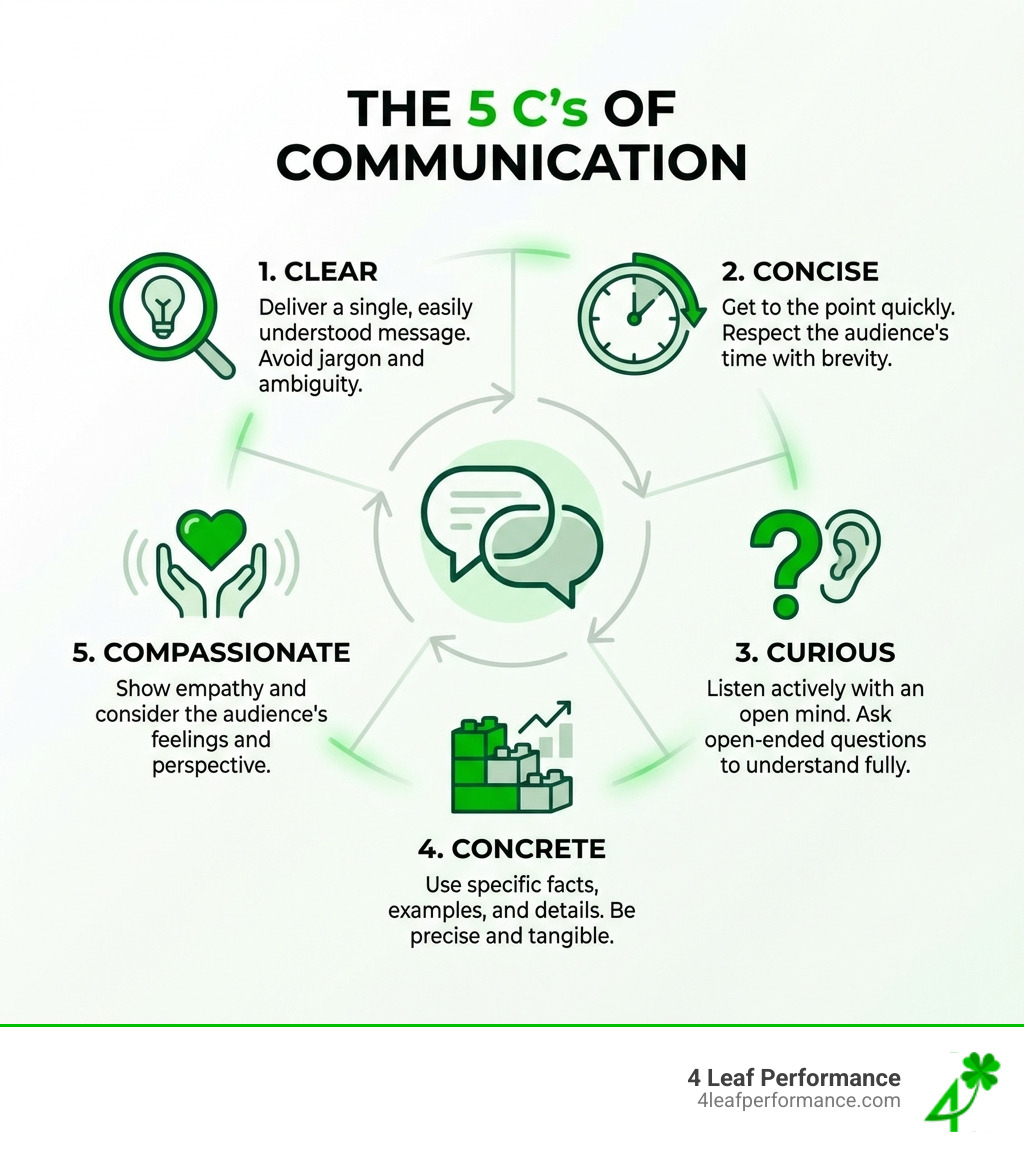
What are the 5 C’s of communication?
The 5 C’s are Clear, Concise, Curious, Concrete, and Compassionate.
- Clear: Use simple words.
- Concise: Don’t use too many words.
- Curious: Ask questions to learn more.
- Concrete: Give real examples.
- Compassionate: Be kind and think about the other person’s feelings.
How can I stop using filler words like “um”?
The best way is to slow down. Most people use filler words because they are afraid of silence. It is okay to pause for a second while you think of your next word. Practice recording yourself to hear how often you use them.
Why is body language more important than words?
Our brains are wired to look for danger or friendship. We trust what we see more than what we hear. If your body language is closed off, people will feel like you are hiding something, even if your words are nice.
Conclusion
To develop communication skills is a journey that never ends. It takes practice, but the rewards are huge. You will lead better, earn more trust, and feel more confident.
At 4 Leaf Performance, we help you find your “WHY” so you can lead with clarity. Our Profit Accelerator Coaching Program isn’t just about numbers—it’s about becoming the leader your business needs. We use the WHY.OS framework to help you and your team talk better and work smarter.
Ready to stop the chaos and start leading? Check out our business coaching insights and let’s open up your voice together. Lead Better. Profit Smarter.