Why the Portfolio Alignment Team Matters for Climate and Investment Goals
The portfolio alignment team is a collaborative initiative of nine major financial institutions that developed a shared framework for measuring whether investment portfolios align with the Paris Agreement’s climate goals. Created under the leadership of Mark Carney when he served as UN Special Envoy for Climate Action and Finance, this team addresses a critical gap: how to consistently measure if financial institutions are truly supporting the transition to net-zero emissions by 2050.
Quick Answer: What is the Portfolio Alignment Team?
- Who: A collaboration of 9 financial institutions working with 11 leading portfolio alignment method providers
- What: Created standardized frameworks for measuring portfolio alignment with climate goals
- Why: To bring transparency and consistency to net-zero commitments across the financial sector
- When: Launched ahead of COP26, with reports published in 2020 and 2021
- Impact: Endorsed by TCFD and incorporated into GFANZ guidance affecting $100 trillion in assets
- Goal: Help investors measure progress toward the 1.5°C warming limit set by the Paris Agreement
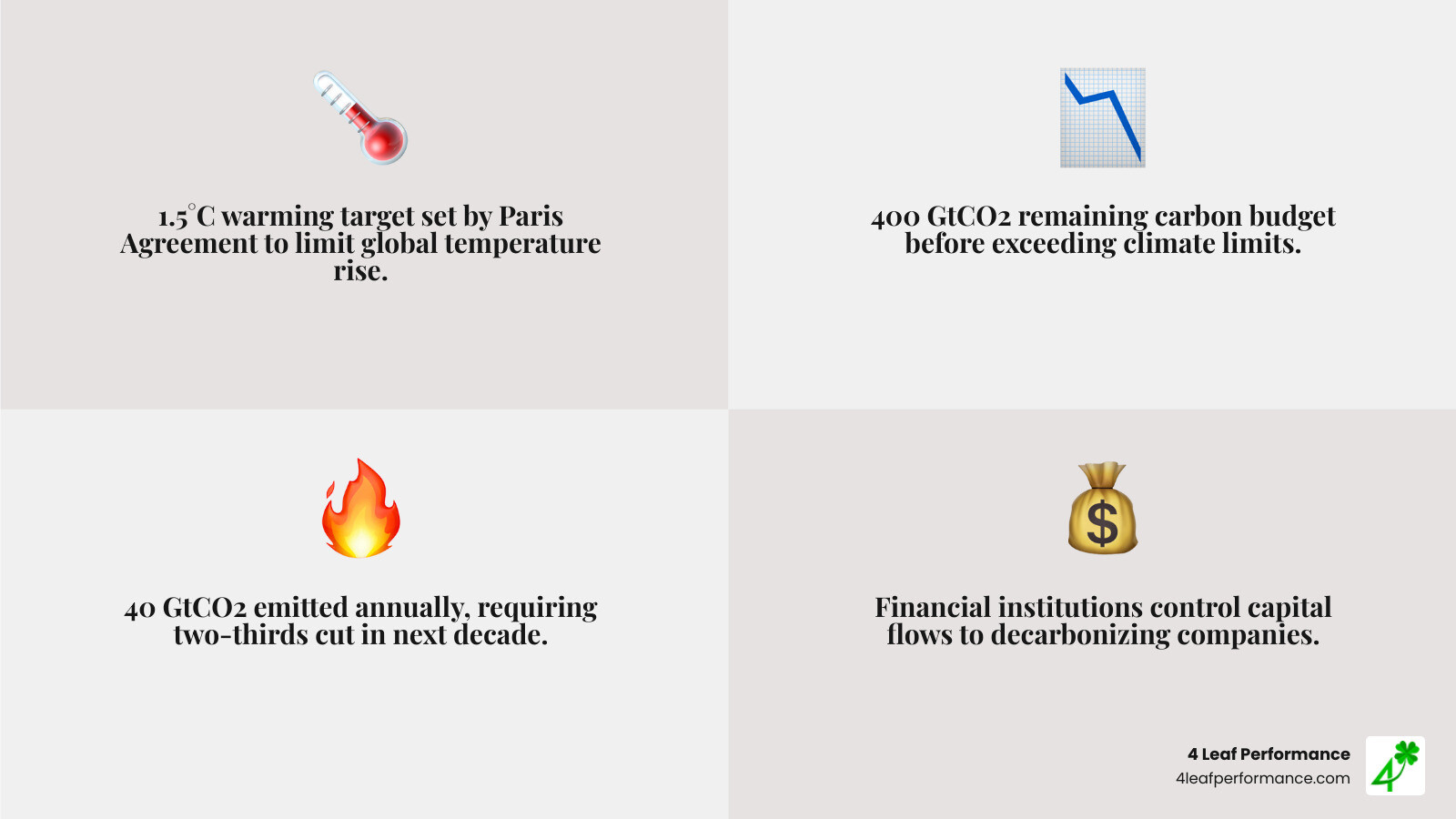
Right now, the world emits about 40 gigatons of CO2 annually. To hit the 1.5°C target, we have only 400 gigatons left in our carbon budget. That means emissions must drop by two-thirds in the next decade.
Financial institutions control where capital flows. But without clear, consistent ways to measure portfolio alignment, it’s hard to know if money is actually supporting companies that are decarbonizing—or just greenwashing their way through climate commitments.
This is where standardized portfolio alignment tools become essential. They help investors see beyond current emissions to understand which companies are on track to meet science-based climate targets and which are falling behind.
I’m Andrew Lamb, and through my work with leadership teams navigating high-stakes transitions, I’ve seen how critical clear frameworks are for making complex decisions. The portfolio alignment team created exactly that kind of clarity for the financial sector—a foundation that helps leaders allocate capital with both confidence and purpose.
What is the Portfolio Alignment Team?
The portfolio alignment team (often called PAT) is a special group that changed how we look at money and the planet. It was started by nine big financial companies. They wanted to make sure that when a bank says they are “going green,” they actually mean it.
Mark Carney, a very important leader in finance, helped put this team together. They worked with many experts to create a guide. This guide helps everyone use the same “ruler” to measure how well a group of investments fits with the Paris Agreement. The Paris Agreement is a big global plan to stop the earth from getting too hot.
The team’s work became very famous at a big meeting called COP26. Their ideas were put into the GFANZ’s Portfolio Alignment Measurement Report. This report is like a playbook for big banks. It helps them be transparent, which means they show their work and don’t hide secrets. Before this team existed, everyone had their own way of measuring things. It was confusing! PAT helped everyone agree on one way to do it.
Why We Need a Portfolio Alignment Team for Better Investing
Imagine you are trying to bake a cake, but everyone has a different idea of what a “cup” of flour is. You would end up with a mess! That is what investing was like before the portfolio alignment team.
We need this team because our “carbon budget” is running out. Think of the carbon budget like a bank account for the whole world. We can only spend about 400 gigatons of CO2 if we want to keep the world’s temperature from rising more than 1.5°C. Right now, we are spending that budget way too fast.
Comparing Old Ways vs. New Ways
In the past, people looked at “financed emissions.” This only looked at how much pollution a company was making right now. But that doesn’t tell the whole story. What if a company makes a lot of pollution today but has a great plan to stop tomorrow?
| Feature | Financed Emissions (Old Way) | Portfolio Alignment Tools (New Way) |
|---|---|---|
| Focus | Past and Present | Future Trajectory |
| Data Type | Backward-looking | Forward-looking |
| Goal | Count Carbon | Align with 1.5°C Target |
| Action | Divest (Sell) | Transition (Improve) |
At 4 Leaf Performance, we know that how great leaders turn tension into teamwork is by having a clear plan for the future. The same is true for your money. These new tools look forward. They help leaders decide where to put capital (money) so it helps the world transition to a cleaner future.
Solving Problems with the Portfolio Alignment Team
The portfolio alignment team helps solve some big problems:
- Greenwashing: This is when a company pretends to be green but isn’t. PAT’s tools make it harder to fake it.
- Data Gaps: Sometimes we don’t have all the facts. PAT shows us where we need more info.
- Better Decisions: When leaders have good data from the Science Based Targets initiative (SBTi), they make smarter choices.
By using these tools, financial institutions can keep their climate commitments. It turns “talk” into “action.”
How Portfolio Alignment Tools Work
How do we actually measure if a portfolio is aligned? The portfolio alignment team uses some cool math. One of the most popular ways is called “Implied Temperature Rise” or ITR.
Think of ITR like a thermometer for your investments. It gives a score in degrees, like 1.5°C or 2.0°C. If your portfolio has a score of 3°C, that means if everyone invested like you, the world would get 3 degrees hotter. That’s a big warning sign!
Other tools include:
- Binary measurements: A simple “Yes” or “No.” Is the company meeting its goals?
- Benchmark divergence models: This looks at how far a company is drifting away from the “green path” it should be on.
The TCFD’s Proposed Guidance recommends that all big financial groups use these forward-looking tools. It’s like having a GPS for your money instead of just looking in the rearview mirror.
Key Steps Used by the Portfolio Alignment Team
Building these tools isn’t easy. The team has nine “design judgements” or steps they recommend. Just like aligning team roles with DISC profiles for maximum productivity helps a business run better, these steps help the tools work better.
- Looking at all Emissions: They look at Scope 1 (direct pollution), Scope 2 (pollution from power), and Scope 3 (pollution from the whole supply chain).
- Granularity: This means looking closely at different types of businesses. A coal mine needs a different plan than a software company.
- Aggregation: This is a fancy word for adding everything up. It helps you see the score for your whole portfolio, not just one company.
- Future Projections: They use data from the Greenhouse Gas Protocol to guess how a company will perform in the future.
Frequently Asked Questions about Portfolio Alignment
What is the difference between financed emissions and portfolio alignment?
Financed emissions look at what happened yesterday. It is backward-looking. Portfolio alignment looks at what will happen tomorrow. It is forward-looking. Alignment tools help us see the “trajectory” or the path a company is on. This is much better for making long-term plans.
Why is Scope 3 important for the portfolio alignment team?
Scope 3 emissions are the ones that happen “hidden” in the background. For example, for a car company, most of the pollution happens when people drive the cars, not when the factory builds them. For fossil fuels and mining, Scope 3 can be 80% of their total impact! Groups like CDP help collect this data so we can see the full picture.
How does PAT help with net-zero goals?
It creates a standard. When everyone uses the same rules, we can compare different banks and funds. Right now, over $100 trillion in assets are part of these commitments. That is a huge amount of money! PAT makes sure all that money is actually moving us toward a net-zero world.
Conclusion
The portfolio alignment team has given us the map we need to steer a changing world. By creating clear rules and forward-looking tools, they help investors move money to the companies that are truly building a greener future.
At 4 Leaf Performance, we believe that clarity is the foundation of success. Whether you are managing a global investment fund or a small business in Houston, you need to know where you are going. We help leaders “Lead Better” and “Profit Smarter” by using frameworks like WHY.OS to find purpose and drive results.
Don’t stay stuck in the old way of doing things. It’s time to align your team, your goals, and your portfolio for the future.
Ready to lead with intention? Start Your Profit Accelerator for $499 per month and see how clarity can transform your business.