Why Culture Makes or Breaks Your Next Big Move
How does organizational culture affect change management is one of the most important questions leaders face when trying to improve their business. Here’s the quick answer:
Culture shapes how people respond to change:
- Shared values and beliefs determine whether teams see change as opportunity or threat
- Trust levels control how openly employees adopt new ways of working
- Group habits and norms either speed up or slow down new initiatives
- Power dynamics decide who gets heard during transitions
- 75-90% of change efforts fail because culture wasn’t aligned with strategy
The truth is simple: your strategy might be brilliant, but if your culture doesn’t support it, change will stall. Research shows that organizations with strong, adaptive cultures see 65% better performance during transitions. Meanwhile, companies that ignore culture face resistance, confusion, and wasted resources.
Culture isn’t just about values on a wall. It’s the invisible force that guides every decision, conversation, and action in your business. When culture and change align, teams move faster. When they clash, even small improvements feel impossible.
I’m Andrew Lamb, and over 25 years in leadership roles—including two decades at HP—I’ve seen how culture quietly determines whether change succeeds or fails. Understanding how does organizational culture affect change management has been central to my work helping leaders prepare for transitions, align their teams, and build systems that support growth instead of fighting it.
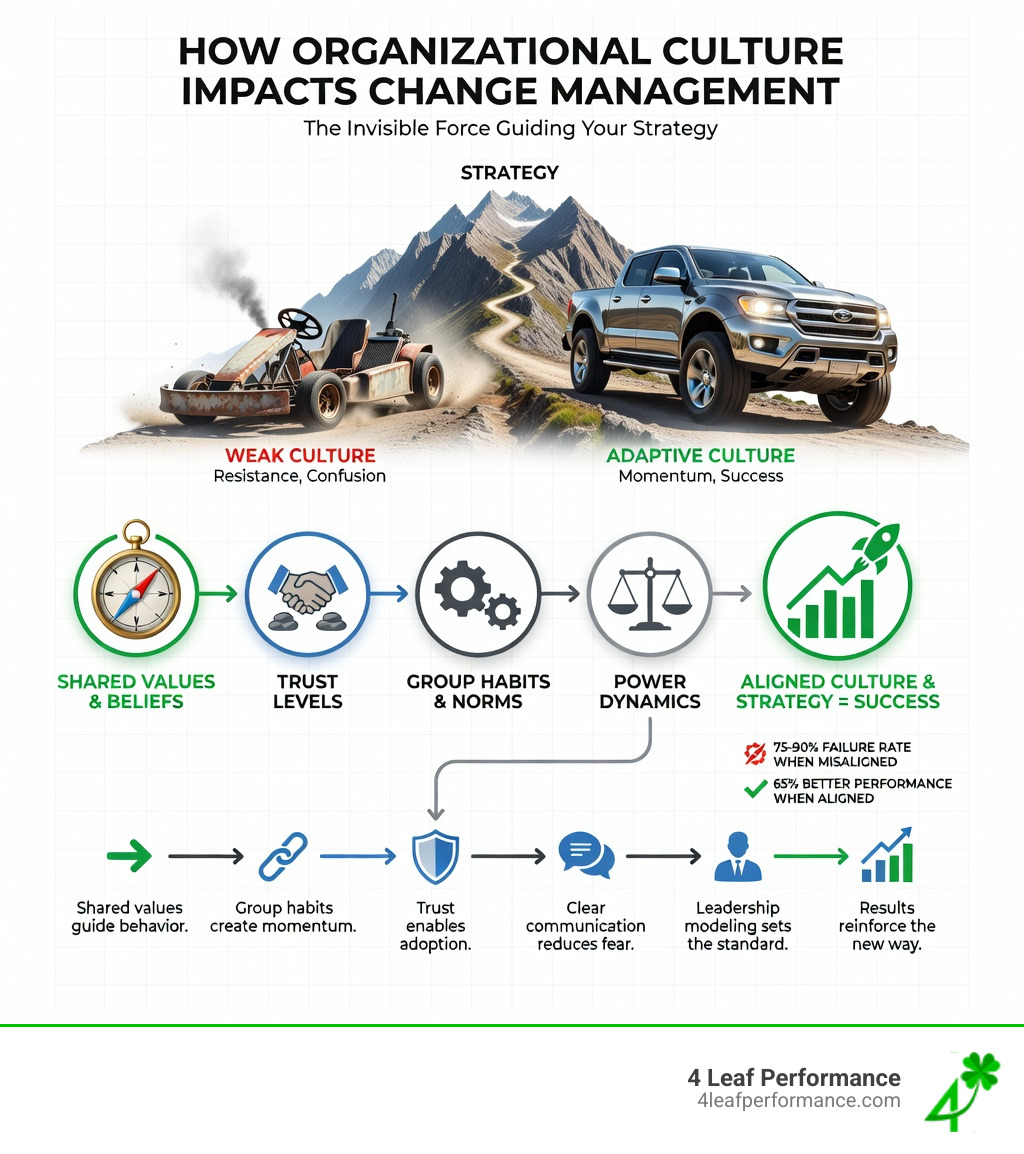
Key Elements of Culture and Change Alignment: Shared values guide behavior → Group habits create momentum → Trust enables adoption → Clear communication reduces fear → Leadership modeling sets the standard → Results reinforce the new way
How Does Organizational Culture Affect Change Management Success?
Think of your company strategy like a map. It tells you where you want to go. But think of your culture like the car you are driving. If you have a map for a mountain but you are driving a tiny go-kart, you won’t get very far! This is exactly how does organizational culture affect change management in the real world.

Research from big groups like McKinsey and Forbes shows a scary truth. Between 75 and 90 percent of strategic change efforts fail because of cultural barriers. This means the plan was good, but the people’s “way of doing things” stopped the plan from working.
When we look at culture-as-a-business-compass, we see that culture guides your team’s every move. If your culture is built on trust, people will listen when you say, “We need to try something new.” They feel safe. But if there is no trust, they might think the change is a bad thing. Building trust is a big part of creating-a-positive-workplace-culture.
When culture and change work together, employees adopt new tools faster. They don’t just “do it because they have to.” They do it because they believe in it. This shared mindset is the secret to making change stick.
The Four Types of Culture and Their Impact
Every business has its own “vibe” or personality. Experts often put these into four buckets. Knowing which one you have helps you see how your team will handle a big shift.
| Culture Type | Main Focus | How it Handles Change |
|---|---|---|
| Adhocracy | Innovation & Risk | Loves it! Always looking for the next big thing. |
| Bureaucracy | Rules & Stability | Slow. Needs a lot of proof and clear steps. |
| Clan | Family & Loyalty | Supportive, but can be scared of losing “the old way.” |
| Market | Results & Winning | Fast, but only if they see how it makes them win. |
If you have an Adhocracy culture, change is like fuel. Your team wants to try new things. But if you have a Bureaucracy, you need to be very careful. Rules are there for a reason, and changing them feels risky. This is why spotting-silent-culture-cracks is so important. If the culture is too rigid, the cracks will show as soon as you try to move.
A Clan culture is great for group safety, but it can sometimes hide problems to keep everyone happy. A Market culture will push hard for results, but might burn people out if the change is too constant. The key is to find a balance that allows for flexibility without losing the core of who you are.
Why Organizational Culture Affects Change Management Resistance
Have you ever tried to push a heavy box across a carpet? It’s hard because of friction. In a business, culture can be that friction. When people resist change, it usually isn’t because they are “bad” workers. It’s because they are afraid.
When a company changes, it creates uncertainty. People wonder, “Will I still have a job?” or “Will I be good at the new way?” This is the-psychology-of-company-restructuring-managing-fear-uncertainty-and-resistance. If your culture doesn’t help people feel safe, they will fight the change to protect themselves.
Sometimes, the resistance comes from the-silent-culture-killer: a lack of communication. If people don’t know why things are changing, they make up their own stories.
There is also scientific research on cultural dimensions that explains this. For example:
- Power Distance: In some cultures, people only do what the boss says. If the boss isn’t excited, no one is.
- Assertiveness: In some teams, people are very blunt. They will tell you “No” to your face. In others, they might say “Yes” but then never do the work.
Understanding these dimensions helps you predict where the “friction” will come from before you even start.
Steps to Align Your Culture with New Goals
So, how do you make sure your culture helps you instead of hurting you? You have to be intentional. You can’t just hope for the best.
- Do a Cultural Assessment: Before you change your business, you need to know where you are starting. Ask yourself: is-your-company-ready-key-questions-to-ask-before-business-restructuring? You can use surveys or just talk to people to find the “unwritten rules” of your office.
- Open Communication: Talk early and talk often. Don’t keep secrets. When you restructure-together-how-involving-employees-eases-transitions, people feel like they are part of the solution, not just a victim of the problem.
- Model the Behavior: If you want your team to be more innovative, you have to be innovative too. If you want them to be honest, you have to be honest first. Leaders are like mirrors; the team reflects what they see.
- Create New Rituals: Maybe you start a weekly meeting to celebrate new ideas. Or maybe you change how you give out rewards. These small things help turning-company-culture-as-a-catalyst-for-creative-thinking.
- Reward the Right Things: If you say you want “teamwork” but you only give bonuses to the person who sells the most, you are sending mixed signals. Make sure your rewards match your new goals.
How Organizational Culture Affects Change Management Leadership
Leadership is the bridge between culture and change. A “Changeal Leader” doesn’t just give orders. They inspire people to want the change. But even the best leader can be stopped by a bad culture.
We often see how-organizational-culture-undermines-leadership-training-programs. You can send a manager to a fancy class, but if they come back to a workplace that hates new ideas, they will eventually stop trying.
Trust and transparency are your best tools. When leaders are managing-resistance-to-change-during-leadership-transitions, they must act as role models. If the team sees the leader working hard and being open about the challenges, they are much more likely to follow.
Frequently Asked Questions about Culture and Change
Why do most change efforts fail?
Most fail because of cultural barriers. Leaders often focus on the “hard” stuff like budgets and software but forget the “soft” stuff like how people feel. A toxic-workplace-culture-in-disguise-how-high-performing-teams-can-still-be-dysfunctional can look good on paper but fail as soon as things get tough.
How can I measure my company’s culture?
You can use tools like the Barrett Values Assessment or simple employee surveys. The best way is to watch “how work gets done” when you aren’t in the room. Are people helping each other? Are they afraid to make mistakes? This tells you more than any document. If things feel off, you need to know how-to-handle-a-toxic-work-culture.
What is the best culture for change?
An Adhocracy or a “Learning Culture” is usually best. This is a culture where it is okay to fail as long as you learn. It values being agile. Implementing-agile-change-management-in-leadership-transitions is much easier when your team is already used to moving fast and trying new things.
Conclusion
At 4 Leaf Performance, we know that your culture is the engine of your business. If the engine is broken, it doesn’t matter how fast you want to go. We use our 25 years of global experience and the WHY.OS framework to help you see your business differently.
We help you Lead Better and Profit Smarter. Most owners are working too hard for the same results. Our Profit Accelerator Coaching Program gives you a Growth Coach and special software to find the hidden profits already sitting in your business.
Don’t let your culture be the thing that holds you back. You can find clarity and freedom without losing your sanity. It’s time to stop working in your business and start leading it.
Start Your Profit Accelerator for $499 per month. Let us help you turn your culture into your greatest strength.