Why So Many Businesses Struggle to Achieve Organizational Goals
Achieve organizational goals — and you give your team direction, purpose, and a reason to show up fully every day.
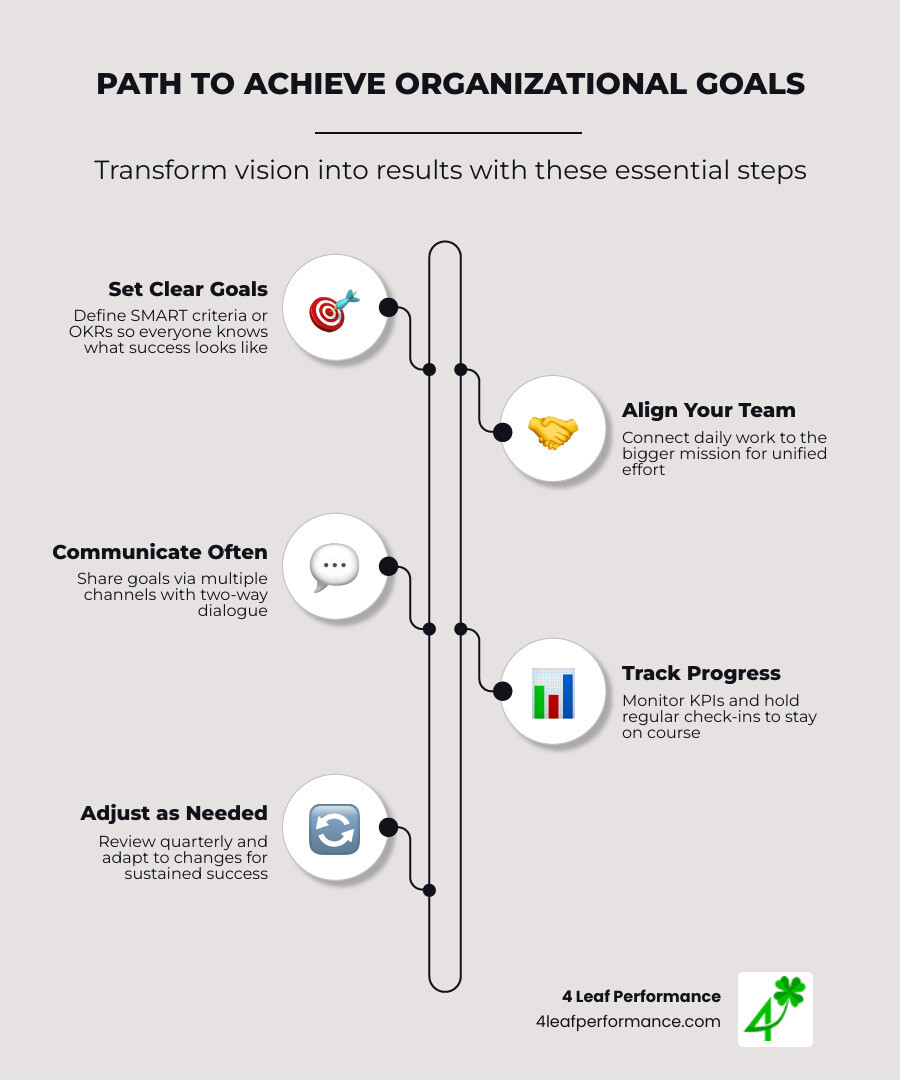
Here is how to do it:
- Set clear goals – Use SMART criteria or OKRs so everyone knows exactly what success looks like
- Align your team – Connect each person’s daily work to the bigger mission
- Communicate often – Share goals through multiple channels and invite two-way dialogue
- Track progress – Use KPIs and regular check-ins to stay on course
- Adjust as needed – Review goals quarterly and adapt when things change
It sounds simple. But most teams never get there.
Here is a number that tells the whole story: only 23% of companies have successfully aligned their individual and organizational goals. That means roughly 3 out of 4 businesses are working hard — but not together.
The result? Burned-out leaders. Confused teams. Growth that stalls.
You may recognize the feeling. Projects drag. Communication breaks down. The strategy looks great on paper but falls apart in practice. Your team is moving — just not in the same direction.
The good news is that this is a solvable problem. And it starts with one thing: clarity.
When people know the goal, understand their role, and feel connected to the mission, everything shifts. As Chris McChesney put it, “Nothing is more motivating than belonging to a team of people who know the goal and align themselves to get there.”
This guide walks you through exactly how to make that happen — from setting the right goals to building the systems that keep your team moving forward.
I’m Andrew Lamb, a leadership advisor and executive coach with over 25 years of senior global leadership experience, including two decades at HP, where I saw what separates teams that achieve organizational goals from those that simply stay busy. Through 4 Leaf Performance, I now help small business owners and leaders build the clarity, alignment, and systems they need to grow — without burning out in the process.
What Are Organizational Goals and Why Do They Matter?
Think of an organizational goal as a destination on a map. Without it, you are just driving around and wasting gas. These goals tell everyone in the company where you are going and why it matters.
Indeed emphasizes the importance of setting both official and operative goals. Official goals are the big dreams you tell the public. They are about your long-term vision and purpose. Operative goals are the small, daily steps your team takes to get there.
When we achieve organizational goals, we shift from just “doing work” to “doing the right work.” This is important because:
- It guides employee efforts: People don’t have to guess what to do next.
- It helps measure success: You can see if you are actually winning or just staying busy.
- It builds motivation: People feel good when they reach a milestone.
At 4 Leaf Performance, we believe that profit freedom starts with clarity. If you don’t know your “Why,” it is hard to set goals that stick. You can find more info about setting business goals on our blog to help you get started.

Proven Frameworks to Achieve Organizational Goals
To reach your targets, you need a system. You wouldn’t build a house without a blueprint, right? Business goals are the same. There are several famous ways to set and reach goals.
The OKR framework stands for objectives and key results. This is a very popular way to stay focused. Other ways include the Balanced Scorecard, which looks at things like money, customers, and how the team is learning. There is also the “4 Disciplines of Execution” (4DX). This system teaches you to focus on just one or two “Wildly Important Goals” so you don’t get distracted.
Using these tools helps you learn how to set achievable objectives that don’t just sit on a shelf.
Using OKRs to Achieve Organizational Goals
OKRs are great because they make everything clear. The “Objective” is what you want to do. The “Key Results” are how you prove you did it.
One cool thing about OKRs is “bottom-up” goals. John Doerr, a famous goal expert, says healthy companies get about half of their goals from the employees, not just the bosses. This makes people feel like they own their work. When everyone can see the goals on a dashboard, it builds trust and focus.
The SMART Way to Achieve Organizational Goals
You have probably heard of SMART goals. They are a classic for a reason! To achieve organizational goals, they must be:
- Specific: Don’t just say “grow.” Say “get 10 new customers.”
- Measurable: How will you count it?
- Achievable: Can you actually do it with the tools you have?
- Relevant: Does it fit your big dream?
- Time-bound: When is the deadline?
When goals are SMART, they turn into clear targets. This is a big part of how to turn plans into wins every single day.
Aligning Your Team for Maximum Impact
Alignment means everyone is rowing the boat in the same direction. If one person rows left and another rows right, the boat just spins.
Research shows that only 23% of companies are truly aligned. That is a big problem! We want your business to be a “well-oiled machine.” This happens when your big vision matches what people are doing at their desks.
| Feature | Top-Down Goal Setting | Bottom-Up Goal Setting |
|---|---|---|
| Who starts it? | Leaders and Bosses | Employees and Teams |
| Main Benefit | Clear vision from the top | High motivation and ownership |
| Main Risk | Employees might feel ignored | Might not match the big strategy |
| Best Use | Setting the big “Why” | Solving daily problems |
To get the best results, you need both. Leaders set the vision (Vertical alignment), and departments work together (Horizontal collaboration). You can read our improving team performance guide to see how to bring your people together.
Communication Strategies for Success
You can’t just send one email about a goal and expect it to happen. That leads to “collective amnesia,” where people forget why the goal mattered in the first place.
Instead, use storytelling. Tell your team why the goal helps the customer. Use two-way dialogue so they can ask questions. Most importantly, make sure everyone has a clear role. When people know exactly what they are responsible for, they work harder. We have found that why metrics should motivate your team often comes down to how well you explain them.
Overcoming Challenges and Measuring Success
It isn’t always easy to achieve organizational goals. You will run into “roadblocks.” Some people might be scared of change. Or, you might not have enough money or time.
The McChrystal Group found that quarterly strategy reviews help track alignment progress. Every three months, sit down and look at your data. Are you hitting your Key Performance Indicators (KPIs)? Are you getting a good Return on Investment (ROI)?
If you are off track, don’t panic. Just adjust. Use data to make decisions, not guesses. Mastering team data measurement is the best way to stay in control of your business growth.
Strategies for Long-Term Growth and Agility
To keep winning, you have to stay “agile.” This means being able to change quickly when the world changes. Organizations that use agile methods often see a 60% boost in productivity!
Here are some tricks to stay on top:
- The Pareto Principle: This is the 80/20 rule. It says that 80% of your results come from just 20% of your work. Find that 20% and focus on it!
- “Eat That Frog”: This means doing your hardest task first thing in the morning. Once the “frog” is eaten, the rest of the day is easy.
- Celebrate Success: Forbes studied the importance of celebration in the workplace. When you reach a goal, party a little! It makes people want to work harder next time.
- ESG Criteria: This stands for Environmental, Social, and Governance. It means setting goals that are good for the planet and the community, not just for profit.
The real test of daily execution is staying consistent even when things get tough.
Frequently Asked Questions about Organizational Goals
What is the difference between a goal and an objective?
A goal is like the destination (e.g., “Become the best bakery in Houston”). An objective is a specific step to get there (e.g., “Sell 500 cupcakes this week”). Goals are broad, and objectives are narrow.
How often should our company review our strategic goals?
We recommend a “quarterly rhythm.” Every three months is often enough to catch mistakes but long enough to see real progress. Some teams also do quick weekly check-ins to stay focused.
What is the 80/20 rule in business?
It is the idea that a small number of actions cause most of your success. For example, 80% of your profit might come from 20% of your customers. If you know who those customers are, you can serve them better and grow faster!
Conclusion
At 4 Leaf Performance, we know that leading a business can feel like juggling too many balls at once. But it doesn’t have to be that way. Structure creates freedom. When you have the right systems and a coach in your corner, you can finally stop reacting and start leading.
Our Profit Accelerator Coaching Program is designed for owners who want to scale without losing their sanity. For just $499 a month, we help you:
- Diagnose – Find the hidden profits in your business using our special software.
- Focus – Use the WHY.OS framework to choose your best next move.
- Grow – Execute with accountability that gets real results.
You don’t have to grow alone. Let’s work together to achieve organizational goals that change your life and your business. Lead Better. Profit Smarter.
Start Your Profit Accelerator Journey today and see your numbers differently!