Why Developing Leadership Skills in the Workplace Is the Highest-Leverage Investment You Can Make
If your team is missing deadlines, repeating the same problems, or waiting for you to solve everything, the issue is often leadership. Developing leadership skills in the workplace helps you create clarity, strengthen accountability, and improve team performance.
Here is the main point up front: the quality of your leadership shapes the quality of your team’s results. Gallup research shows managers account for 70% of the variance in team engagement. In many companies, performance problems are leadership problems in disguise.
How to develop leadership skills in the workplace:
- Start with honest self-assessment using 360-degree feedback to spot blind spots
- Build emotional intelligence through active listening, empathy, and self-regulation
- Use a clear decision process under pressure, such as Frame, Explore, Decide
- Develop people through regular coaching conversations and stretch assignments
- Create accountability with clear expectations and consistent follow-through
- Keep learning through mentorship, reflection, and deliberate practice
These are not abstract ideas. They are practical behaviors you can build through repetition.
When employees strongly agree that their leaders communicate effectively, they are 73% less likely to feel burned out at work. (Gallup)
This guide answers a question many senior leaders ask: How do I build stronger leadership skills at work when my team needs better clarity, ownership, and results right now? You will find specific frameworks and actions you can use this week.
I am Andrew Lamb, a leadership advisor and executive coach with more than 25 years of global leadership experience, including over two decades at HP. I have spent my career helping leaders improve team performance through executive coaching, leadership training, and organizational development. At 4 Leaf Performance, we also use our WHY.OS framework to help leaders lead with intention, not reaction.
Developing leadership skills in the workplace further reading:
Developing Leadership Skills in the Workplace Starts With the Right Mindset
Leadership starts before authority. It starts with behavior.
The best leaders do not wait for a title to begin leading. They build trust, create clarity, and take responsibility for outcomes. That means self-awareness matters first. You need to know how you show up under pressure, how your decisions affect others, and what patterns you repeat when things get messy.
A strong leadership mindset includes:
- ownership instead of blame
- curiosity instead of defensiveness
- consistency instead of mood-driven leadership
- influence instead of control
- accountability instead of avoidance
People also need more than direction from leaders. Research shows followers look for four things over and over: hope, trust, compassion, and stability. If your team does not feel those, your strategy will not land.
Leadership vs. management: what each one does at work
Leadership and management are different, and both matter.
| Leadership | Management |
|---|---|
| Sets direction | Builds plans |
| Creates meaning | Organizes work |
| Influences people | Coordinates execution |
| Builds trust and energy | Tracks progress and resources |
| Coaches growth | Assigns tasks and clarifies roles |
| Navigates change | Maintains consistency and process |
Leadership asks, “Where are we going, and why does it matter?”
Management asks, “How will we get there, who owns what, and when is it due?”
If you only lead, your team may feel inspired but confused. If you only manage, your team may feel efficient but disengaged. The strongest workplace leaders do both.
Why developing leadership skills in the workplace is a learnable process
Some people may begin with natural confidence or presence. But leadership is still built, not magically downloaded.
We see leadership grow fastest when people combine:
- stretch assignments
- coaching and mentorship
- regular feedback
- reflection after key moments
- repeated practice in real work
That lines up with the widely used 70-20-10 idea of development:
- 70% through on-the-job experience
- 20% through social learning like coaching and mentoring
- 10% through formal training
So yes, leadership can be taught. More accurately, it can be practiced. A lot.
The WHY.OS approach to leading with intention, not reaction
At 4 Leaf Performance, we use the WHY.OS framework to help leaders stop reacting and start leading with intention.
That means we help leaders clarify:
- why they lead
- what values guide decisions
- which behaviors build or break trust
- how the team aligns around purpose
- what decision filters reduce confusion
When leaders lack internal clarity, teams feel it fast. Mixed messages. Shifting priorities. Unclear standards. Too many meetings with too little progress.
When leaders operate from purpose and aligned values, they become more authentic, more predictable, and more effective. That is the base for long-term leadership success. For more on that perspective, see Leadership Mindsets That Fuel Long Term Success.
The Most Essential Leadership Skills Needed in Today’s Workplace
The skills that matter most are not only technical. They are human, practical, and measurable.
The most essential leadership skills are:
- communication
- emotional intelligence
- strategic thinking
- adaptability
- conflict management
- decision-making
- relationship-building
- employee motivation
These skills help leaders guide teams through change, uncertainty, hybrid work, and growth.
Developing leadership skills in the workplace through communication and emotional intelligence

If leadership has a home base, it is communication.
Leaders need to communicate clearly in every format:
- face-to-face
- video calls
- team meetings
- one-on-ones
Clear communication includes:
- saying what matters most first
- defining expectations
- checking for understanding
- listening for what is not being said
- adjusting your message to your audience
Emotional intelligence makes communication effective. It includes self-awareness, self-regulation, empathy, motivation, and relationship management.
In practice, emotional intelligence helps you:
- notice your own reaction before it controls the meeting
- read the room
- respond instead of react
- handle difficult conversations without escalating them
- support people without becoming vague
That balance matters. Employees who strongly agree their leaders communicate well are far less likely to feel burned out.
Here is a simple one-on-one framework you can use this week:
The 5-5-5 Check-In
- 5 minutes: Ask what is going well and listen without interrupting
- 5 minutes: Ask where they are blocked, confused, or overloaded
- 5 minutes: Clarify next steps, ownership, and support needed
Example: A team member says a project is behind. Instead of jumping in with answers, ask:
- What is the real blocker?
- What decision is still unclear?
- What support do you need from me?
This keeps the conversation focused on clarity, not rescue.
To build these skills this week:
- spend the first five minutes of one-on-ones listening, not talking
- paraphrase what you heard before offering a solution
- name the issue clearly in difficult conversations
- ask, “What am I missing?” before deciding
- watch nonverbal cues, especially in hybrid meetings
For a deeper look at how soft skills build loyalty and trust, see Upgrading Your Leadership Skills Hard Skills Build Credibility But Soft Skills Build Loyalty.
Decision-making, adaptability, and critical thinking under pressure
Leadership gets real when the answer is not obvious.
Strong leaders make decisions with incomplete information, changing conditions, and competing priorities. That requires judgment, not just intelligence.
One useful model is FrED:
- Frame the problem
- Explore possible solutions
- Decide on the best path
Example:
- Frame: What problem are we actually solving?
- Explore: What options do we have, and what are the tradeoffs?
- Decide: What will we do now, and what will we revisit later?
Add a simple risk check:
- What is the worst likely outcome?
- How likely is it?
- What is our backup plan?
Here is a real-world scenario: A department head sees missed deadlines across two teams. The first reaction is to push harder. A better approach is to use FrED.
- Frame: Is the issue poor effort, unclear priorities, or too many projects at once?
- Explore: Pause lower-value work, reset ownership, or add decision checkpoints
- Decide: Cut one project, assign one accountable owner per deliverable, and review progress twice a week for 30 days
This is where the WHY.OS framework helps. It pushes leaders to align decisions with purpose, values, and the few priorities that matter most. That reduces reactive leadership and keeps the team focused.
Adaptability matters just as much. Plans change. Markets move. Teams shift. Leaders who cannot adjust create drag for everyone else.
Adaptable leaders:
- separate core priorities from temporary tactics
- communicate changes early
- stay calm when the first plan falls apart
- learn quickly without pretending they saw it coming all along
Relationship-building, motivation, and appreciation that lift performance

Leadership is relational work.
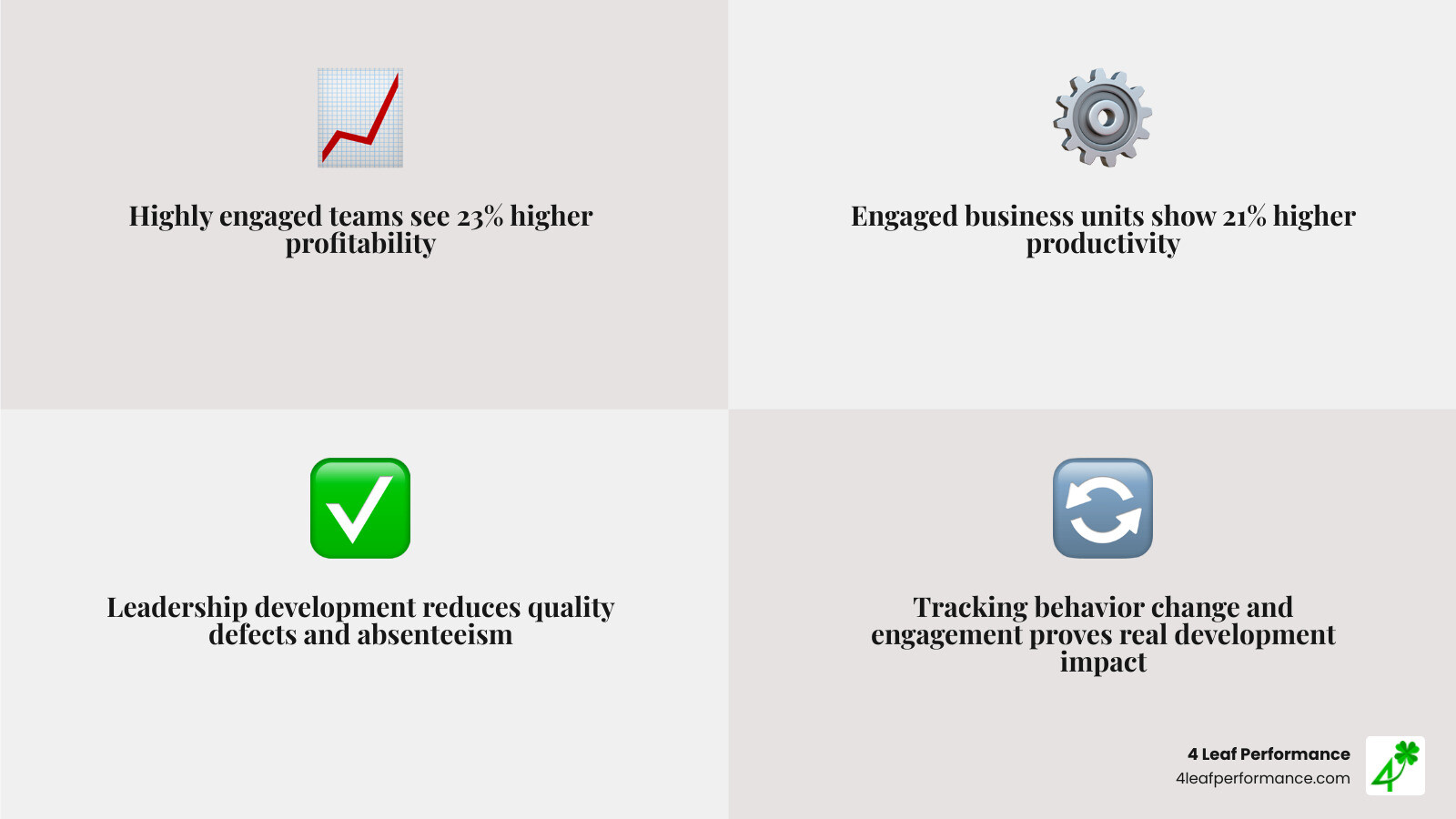
Research consistently shows that engagement, retention, and performance improve when people feel seen, valued, and supported. Highly engaged business units show 41% fewer quality defects, 37% less absenteeism, and 21% higher productivity. High-engagement teams also see 23% higher profitability.
Recognition plays a big role. Lack of appreciation is one of the top complaints employees have about managers.
That does not mean empty praise. It means specific acknowledgment:
- what the person did
- why it mattered
- how it helped the team or customer
Practical habits:
- hold regular one-on-ones
- ask about career goals, not just deadlines
- recognize effort and progress in public when appropriate
- give developmental feedback in private
- follow through on commitments
Relationship-building also creates resilience. When trust is strong before a problem, conflict is easier to solve when the problem arrives.
How to Build Leadership Skills Step by Step
Leadership growth needs structure. Good intentions alone do not change behavior.
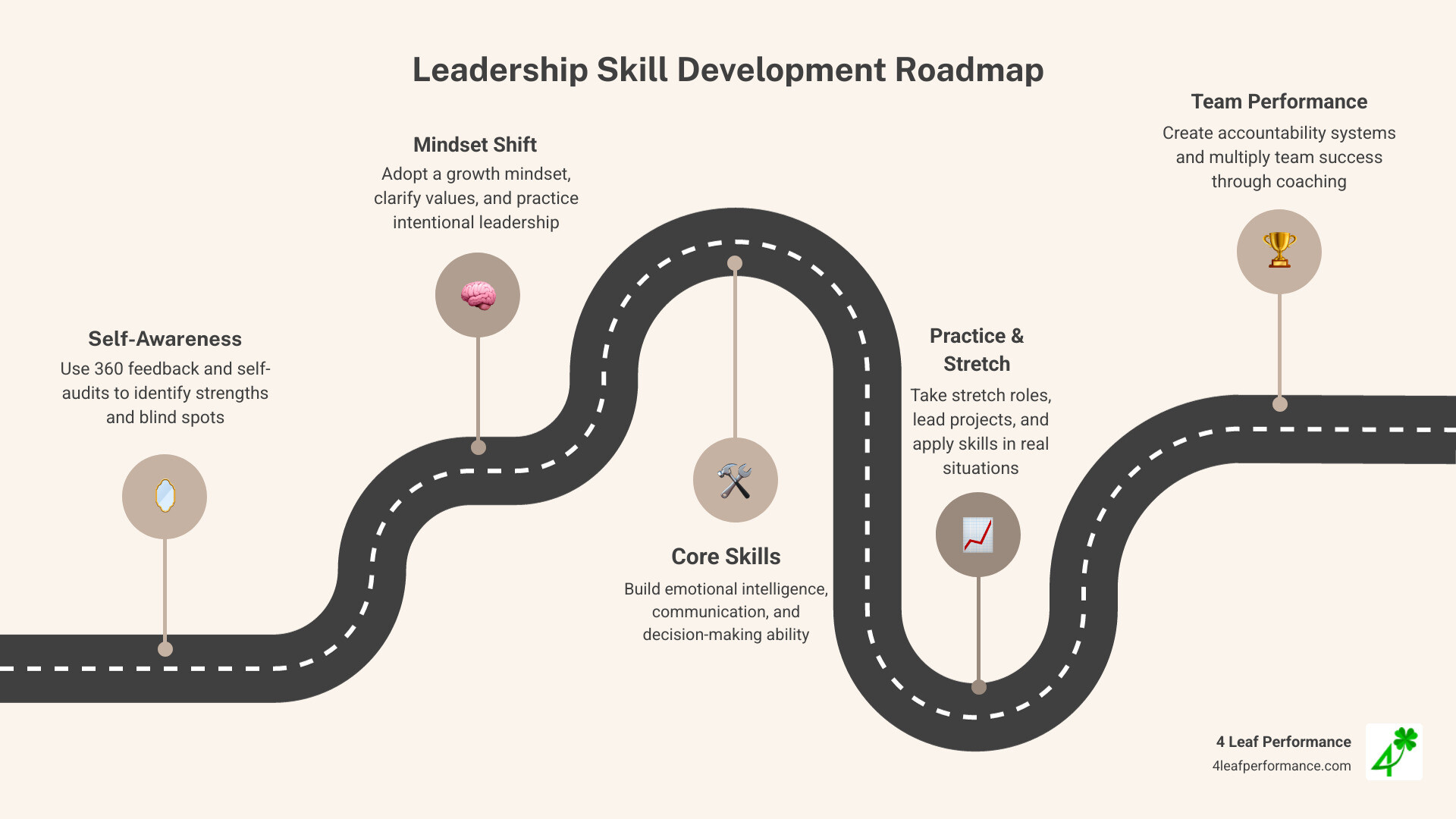
Assess your starting point with feedback, strengths, and blind spots
Start with a leadership self-audit.
Ask:
- What do I do consistently well?
- Where do I create confusion?
- How do I respond under stress?
- What feedback do I keep hearing?
- Where is my impact weaker than my effort?
Then gather input from:
- your manager
- peers
- direct reports
- trusted partners
A 360-degree feedback process is especially useful because leaders often rate themselves more positively than others do. That gap is not bad news. It is useful news.
Look for patterns in three areas:
- strengths you should use more often
- blind spots that limit trust or clarity
- skill gaps tied to your current role or next role
If you want help identifying common weak spots, read 12 Common Leadership Weaknesses And How To Improve Them.
Use a 30-60-90 leadership development plan that builds real habits
The fastest way to improve is to focus on a few behaviors, not fifteen.
Use a 30-60-90 plan.
First 30 days
- gather feedback from 5 to 8 people
- choose 2 leadership skills to improve
- start a weekly reflection habit
- schedule recurring one-on-ones
- keep a leadership learning log after key conversations
Days 31-60
- practice one coaching conversation every day or week
- use FrED for real decisions
- ask for feedback after meetings: “What could I have done more clearly?”
- take on one stretch assignment
- work on one visible accountability behavior, such as clearer follow-through
Days 61-90
- compare current feedback with your baseline
- identify one behavior that improved team trust
- identify one habit that still breaks down under pressure
- teach one skill you learned to someone else
- set the next 90-day development focus
A short list of 30-60-90 leadership actions:
- listen first
- clarify expectations
- delegate one level higher
- give one recognition message daily
- document key decisions and why they were made
- reflect weekly on wins, misses, and patterns
Practice leadership before you have the title
You do not need direct reports to lead.
You can practice leadership by:
- running a meeting with clear outcomes
- mentoring a peer
- leading a cross-functional project
- solving a recurring problem no one owns
- improving a process that affects others
- speaking up about risks early
This matters because transition into leadership is easier when influence skills already exist. Leadership is not something that starts on promotion day.
For more on building that path, see Detailed Guide To Leadership Development.
How Employees Can Transition from Individual Contributor to Leader
This is one of the hardest shifts in the workplace.
Why? Because success as an individual contributor often comes from personal output. Success as a leader comes from multiplying the output of others.
The biggest mindset shifts new leaders must make
New leaders need to shift from:
- doing the work to enabling the work
- having the answer to asking better questions
- proving value personally to creating value through the team
- being liked by everyone to being clear with everyone
That means learning to delegate, set boundaries, and let others own decisions.
A simple rule: if you keep rescuing every task, your team learns dependence, not excellence.
Common mistakes first-time leaders make and how to avoid them
Common mistakes include:
- micromanaging
- unclear expectations
- avoiding conflict
- overhelping
- playing favorites
- failing to follow through
How to avoid them:
- define outcomes, not just activities
- agree on decision rights early
- address tension while it is still small
- coach instead of stepping in too fast
- hold all team members to the same standard
- track commitments and close the loop
A little discomfort early saves a lot of drama later.
How to handle resistance, conflict, and toxic team dynamics early
Managers spend at least 24% of their time dealing with conflict, yet 60% of U.S. employees have had no conflict management training. That is not a great combo.
Start early. Conflict ignored becomes culture.
Use a simple conversation structure:
- State the facts
- Share the impact
- Ask for their view
- Agree on next steps
- Set a follow-up date
For toxic behavior:
- name the behavior clearly
- link it to standards, not personality
- document expectations
- follow through consistently
Psychological safety does not mean avoiding hard conversations. It means people know issues will be handled fairly and directly.
Leadership in Real Work Conditions: Hybrid Teams, Change, and Culture
Leadership is tested in the real world, not in theory. That means remote work, change fatigue, different cultures, and ethical gray areas.
Leading remote and hybrid teams without losing trust or clarity
Remote and hybrid teams need more intentional communication, not more random meetings.
Use simple norms:
- define what belongs in meetings versus async updates
- document decisions in writing
- clarify response-time expectations
- measure outcomes, not online visibility
- watch for burnout signals such as silence, delay, or withdrawal
In hybrid environments, fairness matters. Do not let proximity become preference.
Leading through change while keeping people engaged
People handle change better when leaders provide both honesty and direction.
During change, communicate:
- what is changing
- what is not changing
- why it matters
- what people should do now
- when the next update will come
Employees who believe their leaders give them hope about the future are far more engaged. That means leaders must communicate a believable path forward, not vague optimism.
The formula is simple:
- tell the truth
- show the path
- stay present
Cross-cultural and ethical leadership skills that matter more in 2026
Global teams require cultural awareness, humility, and respect.
Leaders need to:
- avoid assuming their communication style is universal
- check for bias in hiring, feedback, and promotion decisions
- invite varied viewpoints
- explain decisions transparently
- make fair choices even when pressured
Ethical leadership matters because trust is easy to lose and hard to rebuild. For broader perspective on global leadership, see Scientific research on global leadership.
How Organizations Can Support Leadership Development at Every Level
Leadership development should not be reserved for executives after problems appear. It should be built across the pipeline.
What support looks like at each leadership level
Different levels need different support.
- Individual contributors: self-awareness, communication, initiative
- Frontline managers: coaching, delegation, feedback, conflict handling
- Mid-level leaders: cross-functional influence, strategic thinking, change leadership
- Senior leaders: alignment, culture shaping, talent development
- Executives: enterprise thinking, succession, executive presence, organizational design
Effective programs are role-specific, include practice over time, and connect to business needs. Structured pathways work better than one-off workshops. For more on building programs that stick, see Scientific research on leadership development programs and Developing Executive Leadership.
How to measure whether leadership development is working
Measure behavior change, not attendance.
Useful indicators include:
- 360 feedback improvement
- employee engagement scores
- retention and promotion rates
- reduction in turnover
- team productivity
- quality defects
- absenteeism
- manager bench strength
If training ends and behavior stays the same, development did not happen.
For executive-level capability building, see Mastering Leadership Competencies For Executive Impact.
The business case for strong leadership skills
The business case is strong.
Research shows:
- highly engaged teams can see 23% higher profitability
- engaged business units show 21% higher productivity
- quality defects can drop by 41%
- absenteeism can fall by 37%
- organizations that invest in employee development are twice as likely to retain people and report 11% greater profitability
In short, leadership skill is not a soft extra. It is a performance driver.
Frequently Asked Questions about Developing Leadership Skills in the Workplace
How can I improve my leadership skills in the workplace quickly?
Start with five moves:
- hold better one-on-ones
- ask for direct feedback
- practice active listening
- take one stretch assignment
- reflect weekly on what worked and what did not
Quick improvement comes from repetition, not inspiration.
What qualities make a successful leader?
The core qualities are:
- clear communication
- emotional intelligence
- accountability
- adaptability
- trustworthiness
- sound judgment
- ability to motivate others
- consistency under pressure
Successful leaders also develop people, not just results.
What role does continuous learning play in becoming a better leader?
A major one.
Leadership is not a finish line. The workplace changes, teams change, and your role changes. Continuous learning helps you stay useful as a leader.
That can include:
- coaching
- mentorship
- workshops
- reading and reflection
- peer learning
- structured development programs
For emerging leaders, Improving Leadership Skills for Emerging Leaders offers helpful outside perspective.
Conclusion
Developing leadership skills in the workplace is one of the few investments that improves communication, culture, engagement, and results at the same time.
Start small, but start now:
- assess your current habits
- choose two skills to improve
- practice them in real work
- ask for feedback
- repeat
Leadership compounds. One better conversation can change a relationship. One better decision can change a quarter. One better leadership habit can change a team.
At 4 Leaf Performance, we help senior leaders build those habits through executive coaching, leadership training, and organizational development grounded in real business pressure and our WHY.OS framework. If you are ready to lead with more clarity, alignment, and accountability, explore our workshops and Schedule a Discovery Call.