Why Team Leadership Skills Determine Whether Your Team Thrives or Stalls
Team leadership skills are the specific abilities that allow a leader to align people, drive performance, and create the conditions where teams can actually do their best work.
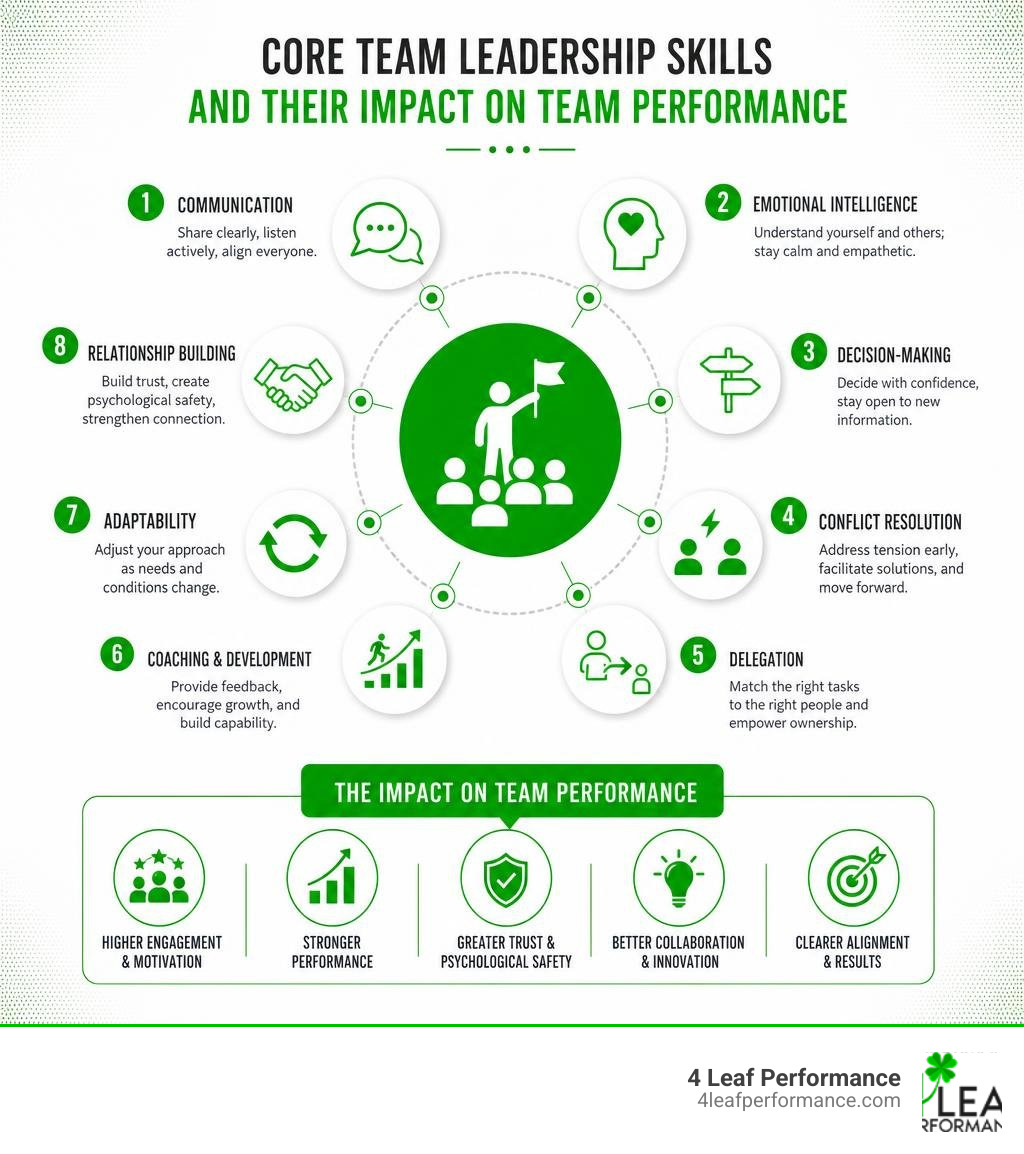
Here are the core skills that define effective team leadership:
- Communication — clear, honest, and consistent across all directions
- Emotional intelligence — self-awareness, empathy, and the ability to regulate under pressure
- Decision-making — acting with conviction while remaining open to new information
- Conflict resolution — identifying tension early and moving toward productive outcomes
- Delegation — matching the right tasks to the right people and trusting them to deliver
- Coaching and development — helping team members grow, not just perform
- Adaptability — adjusting your approach as team needs, structures, and conditions change
- Relationship building — creating trust and psychological safety that sustains performance over time
Most leadership problems inside organizations are not strategy problems. They are people problems. Teams drift when leaders fail to communicate expectations clearly, ignore brewing conflict, or mistake authority for influence.
Business units with highly engaged employees demonstrate 41% fewer quality defects and 37% less absenteeism, yet 63% of employees cite lack of appreciation as their top complaint about their manager. (Gallup / Interact)
That gap between what leaders intend and what teams experience is exactly where team leadership skills matter most. A title does not make someone effective. Behavior does.
This guide breaks down what team leadership actually requires, from the functional demands of high-performing teams to the specific skills and frameworks that separate strong leaders from struggling ones.
I’m Andrew Lamb, a leadership advisor and executive coach with over 25 years of global senior leadership experience, including two decades at HP, where I saw how team leadership skills either compound organizational strength or quietly erode it from within. That experience shapes everything I bring to leaders at 4 Leaf Performance, and it is the foundation of what you will find in this guide.
Team leadership skills helpful reading:
Redefining Team Leadership vs. Hierarchical Authority

Traditional organizational structures rely on vertical hierarchies. In these systems, authority is derived strictly from a box on an organizational chart. However, modern operational environments require a shift in perspective.
True team leadership is not defined by formal status or the unilateral power to command. Instead, it is a dynamic, social process characterized by shared influence, collective problem-solving, and the co-creation of direction, alignment, and commitment.
According to research highlighted in the Asana Team Lead Role Insights, a fundamental distinction exists between a manager who oversees processes and a team leader who actively guides and empowers people. While a manager focuses on compliance, resource allocation, and reporting, a team leader focuses on motivation, psychological safety, and collective capability.
This requires a highly adaptive approach. Leaders must recognize when to step forward and direct, and when to step back and facilitate. For a deeper analysis of this balance, read our guide on Adapting leadership styles.
The Shift from Command-and-Control to Shared Influence
The command-and-control model of leadership is increasingly ineffective in modern business environments. When intellectual capital and creative problem-solving are the primary drivers of organizational value, rigid directive structures stifle innovation and suppress employee engagement.
To unleash the full potential of a team, leaders must cultivate psychological safety: the shared belief that the team is safe for interpersonal risk-taking.
When team members feel safe to voice dissenting opinions, admit errors, and propose unconventional ideas, innovation increases. This environment requires authentic leadership. Leaders must model vulnerability, acknowledge their own cognitive limitations, and invite collaboration.
By shifting from a directive posture to one of shared influence, leaders foster intrinsic motivation. This transition is explored in detail in our article on Authentic leadership.
Internal vs. External Sources of Team Influence
Leadership within a team does not originate from a single source. It can be categorized into four distinct quadrants based on whether the leader is internal or external to the team, and whether their authority is formal or informal. Understanding these dynamics is critical for managing team performance.
- Formal Internal Leader: A designated team leader or supervisor who works directly within the team. They possess structural authority and are responsible for daily execution and individual performance management.
- Informal Internal Leader: A team member without a formal title who exerts significant influence due to their technical expertise, social capital, or tenure. These individuals often shape team culture and morale.
- Formal External Leader: A functional director, division head, or executive sponsor who sits outside the daily operations of the team but establishes strategic parameters, allocates budgets, and evaluates high-level outcomes.
- Informal External Leader: An external mentor, consultant, or cross-functional peer who influences the team’s direction through advice, advocacy, or political support within the broader organization.
| Leadership Source | Primary Focus | Key Mechanism of Influence | Potential Risk to Team Dynamics |
|---|---|---|---|
| Formal Internal | Daily execution, goal alignment, workload management | Positional power and direct coaching | Micro-management, bottlenecking decision-making |
| Informal Internal | Peer trust, technical guidance, cultural norms | Social capital and expertise | Subversion of formal goals, factionalism |
| Formal External | Strategic direction, resource allocation, boundary management | Structural authority and organizational resources | Disconnect from daily operational realities |
| Informal External | Mentorship, cross-functional advocacy, political support | Expert credibility and organizational relationships | Misalignment with formal internal objectives |
The 15 Functional Demands of High-Performing Teams

To understand how team leaders drive performance, we must look beyond individual personality traits and examine leadership functions. According to Morgeson’s Functional Leadership Research, leadership is fundamentally about doing whatever is necessary to satisfy the critical needs of the team and regulate collective behavior.
When team leaders understand these functional demands, they can systematically diagnose performance bottlenecks and intervene. This functional approach is a core element of Core leadership competencies.
Task-Focused Leadership Functions
Task-focused functions ensure that the team understands its objectives, possesses the necessary resources, and maintains a high standard of execution. Leaders must master these five critical task functions:
- Goal Specification: Defining clear, measurable, and time-bound objectives. Without strategic clarity, team members waste energy on divergent priorities.
- Structuring for Task Execution: Designing workflows, assigning roles based on capability, and establishing clear operating procedures.
- Providing Feedback: Offering timely, objective, and actionable performance data to correct course and reinforce positive behaviors.
- Resource Allocation: Securing and distributing the tools, technology, and budgets required for execution.
- Monitoring the Team’s Environment: Scanning for external market shifts, resource constraints, or organizational changes that could disrupt the team’s progress.
To execute these functions effectively, leaders must develop a sharp eye for Recognizing key competencies within their teams, ensuring that tasks are matched to individual strengths.
Team-Centric Behavior Regulation
Relational and behavioral regulation functions focus on maintaining team cohesion, resolving interpersonal friction, and managing the team’s relationship with external stakeholders. Leaders must actively manage these five relational functions:
- Conflict Management: Resolving interpersonal disputes before they erode trust and degrade team performance.
- Fostering Cohesion: Building shared commitment to the team’s mission and cultivating mutual respect among members.
- Providing Social Support: Demonstrating empathy, recognizing individual contributions, and supporting employee well-being to prevent burnout.
- Boundary Spanning: Advocating for the team within the wider organization, protecting the team from external interference, and securing cross-functional collaboration.
- Structuring Team Learning: Facilitating post-project reviews and creating structured environments for peer-to-peer mentoring.
Cultivating these behaviors requires a shift from short-term tactical thinking to Long-term leadership mindsets.
Core Team Leadership Skills for Modern Organizations
The capabilities required to lead teams have evolved. While technical expertise and project management skills remain valuable, they are no longer sufficient.
According to the IMD 2026 Leadership Skills Guide, modern organizations require leaders who excel in relationship building, critical thinking, and cognitive flexibility. Leaders must master both the emotional and structural dimensions of team dynamics.
Emotional Intelligence and Conflict Resolution
Conflict is inevitable in any high-performing team. In fact, research indicates that managers spend at least 24% of their time resolving conflicts, yet 60% of employees have never received formal conflict management training.
This gap represents a major threat to organizational performance. When conflict is left unmanaged, it shifts from productive task disagreement to destructive personal friction.
Effective conflict resolution requires high emotional intelligence. Leaders must practice active listening, which involves listening to understand rather than to reply.
By demonstrating empathy and remaining calm under pressure, leaders can guide conflicting parties toward win-win solutions. Addressing these behavioral gaps is a critical step in Addressing leadership weaknesses.
Adapting Team Leadership Skills for Hybrid and Cross-Functional Structures
The rise of remote, hybrid, and cross-functional team structures has fundamentally changed team dynamics. When team members operate across different geographies, time zones, and functional areas, traditional face-to-face oversight is impossible. Leaders must adapt by shifting from presence-based monitoring to outcomes-based trust.
To lead distributed teams effectively, leaders must establish robust asynchronous communication protocols. This means defining which tools are used for urgent issues, project tracking, and general updates.
Furthermore, leaders must deliberately design virtual team-building opportunities to maintain social cohesion. Trust in hybrid teams is built through reliability, transparency, and clear expectations.
Fostering Alignment and Collaboration Through the WHY.OS Framework
The most common cause of team dysfunction is misalignment. When individual team members do not understand why their work matters or how it connects to the organization’s strategic vision, engagement plummets.
At 4 Leaf Performance, we address this challenge through the proprietary WHY.OS framework. This framework helps leaders identify their team’s core purpose and align individual motivations with organizational goals. For an in-depth look at this approach, see our guide on Leading with your why.
Aligning Team Leadership Skills with Individual Purpose
Every individual is driven by a unique set of operating principles: their WHY, their HOW, and their WHAT. When a leader understands these drivers, they can move beyond generic motivational techniques and tailor their leadership approach to each team member.
- The “WHY”: The core belief, passion, or purpose that drives an individual.
- The “HOW”: The unique strengths, behaviors, and strategies they use to bring their WHY to life.
- The “WHAT”: The tangible results, projects, and daily tasks they deliver.
When individual team members operate in alignment with their WHY.OS, their work becomes intrinsically motivating. This alignment reduces friction, improves collaboration, and drives sustainable performance. This is one of our core Strategies for long-term success.
Building Psychological Safety and Trust
A team cannot achieve high performance without a foundation of trust. Trust is not built through grand gestures; it is built through daily, consistent actions. Leaders must be willing to show vulnerability first. By admitting when they do not have all the answers and encouraging dissenting opinions, they create a culture of psychological safety.
When a team operates with psychological safety, mistakes are treated as learning opportunities rather than failures. This encourages calculated risk-taking and accelerates innovation.
Leaders can assess and improve their self-awareness to better support this environment, as discussed in our analysis of Self-aware leadership.
Developing and Supporting Team Leadership Capabilities
Organizations cannot simply hire their way out of leadership deficits; they must build leadership capabilities from within. Developing effective team leaders requires a structured approach that combines formal training, coaching, and experiential learning.
- Executive Coaching: One-on-one coaching helps leaders identify blind spots, refine their communication styles, and develop tailored strategies for their specific team challenges.
- 360-Degree Feedback: Gathering anonymous feedback from peers, direct reports, and supervisors provides leaders with an accurate, objective view of their strengths and growth areas.
- Experiential Learning: Providing leaders with stretch assignments, cross-functional projects, and simulation exercises allows them to practice new behaviors in low-risk environments.
- Structured Mentorship: Pairing emerging leaders with seasoned executives fosters knowledge transfer and builds long-term leadership capacity.
Frequently Asked Questions about Team Leadership
What is the difference between team leadership and project management?
While both roles are critical to business execution, they focus on different dimensions of work. Project management is process-focused. It centers on timelines, budgets, scopes, and deliverables.
In contrast, team leadership is people-focused. It centers on motivation, alignment, conflict resolution, and talent development. A project manager ensures the work gets done on time; a team leader ensures the people are motivated, aligned, and capable of doing the work.
How do you measure the effectiveness of team leadership skills?
Measuring leadership effectiveness requires a combination of quantitative and qualitative metrics. Key indicators include:
- Employee Engagement and Retention: High engagement scores and low voluntary turnover are strong indicators of effective leadership.
- Team Productivity and Quality: Consistently meeting performance targets and maintaining low defect rates.
- 360-Degree Feedback: Tracking positive shifts in how team members perceive the leader’s communication, empathy, and decision-making over time.
Can team leadership skills be developed without formal authority?
Yes. Leadership is influence, not formal authority. Individuals can demonstrate team leadership skills by taking initiative, offering support to peers, modeling positive behaviors, and facilitating collaboration.
Informal leaders who build strong relationships and consistently deliver high-quality work often exert as much influence over team culture and performance as formal managers.
Conclusion
Developing exceptional team leadership skills is not a one-time event; it is a continuous process of self-reflection, deliberate practice, and strategic alignment. When leaders focus on building trust, establishing clear alignment, and understanding the unique drivers of their team members, they transform dysfunctional groups into high-performing, cohesive units.
At 4 Leaf Performance, we combine over 25 years of global executive experience with our proprietary WHY.OS framework to help organizations build high-performing teams and drive real organizational transformation.
If you are ready to address team dysfunction, establish strategic clarity, and build the leadership capabilities your business needs to scale, we invite you to take the next step. To explore how we can support your leadership journey, read our guide on how to Upgrade your leadership skills.
Contact us today to Schedule a Discovery Call.