
Why the Key Responsibility of a Performance Improvement Project Team Facilitator Can Make or Break Your Team
The key responsibility of a performance improvement project team facilitator is to guide a group through a structured process — without taking sides — so the team can solve problems, align on goals, and drive real results together.
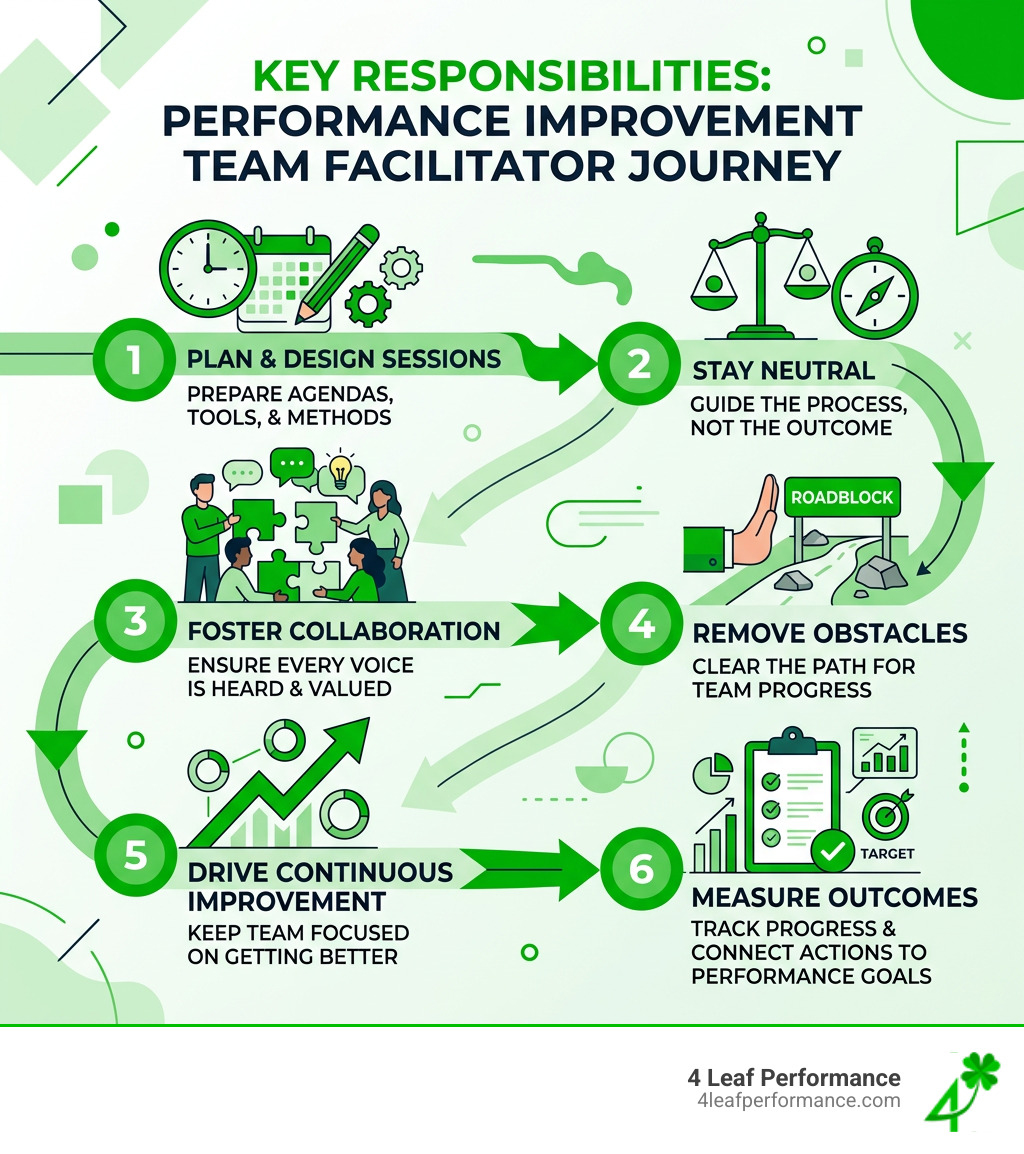
Here is a quick summary of the core responsibilities:
- Plan and design sessions — prepare agendas, tools, and methods before each meeting
- Stay neutral — guide the process, not the content or outcome
- Foster collaboration — make sure every voice is heard and valued
- Remove obstacles — clear the path so the team can move forward
- Drive continuous improvement — keep the team focused on getting better, not just getting by
- Measure outcomes — track progress and connect team actions to real performance goals
This matters more than most leaders realize. 70% of projects fail — and a big reason is that teams lack clear direction, shared purpose, and someone skilled enough to hold the process together.
A facilitator is not the loudest voice in the room. They are the person who makes the room work.
I’m Andrew Lamb, a leadership advisor and executive coach with over 25 years of senior global leadership experience, including two decades at HP, where I saw how the key responsibility of a performance improvement project team facilitator shapes whether a team struggles or scales. That experience is the foundation of everything I teach through 4 Leaf Performance.
What is a Performance Improvement Project Team Facilitator?
A facilitator is like a guide for a journey. They don’t pick where the team goes, but they make sure the team has a map and stays on the path. In a performance improvement project, this person is a “process expert.” They know how to run a meeting so that people actually get work done.
Think of it as having a social presence in the room. When a team is working remotely or in a high-pressure office, it is easy to feel lonely or confused. A facilitator brings everyone together. They make the work easier by asking the right questions instead of giving all the answers.
At 4 Leaf Performance, we believe that the definitive guide to team performance improvement starts with understanding that the team owns the results. The facilitator just helps them get there faster and with less stress.
The Key Responsibility of a Performance Improvement Project Team Facilitator in Setting the Stage
Before a meeting even starts, the facilitator is busy. They don’t just “show up.” They plan the whole session. This includes picking the right tools and making an agenda that makes sense.

A big part of the job is standardizing business procedures for consistency and efficiency. If the team doesn’t have a clear way of doing things, they will waste time. The facilitator might use tools like Resource Guru to see who is available to help. By designing the workshop ahead of time, they ensure that the team focuses on the right problems from the very first minute.
Key Responsibility of a Performance Improvement Project Team Facilitator: Guiding the Process
The facilitator is the guardian of the “how.” While the team talks about “what” they are building or fixing, the facilitator watches how they are talking to each other. They use explicit coordination to summarize what people say and clear up any confusion.
One of the hardest parts of this job is staying neutral. This means the facilitator doesn’t take sides. Even if they have a great idea, they usually keep it to themselves so the team can find their own way. This helps the team feel like they own the project.
| Feature | Facilitator | Project Manager |
|---|---|---|
| Focus | The Process (How) | The Task (What) |
| Decision Power | Low (The team decides) | High (The PM often decides) |
| Neutrality | Must stay neutral | Usually has an opinion |
| Goal | Better collaboration | On-time delivery |
By focusing on the process, the facilitator helps with business process management to identify and eliminate bottlenecks. They see where the team is getting stuck and help them find a way around it.
Managing Group Dynamics and Avoiding Groupthink
Have you ever been in a meeting where everyone just agrees with the boss because they are afraid to speak up? That is called Groupthink. It is dangerous because it leads to bad decisions.
A facilitator’s job is to stop this from happening. They encourage “healthy conflict.” This doesn’t mean fighting. It means looking at a problem from different angles. We often use the DISC framework to build high-performing teams. By knowing if someone is naturally bold or more quiet, the facilitator can make sure everyone gets a chance to speak.
They might also use something called dialectical inquiry. This is just a fancy way of saying they ask the team to argue for the opposite of their main idea. It helps find hidden risks before they become big problems.
Essential Skills for Effective Facilitation
To be great at this, you need to be a world-class listener. It is an important soft skill that helps people feel safe. When people feel safe, they are okay with failing. According to the Harvard Business Review, learning from failure is the only way to truly improve.
A facilitator also needs to understand the psychology of motivation. They need to know what makes people want to work hard. Is it a clear goal? Is it feeling valued? The facilitator keeps the energy high and the team focused on the “why” behind their work.
Using Data to Drive the Key Responsibility of a Performance Improvement Project Team Facilitator
Good facilitation isn’t just about feelings; it’s about facts. The facilitator helps the team look at KPI metrics and team data measurement. Without data, a performance improvement project is just guessing.
They look at collective performance indicators to see if the whole group is getting better. By creating a data-driven feedback loop, the facilitator ensures the team knows exactly where they stand. If the numbers aren’t moving, the facilitator helps the team change their plan.
Overcoming Challenges in Performance Improvement
Every project hits a wall eventually. Maybe the team runs out of money, or two departments start arguing. The facilitator is the one who helps prioritize business bottlenecks for maximum efficiency. They don’t fix the bottleneck themselves, but they lead the team through a session to figure out how to clear it.
Sometimes the team gets bored or loses focus. The facilitator knows how to enhance concentration and focus by pushing people slightly out of their comfort zones. This is where the real learning happens.
We also use the Kaizen approach. This means looking for small, easy changes that make things 1% better every day. Over time, those small changes add up to a huge improvement in performance.
Frequently Asked Questions about Facilitation
How is a facilitator different from a leader?
A leader often has the final say and tells people what to do. A facilitator helps the team decide what to do. The leader focuses on the vision, while the facilitator focuses on the conversation. In a perfect world, a leader uses facilitation skills to help their team grow.
Can a project manager also be a facilitator?
Yes, but it is hard! A project manager usually cares a lot about the “content” (the budget and the dates). To be a facilitator, they have to “put on a different hat” and focus only on the “process” for a while. It takes a lot of practice to stay neutral when you are also responsible for the deadline.
What training do facilitators need?
Many facilitators get certified through groups like the International Association of Facilitators (IAF). They learn things like conflict resolution, workshop design, and active listening. At 4 Leaf Performance, we also teach facilitators how to use the WHY.OS framework to understand what truly drives each person on the team.
Conclusion
The key responsibility of a performance improvement project team facilitator is the glue that holds a project together. Without someone to guide the process, even the smartest teams can get lost in the 70% of projects that fail.
At 4 Leaf Performance, we help you lead better and profit smarter. We know that running a business can feel like a lot of weight on your shoulders. You don’t have to do it alone. Whether you need to learn everything about executive coaching for teams or you want a system to find hidden profits, we are here to guide you.
Stop working in your business and start leading it. You can get the clarity and systems you need to scale without the burnout.
Start Your Profit Accelerator for $499 per month and turn your team into a high-performing machine today.