Why Most Teams Are Disengaged (And What You Can Do About It)
Team engagement solutions are tools, strategies, and programs that help leaders build motivated, connected, and high-performing teams.
Here are the most effective types:
- Pulse surveys – quick, regular feedback from your team
- Recognition programs – celebrate wins, big and small
- One-on-one check-ins – build trust through honest conversation
- Professional development – give people a reason to stay and grow
- AI-powered HR tools – turn data into action fast
- Onboarding improvements – start the relationship right
- Culture-building practices – shared values, transparency, and safety
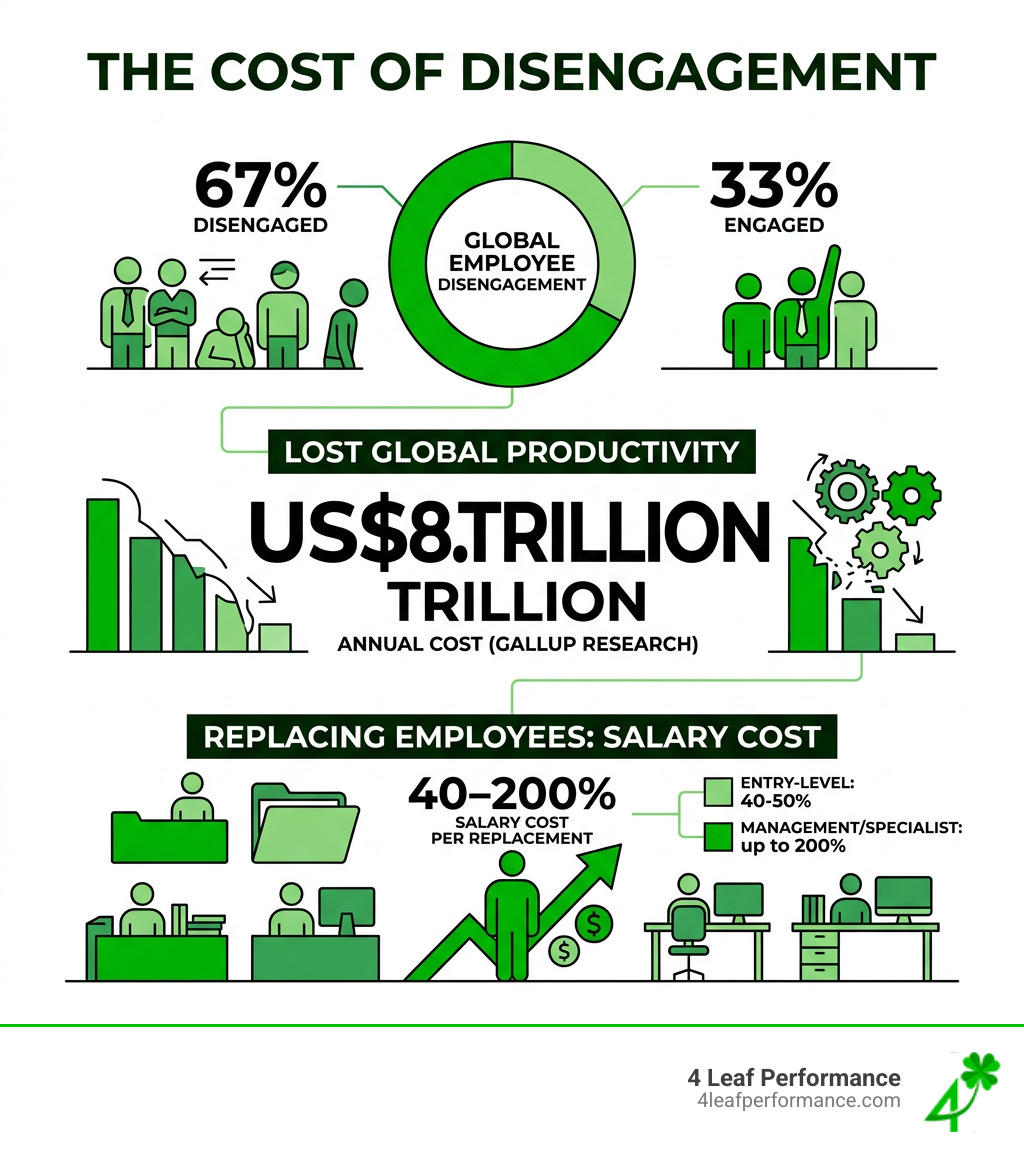
Two out of three employees are disengaged at work right now. That is not a small problem. A disengaged workforce costs the global economy around $8.8 trillion in lost productivity every year, according to Gallup research.
That number is hard to wrap your head around. But here is what makes it real: it might be happening on your team right now.
You have probably tried things. Team lunches. A suggestion box. Maybe a motivational speaker. And yet the energy still feels flat. People show up but they do not really show up.
The good news? Fixing this does not require a big budget or an HR department. It requires the right approach.
I am Andrew Lamb, a leadership advisor and executive coach with over 25 years of senior global leadership experience, including two decades at HP, where I saw how team engagement solutions can either unlock a team’s full potential or quietly drain it. In my work with 4 Leaf Performance, I help leaders like you cut through the noise and build teams that actually want to do great work.
Let’s get into what works.
Why Team Engagement Solutions Matter for Your Bottom Line
When people are not happy at work, it shows up in your bank account. It is not just about “vibes” or having a nice office. It is about money.

A disengaged team is like a car running on three wheels. You can keep pushing the gas, but you will not go very far, and you will ruin the engine. Globally, Gallup research on the $8.8 trillion cost of disengagement shows that when workers stop caring, productivity falls off a cliff.
In Houston, Texas, and across the globe, small business owners often feel they have to work harder just to stay in the same place. This happens because the team is not pulling in the same direction. When you find more info about team productivity, you realize that engagement is the secret fuel that makes everything else work better.
The Real Cost of Losing People
Have you ever had a great employee quit? It hurts. But it also costs a lot of money. Replacing an employee can cost anywhere from 40% to 200% of their yearly salary.
Think about that for a second. If someone makes $50,000, losing them could cost your business up to $100,000! You have to pay for:
- Job ads and interviews.
- Training time for the new person.
- The work that didn’t get done while the seat was empty.
Gallup research on the cost of replacing employees tells us that 42% of this turnover is actually preventable. If leaders invest in the right team engagement solutions, people stay longer.
Why Happy Teams Win
When teams feel good, they do better work. It sounds simple because it is. Scientific research on positive work environments shows that a pleasant workplace makes people more loyal.
Loyal employees care about your customers. They find ways to save money. They solve problems instead of just complaining about them. At 4 Leaf Performance, we believe that profit freedom starts with clarity—and nothing is clearer than a team that loves what they do.
The Best Types of Team Engagement Solutions
So, how do you actually engage people? Forget the pizza parties. Real engagement comes from feeling heard and valued.
One of the best team engagement solutions is the “pulse survey.” These are short, quick questions sent out every week or month. It is like taking the temperature of your team. You get to see if people are stressed or happy before they decide to quit.
You also need recognition programs. But not just a “worker of the month” plaque. People want to be noticed for the specific hard work they do. When you understand the psychology of motivation-what drives high-performing teams, you see that people need to feel they are growing.
Using Software as a Team Engagement Solution
Technology can be a huge help here. Modern HR software tools can track how people are feeling in real-time.
Recent Slack research on AI and productivity gains shows that AI use at work has jumped by 60% recently. Why does this matter for engagement? Because AI can handle the boring, repetitive tasks. This lets your team focus on the creative work they actually enjoy.
When your team uses smart tools, they feel more productive. And 82% of workers say that seeing productivity gains makes them feel better about their jobs.
Building Culture as a Team Engagement Solution
Culture is not what you write on the wall. It is how people treat each other when you are not in the room.
The best teams have “psychological safety.” This means people feel safe to take risks and admit mistakes without getting in trouble. They also need transparency. If you are honest about how the business is doing, they will trust you more.
Building this kind of workplace culture is a long-term strategy, but it is the strongest one you have.
How to Avoid Common Pitfalls in Your Strategy
Many companies try to fix engagement and fail. Why? Usually, it is because they treat it like a “task” for HR to do, rather than a way of leading.
If the boss does not care about engagement, the team won’t either. You need “buy-in” from the top. If you ask for feedback in a survey but never change anything, people will stop answering. This is called an “action gap,” and it kills trust faster than anything else. You can learn more about why your metrics arent motivating your team to avoid these traps.
Why Most Programs Fail
Most programs fail because they are too complicated. Leaders get obsessed with big numbers and complex charts. Gallup research on improving engagement shows that engagement often fails when it is siloed in HR.
Engagement is not an “HR thing.” It is a “business thing.” If your team is not engaged, your business will not grow. It is that simple.
Keeping It Simple and Human
You do not need a 50-page plan. You need to be a human. Empathetic leadership means listening to your people and treating them like adults.
One of the best ways to do this is through regular check-ins. Just 15 minutes a week to talk about how things are going can change everything. No icebreakers, just honest talk.
Actionable Steps for Leaders Today
Ready to start? You can improve your team’s energy right now by focusing on how they join and grow in your company.
Improving your team is a journey. For a deep dive, check out the definitive guide to team performance improvement.
Better Onboarding and Training
Did you know that 70% of new hires decide if a job is a good fit within the first month? If your onboarding is just a pile of paperwork, you are losing them.
Good onboarding should last at least three months. It should include:
- Shadowing other team members.
- Clear goals for the first 30, 60, and 90 days.
- Learning about the company’s “WHY.”
Using tools like the DISC framework can help you build a high-performing team by understanding how different people communicate.
Using Data to Lead Better
You can’t fix what you don’t measure. Use “people analytics” to see who is at risk of leaving. Smart software can show you “heat maps” of where people are stressed.
When you master team data measurement, you stop guessing. You start leading with intention.
Frequently Asked Questions about Team Engagement
Why is employee engagement so important?
It is the difference between a business that survives and one that thrives. Engaged teams are 21% more profitable. They stay longer, work harder, and make fewer mistakes.
How do you measure team engagement?
The best way is a mix of things. Use pulse surveys for quick data, but also use one-on-one meetings for deep trust. Watch your retention rates—if people are leaving, your engagement is low.
What are the latest trends in engagement?
AI is a big one. It helps managers give better feedback. Remote work is another. Engagement for remote teams requires more intentional communication and better digital tools. Wellness apps are also becoming popular to help with stress.
Conclusion: Lead Better and Profit Smarter
Fixing your team’s engagement doesn’t have to be a mystery. At 4 Leaf Performance, we use our 25 years of global experience to help you find the hidden profits in your business by leading your people better.
We use something called the WHY.OS framework. It helps you and your team discover your purpose. When people know why they are working, they don’t need icebreakers to feel engaged. They feel it because their work matters.
Stop working in your business and start leading it. Growth should not cost your sanity. We offer affordable, actionable coaching that keeps you accountable.
Ready to see your numbers differently? Start Your Profit Accelerator for $499 per month and build the kind of team that grows your business while you sleep.