What Is Organizational Transformation (And Why It’s So Hard to Get Right)
Organizational transformation is the process of making deep, lasting changes to how a business operates — its structure, culture, leadership, and strategy — so it can grow, adapt, and survive in a changing world.
Here’s a quick breakdown of what it involves:
- What it is: A company-wide shift in how people work, lead, and think
- Why it matters: Markets change fast — and businesses that don’t change with them get left behind
- What makes it hard: Most change programs focus on plans and numbers, but ignore the people and emotions behind the work
- What actually works: Combining clear strategy with team empowerment, skill-building, and strong leadership
The road to transformation is full of failed programs. Leaders set goals, build project plans, agree on KPIs, and hire the right people. Then nothing sticks.
It’s not because the plan was bad.
It’s because change is hard for people — and most programs treat it like a spreadsheet problem instead of a human one.
The research is clear: organizations that treat transformation as both a strategic and emotional journey see far better results. Those that get it right don’t just survive disruption. They pull ahead of their competitors and stay there.
I’m Andrew Lamb — leadership advisor, executive coach, and M&A integration specialist with over 25 years of senior global leadership experience, including two decades at HP, where I saw what drives real organizational transformation and what quietly kills it. That experience shapes everything I bring to leaders and teams who are ready to do the hard, meaningful work of change.
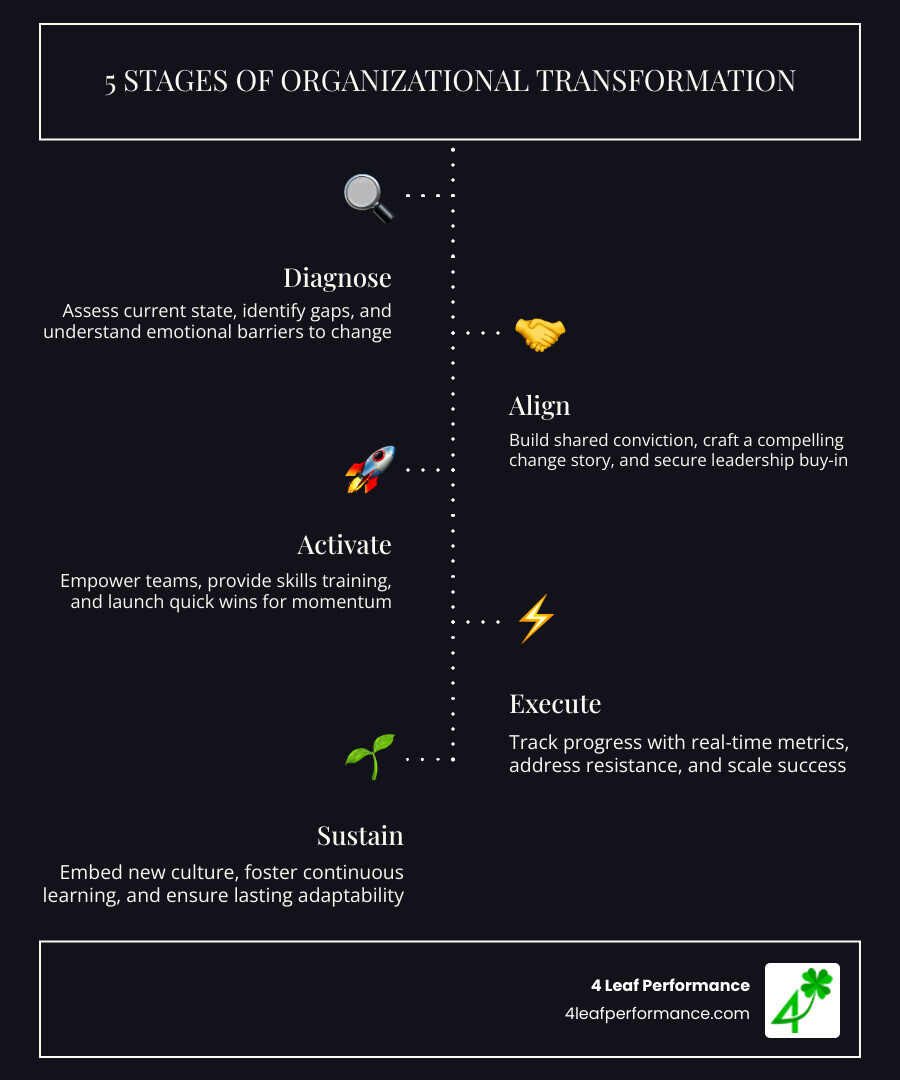
Why Most Change Plans Fail

Did you know that about 70% of big change plans fail? That is a very big number! It means most bosses try to fix their business, but it does not work. We see this happen all the time.
Usually, leaders focus only on the “hard” stuff. They look at money, new software, and big charts. But they forget the most important part: the people. When we ignore how people feel, the whole plan can fall apart. People get scared. They worry they will lose their jobs or that they aren’t good enough anymore.
To help your team through this, you have to understand The Psychology of Company Restructuring: Managing Fear, Uncertainty, and Resistance. If you don’t handle the fear, your team will stop trying.
Why Organizational Transformation is an Emotional Journey
Many people think organizational transformation is just a rational project. They think if they show a PowerPoint, everyone will say, “Okay, let’s go!” But it doesn’t work that way.
Change is an emotional journey. It’s like going on a scary roller coaster. Some people are excited, but many are terrified. They feel like they are losing their “status” or their place in the group. In one study of a newspaper company, the sales team was very scared to sell digital ads. They were used to paper ads. They felt like they didn’t know how to do the new stuff.
To win, you need a shared purpose. Everyone needs to know why the change is happening. When people feel safe and have a reason to care, they stop fighting the change. You can learn more about this on the Organizational transformation – HBR page.
The Problem with Old Metrics
Another reason plans fail is that leaders use “legacy metrics.” This is just a fancy way of saying they are looking at old numbers that don’t matter anymore.
If you want to grow fast, you can’t just look at what you did last year. You need to look at the future. If your team is hitting a wall and things feel slow, it might be time for a change. You should check out When Your Team Hits a Wall: Recognizing the Signs It’s Time to Restructure to see if your old ways are holding you back.
The 6 Levers for Successful Organizational Transformation
To make a real change, we use specific “levers.” Think of these like tools in a toolbox. Research shows that if you use all the right tools, your chance of success goes up to 96%! That is almost a perfect score. If you only use one tool, your chance is only 13%.
The main tools are Will, Skill, Rigor, and Scope. You can read more about these in the 6 Key Levers of a Successful Organizational Transformation article.
Building the Will to Change
“Will” means your team actually wants to change. You can’t force people to care. You have to build conviction.
One way we do this is by telling a “change story.” This story explains where the company is going and why it will be great. Leaders also need to “role model” the change. If the boss wants everyone to be on time but the boss is always late, nobody will listen! You have to show the way. This is a big part of The Culture Code: Mastering Organizational Change for Lasting Success.
Measuring Your Organizational Transformation Progress
You need to know if your plan is working. We like to look for “quick wins.” These are small goals you hit in the first six months.
When people see a quick win, they feel happy and want to do more. About 57% of companies that see success in the first six months keep that success going for a long time. You should ask yourself: Is Your Company Ready? Key Questions to Ask Before Business Restructuring. This helps you track things in real-time so you don’t get lost.
Five Key Areas Driving Change in 2025
The world is changing fast. By the year 2025, there are five big things every business must think about.
| Old Business Habits | 2025 Transformation Trends |
|---|---|
| Humans doing all the data entry | AI integration in every job |
| Slow, rigid plans | Agility and being able to pivot |
| Only caring about profit | Sustainability and social responsibility |
| Guessing what customers want | Using data analytics to know for sure |
| Learning stops after school | Continuous learning every day |
Using AI to Lead Better
AI is not just for robots. It is a smart tool that helps us make better choices. In 2025, organizational transformation means putting AI at the center of your strategy. It helps you see patterns and make decisions faster. This is very important when leaders are changing roles. You can see how to do this in Implementing Agile Change Management in Leadership Transitions.
The Need for Continuous Learning
Did you know that by 2030, most of the skills we use at work will change? That is very soon! We can’t just keep doing what we know. We have to learn new things all the time.
This is called “upskilling.” When we help our employees learn, they feel better about the company. It makes the transition much easier for everyone. You can learn how to Restructure Together: How Involving Employees Eases Transitions to keep your team smart and ready.
Four Steps to Empower Your Highest-Value Teams
We believe that teams are the engine of change. If you focus on your best teams, you can get 30% more work done! This is a “team-centric” way to grow. Instead of just telling everyone what to do from the top, we help the teams lead themselves. This is one of the Top Corporate Restructuring Strategies to Optimize Team Efficiency.
Identify and Activate Your Teams
First, you have to find your “highest-value” teams. These are the groups that make the most money or solve the biggest problems. Sometimes, these teams don’t even exist yet! You might need to build a “cross-functional” team. This means putting people from different departments together.
When you start, you must give them a clear mandate. They need to know exactly what their job is. It is also very important to have “psychological safety.” This means people feel safe to speak up and share ideas without getting in trouble. We talk more about this in Strategic Shifts & Human Impact: Navigating Restructuring with Empathy.
Scaling Success Across the Company
Once one team is doing great, you want to spread that success. We look for “internal influencers.” These are people that other employees like and trust. When they start acting in new ways, others follow them.
We also use “coach training.” We teach leaders how to be coaches instead of just bosses. When you share success stories, the whole company gets excited. This is how you handle Outgrowing Your Org Chart: How to Reset for Scalable Success.
Frequently Asked Questions about Organizational Transformation
Why do 70% of transformations fail?
Most fail because they forget the people. They focus on spreadsheets and forget that employees are scared or don’t have the right skills. To succeed, you need to handle the emotional journey and the technical plan at the same time.
How can we make change happen faster?
The best way to go fast is to find “quick wins.” When you show results in the first six months, people start to believe in the plan. Using “internal influencers” also helps the new behaviors spread like a movement.
What role does leadership play in team success?
Leaders are the most important part. They must be “role models.” If the leader doesn’t change, nobody else will. Leaders should act like coaches, helping their teams solve problems instead of just giving orders.
Conclusion
At 4 Leaf Performance, we know that organizational transformation can feel like a lot. It is a big mountain to climb. But you don’t have to do it alone. We use our 25 years of experience and the WHY.OS framework to help you find your purpose and lead better.
We want to help you find “profit freedom.” This means your business grows, your team is happy, and you don’t have to work 100 hours a week. You can stop working in your business and start leading it.
Are you ready to grow? We can help you scale from $500k to $1M and beyond without losing your sanity.
Start your journey to scale from $500k to $1M with us today. Let’s lead better and profit smarter together!