Why Most Teams Fail Before They Ever Really Start
Most teams fail because they are not built right. It is not about the people. It is about the plan.
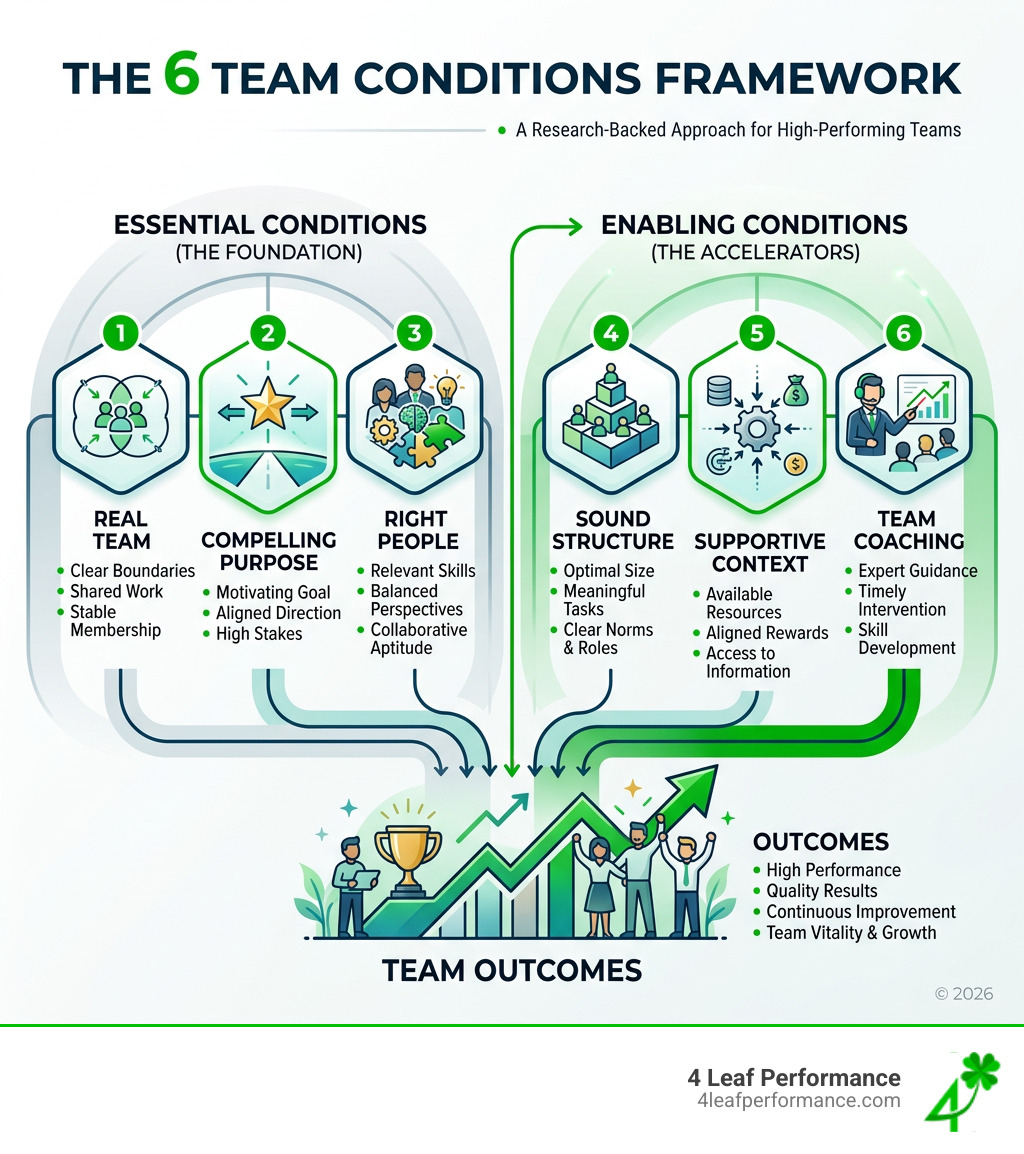
The 6 team conditions are a simple way to see what a team needs to win. Here is a quick look at all six:
| # | Condition | Type | What It Means |
|---|---|---|---|
| 1 | Real Team | Essential | Clear rules, shared work, same people |
| 2 | Compelling Purpose | Essential | A goal that makes people want to work |
| 3 | Right People | Essential | The right skills and different ideas |
| 4 | Sound Structure | Enabling | Small size, good tasks, clear rules |
| 5 | Supportive Context | Enabling | Tools, rewards, and information |
| 6 | Team Coaching | Enabling | Help from a coach at the right time |
You have smart people. You have a goal. So why is it so hard?
If your team is stuck or fighting, you are not alone. It is usually a design problem, not a people problem. Research from Harvard shows that how a team is built counts for 80% of its success. This means most of the win is decided before the work starts.
I am Andrew Lamb. I have spent 25 years leading teams at big companies like HP. I have seen how the 6 Team Conditions make or break a team. Now, I help leaders at 4 Leaf Performance use these rules to win.
What is the 6 Team Conditions Framework?
The 6 team conditions framework is a way to look at how teams work. It does not start with feelings. It starts with design. Think of it like a house. If the floor is weak, the house will shake. It does not matter how nice the paint is.
This framework comes from smart people at Harvard University. They studied thousands of teams in many settings, including business and sports. They wanted to know why some teams win and others struggle.
They found something simple: you cannot just tell a team to “try harder.” You have to set the team up to succeed. The 6 Conditions for Team Effectiveness framework is like a map. It helps you see what is missing so you can fix the right thing.
The Science Behind the 6 Team Conditions
This is based on real research. The team scientists used a tool called the Team Diagnostic Survey (TDS). The TDS helps measure how strong a team is in each of the six areas.
The data shows that these 6 team conditions predict about 80% of how well a team will do. That means most results come from the setup, not luck.
This matters for small business owners, too. When your team is not working well, you often feel it in your day.
- Projects take longer.
- People argue or avoid hard talks.
- You end up doing the “important” work yourself.
- Profit gets squeezed because time and energy get wasted.
If you want a clear way to improve, start by spotting the design gaps first. Then you can coach, hire, and build systems that actually stick. For a deeper look, check out this guide to team performance improvement.
How it Differs from Hackmans 5 Conditions
You may also hear about Hackmans earlier model with five conditions. The 6 team conditions framework builds on that research and makes it easier to use.
One big change is that it separates “Right People” as its own condition. That is helpful because team success is not only about the task. It is also about the mix of skills, teamwork habits, and different points of view.
The goal is not to blame people. The goal is to give the team better support and clearer guardrails. When the setup is strong, the team has a fair shot to win.
The 3 Essential Conditions: The Non-Negotiables

There are three things your team must have. We call these the “Essentials.” If you miss one, your team will struggle. It is like trying to bake a cake without flour.
The three essentials are:
- Real Team
- Compelling Purpose
- Right People
Building a Real Team
A “Real Team” is more than just people in an office. To be a real team, you need:
- Boundaries: Everyone knows who is on the team and who is not.
- Working Together: Members must work together to finish the job.
- Stability: The members stay together for a while.
If you want to elevate your squad, start by making sure everyone knows they are part of a solid unit.
Finding the Right People
Having the “Right People” means more than just hiring smart folks. You need:
- Task Skills: Can they do the work?
- Teamwork Skills: Can they work well with others?
You also need people who think differently. If everyone thinks the same, you will miss big problems. Using tools like the DISC framework for team building can help you find the right mix.
Creating a Compelling Purpose
A team needs a reason to exist. This is the “Why.” It needs to be clear and important. If the goal is boring, people will not try their best. We know that purpose-driven teams thrive because they feel their work matters.
The 3 Enabling Conditions: Going Faster
Once you have the essentials, you need the “Enablers.” These are like the engine in a car. They make the team go fast.
Creating a Sound Structure
Structure helps you be free. A sound structure means:
- Small Size: Usually 5 to 9 people. Big teams are slow.
- Good Tasks: The work should be interesting.
- Clear Rules: How do we talk? How do we make choices?
When you align team roles, everyone knows what to do. This stops people from getting in each other’s way.
A Supportive Company
The team needs help from the company. This means:
- Rewards: Does the company reward the whole team?
- Information: Does the team have the facts they need?
- Resources: Do they have the tools and money?
If your metrics aren’t motivating your team, it might be because the company only pays for individual stars.
Providing Team Coaching
Even the best teams need a coach. A coach helps the team look at how they work. A good coach helps at the start, the middle, and the end.
How the 6 Conditions Drive Real Results
When you have the 6 team conditions, three great things happen:
- Effort: People work harder because they care.
- Strategy: The team finds smarter ways to solve problems.
- Talent: Every person’s skills are used well.
This leads to success. Customers are happy. The team grows. And people feel good about their work.
| Feature | Essential Conditions | Enabling Conditions |
|---|---|---|
| Goal | Build the Base | Speed up the Work |
| Focus | Who and Why | How and Where |
| Outcome | Team Stability | Team Excellence |
You can find more details in scientific publications on team science.
Applying the 6 Conditions to Remote Teams
Today, many teams work from home. Does the 6 team conditions framework still work? Yes! It is even more important now.
In a world that changes fast, teams can feel lost. When you are not in the same room, you have to be very clear about your goals.
Remote teams need:
- Clear Talk: You must say things clearly so everyone understands.
- Strong Rules: You need rules for how to use chat and video calls.
- Same Facts: Everyone needs the same information.
If your remote team is stuck, look at your design. Sometimes, recognizing the signs it is time to restructure is the first step to getting better.
Frequently Asked Questions about 6 Team Conditions
How do I measure my team?
The best way is to use a survey like the Team Diagnostic Survey. This shows you which of the 6 team conditions are strong and which are weak. Then you can fix the right thing.
What is the best team size?
Smaller is usually better. Aim for 5 to 9 people. If you have more than 10 people, it is hard to talk and make choices.
Can these rules fix a bad culture?
Yes. A lot of bad behavior comes from people being frustrated. When people don’t know their roles or goals, they get grumpy. Fixing the 6 team conditions removes these problems.
Conclusion: Lead Better and Profit Smarter
Building a great team is a science. At 4 Leaf Performance, we believe that profit freedom starts with clarity. When you know the 6 team conditions, you stop guessing and start leading.
Most small business owners are stuck working harder for the same results. They feel trapped by daily chaos. But growth should not cost your sanity.
The Profit Accelerator Coaching Program gives you the systems, leadership skills, and real-time profit facts you need to scale without burnout. You can get all of this for just $499 a month.
Our plan is simple:
- Diagnose: Use our software to find hidden profits.
- Focus: Work with a coach to choose your best move.
- Grow: Use systems to get results.
Stop working in your business. Start leading it. Lead Better. Profit Smarter. Affordable. Actionable. Accountable. You never have to grow alone.
Take the first step toward a high-performing team today.