Why Conflict Management in Team Settings Defines Leadership Success
Conflict management in team environments is the process of identifying, addressing, and resolving disagreements before they erode trust, drain productivity, and push your best people out the door. Here is what effective team conflict management looks like in practice:
- Identify the type of conflict — task-based, relationship-based, process-based, or status-based — before choosing a response.
- Address it early. Leaders who respond promptly see 50% fewer resignations tied to workplace tension.
- Listen first. Use reflective listening and ask questions before proposing solutions.
- Separate the people from the problem. Focus on behaviors and outcomes, not personalities.
- Follow through. Resolution without accountability reverts to the same pattern within weeks.
If you manage a team of 10 or more, conflict is not an occasional interruption. It is a constant variable you either manage intentionally or absorb as dysfunction.
85% of employees experience some degree of workplace conflict, and unresolved friction costs U.S. companies an estimated $359 billion in lost productivity every year.
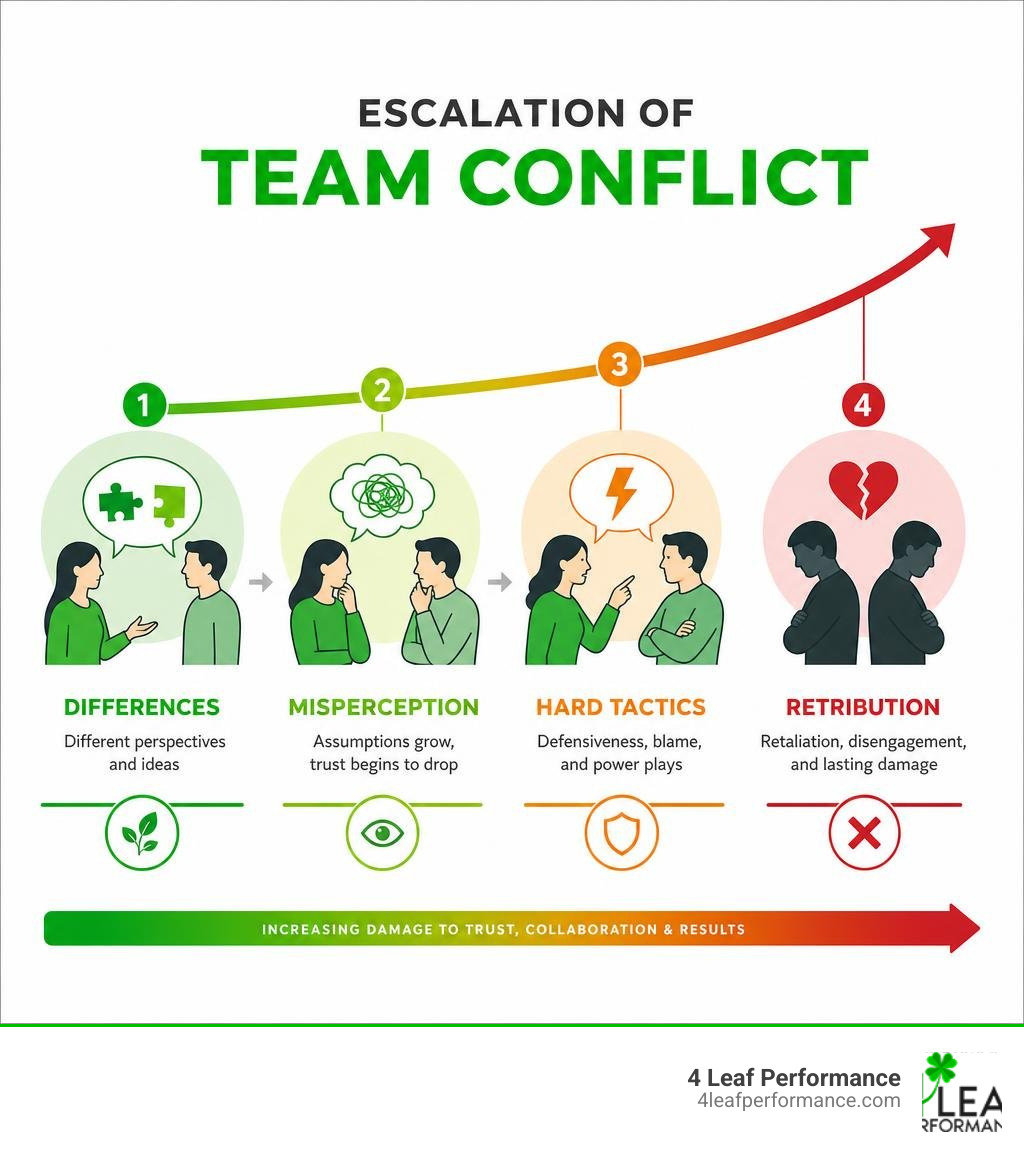
Most leaders know conflict is inevitable. What they underestimate is how fast it compounds. A disagreement over project priorities becomes a communication breakdown. A communication breakdown becomes a trust deficit. A trust deficit becomes turnover. And turnover, as most senior leaders have learned the hard way, is expensive in ways that never appear on a single line item.
Poor communication is the trigger in 86% of workplace disputes. That number is not a communication skills problem. It is a systems and leadership problem. When roles are unclear, goals are vague, and priorities shift without explanation, people fill the gaps with assumptions. Assumptions become friction. Friction becomes conflict.
The good news is that teams managing conflict effectively outperform those that don’t by 25%. That gap is not about hiring people who never disagree. It is about building the leadership infrastructure to handle disagreement well.
I’m Andrew Lamb, a leadership advisor and executive coach with over 25 years of senior global leadership experience, including two decades at HP, where I saw how unmanaged team conflict quietly dismantles even the strongest organizations. My work at 4 Leaf Performance focuses directly on conflict management in team settings, helping leaders build the clarity, communication systems, and organizational alignment that turn friction into forward momentum.
Quick conflict management in team terms:
The Anatomy of Workplace Friction: Types and Structural Sources
To manage conflict effectively, we must first diagnose its structural origins. Workplace friction is rarely a simple case of difficult personalities. More often, it is a symptom of systemic design flaws within the organization.
One primary driver of team friction is role ambiguity. When individual responsibilities are poorly defined, team members overlap, duplicate efforts, or leave critical tasks unaddressed. This ambiguity breeds frustration and mutual suspicion. When combined with poor goal definition and a lack of clear priorities, teams quickly split into factions, with each member operating under different assumptions of what success looks like.
These structural misalignments are highly visible during high-stress periods, such as project closeouts and organizational transitions. During a project closeout, the pressure of impending deadlines, resource depletion, and anxiety about future assignments can cause minor disagreements to escalate rapidly. If you are operating in specialized environments, such as medical facilities, these pressures are even more intense. Clinical studies show that unresolved disputes among clinical staff directly degrade patient safety and increase 30-day mortality rates. To explore these dynamics in a clinical context, see the clinical research on Conflict Management in Healthcare – StatPearls – NCBI Bookshelf.
In large-scale or global projects, leaders also face interface conflicts. These occur when different subgroups, such as engineering, marketing, and external stakeholders, bring incompatible requirements to the table. Managing these structural friction points requires proactive design rather than passive reaction. For a deeper analysis of how to structure your organization to prevent these issues, read our guide on Team Cohesion: Reducing Conflict and Boosting Efficiency.
To systematically address these structural sources, leaders can reference established project management methodologies. The Project Management Institute outlines clear frameworks for identifying and mitigating these systemic failures. You can review these approaches in the discussion on Managing conflict – project environment – Resolution Strategies – PMI. Furthermore, if localized, deep-seated systemic issues persist within your teams, utilizing specialized local expertise can help. For organizations based in the Gulf Coast region, seeking targeted mediation can restore operational balance, as detailed by Conflict Resolution Services Houston – Pollack Peacebuilding Systems.
Task Versus Relationship Conflict: The Performance Paradox
Not all conflict is destructive. To build high-performing teams, leaders must distinguish between task-focused conflict and relationship-focused conflict.
Task-focused conflict involves disagreements regarding the work itself, including project goals, data analysis, and strategic directions. When kept civil, task-focused conflict is highly productive. It challenges assumptions, prevents premature consensus, and drives innovation. Conversely, relationship-focused conflict is personal, emotional, and subjective. It targets the individual rather than the idea, and it consistently damages team performance and morale.

The critical danger of eliminating all disagreement is groupthink. When team members prioritize harmony over critical analysis, they ignore obvious risks. The most famous examples of groupthink failures are the NASA Challenger and Columbia disasters, where organizational pressure and a highly cohesive culture silenced dissenting engineers who raised valid technical concerns.
However, recent scientific research reveals a complex reality. A comprehensive meta-analysis shows that even task conflict, if not carefully managed, can negatively correlate with overall team performance and satisfaction. When trust is low, team members easily misinterpret intellectual disagreements as personal attacks. To understand this delicate balance, read the full meta-analysis on The Paradox of Team Conflict Revisited: An Updated Meta-Analysis of the Team Conflict–Team Performance Relationships.
The goal is not to eliminate tension, but to channel it productively. When properly managed, intellectual friction can be converted into a competitive advantage. For practical strategies on how to foster constructive debate while shielding your team from personal animosity, read our insights on The Advantages of Workplace Conflict and explore From Conflict to Creativity: The Power of Diverse Perspectives.
Implementing Conflict Management in Team Structures
To navigate these dynamics, leaders need an objective, repeatable framework. The Thomas-Kilmann Conflict Mode Instrument (TKI) is the gold standard for identifying how individuals respond to conflict based on two dimensions: assertiveness (the degree to which you satisfy your own concerns) and cooperativeness (the degree to which you satisfy the other person’s concerns).
| Conflict Mode | Assertiveness | Cooperativeness | Best Used When |
|---|---|---|---|
| Collaborating | High | High | Both sets of concerns are too important to be compromised; synthesis of perspectives is required. |
| Compromising | Moderate | Moderate | Goals are moderately important but not worth the effort of potential disruption; temporary settlements are needed. |
| Accommodating | Low | High | You realize you are wrong; the issue is much more important to the other person; building social capital is key. |
| Competing | High | Low | Quick, decisive action is vital (such as emergencies); vital issues where unpopular courses of action must be taken. |
| Avoiding | Low | Low | An issue is trivial; you perceive no chance of satisfying your concerns; damage of confrontation outweighs benefits. |
Developing these skills across a large organization requires structured training. Traditional classroom instruction can be reinforced with modern, scalable simulation tools. Recent empirical studies highlight how interactive simulations can help leaders practice these modes in low-risk environments. To learn more about these training methodologies, review the research on Teamwork Conflict Management Training and Conflict Resolution Practice via Large Language Models.
Additionally, behavioral frameworks can help you customize your approach. Understanding behavioral styles allows you to tailor your communication to how different team members naturally process tension. We discuss this in depth in our guide on How to Improve Conflict Resolution in the Workplace by Understanding DISC Styles. For a comprehensive blueprint on implementing these programs, refer to our AZ Guide to Conflict Resolution Training. Leaders seeking to formalize these mediation capabilities can also explore academic programs, such as those offered through the Mediation and Conflict Resolution | Bauer College of Business at UH.
How Leadership Styles Impact Conflict Management in Team Settings
Your leadership style dictates how conflict is processed within your organization. Different styles yield highly contrasting team outcomes:
- Transformational Leadership: This style uses trusting relationships and shared vision to inspire team members. Transformational leaders excel at converting personal friction into collaborative problem-solving.
- Servant Leadership: Focused on the growth and well-being of the team, servant leaders build high levels of psychological safety, making team members feel secure enough to voice dissenting opinions.
- Authoritarian Leadership: While valuable in high-stakes emergencies where rapid, top-down decision-making is required, this style suppresses healthy debate and breeds long-term resentment if used as a default.
- Laissez-Faire Leadership: This hands-off approach is highly damaging. Failing to intervene in team disputes creates a vacuum where a culture of blame and passive-aggressive behavior can thrive.
At 4 Leaf Performance, we integrate these leadership dynamics with our proprietary WHY.OS framework. By discovering your team members’ underlying “Why” (their driving purpose), “How” (their operational style), and “What” (their actual contributions), you can predict and resolve behavioral clashes before they escalate. When you understand what naturally motivates an individual, you can structure their responsibilities to play to their strengths, eliminating the root causes of friction. To understand why proactive leaders lean into these dynamics, read our article on Why Smart Leaders Embrace Conflict and You Should Too.
Active Listening as the Foundation of Conflict Management in Team Workflows
The absolute tactical foundation of any conflict resolution strategy is active, disciplined listening. When tension is high, most people do not listen to understand; they listen to formulate a rebuttal. Effective leaders must model high emotional intelligence by practicing reflective listening, which involves paraphrasing the speaker’s words and validating their emotions before responding.
To implement this on your team, establish a “delayed response” protocol during heated discussions. Encourage team members to pause, count to ten, or use non-reactive statements such as, “Help me understand how you arrived at that conclusion,” rather than immediately defending their position. This simple pause helps separate the idea from the person, building rapport even amidst deep disagreement. To build these capabilities within your organization, read our detailed guide on Active Listening Skills Are Key to Conflict Management in the Workplace and examine The Cost of Low Emotional Intelligence and Conflict Avoidance.
A Managerial Framework for Resolving Interpersonal Disputes
When a conflict between team members escalates, hoping it will resolve itself is a recipe for failure. Leaders must step in as structured mediators. We recommend a strict, four-stage mediation framework designed to prevent triangulation and drive lasting behavioral change.

Stage 1: Separate One-on-One Meetings
Before bringing the conflicting parties into the same room, meet with each individual privately. Use this time to listen without making promises or validating their narrative about the other person. Your goal is to diagnose the root cause: is this a true interpersonal conflict, a performance issue disguised as a personality clash, or a values mismatch?
Stage 2: Define Specific Behavior Changes
Do not accept vague complaints like, “They are disrespectful.” Force each party to identify specific, observable behaviors that must change. Write these down. For example, change “They ignore my input” to “They interrupt me during our weekly status meeting.”
Stage 3: The Joint Conversation
Bring both parties into a neutral setting. Establish strict ground rules: no interrupting, no historical grievances, and a absolute focus on future behavior. Use structured scripts to guide the conversation. For exact phrasing and templates on what to say in these high-stakes meetings, refer to How to Resolve Conflict Between Team Members: What to Actually Say — Planning in High Heels.
Stage 4: Structured Follow-Through
A resolution is only as good as its execution. Schedule formal follow-up meetings at the two-week and six-week marks. If backsliding occurs, address it within 48 hours based on the agreed-upon behaviors.
This framework must be customized based on the structural pattern of the conflict. In our experience, team disputes fall into distinct categories:
- The Solo Dissenter: One individual is at odds with the rest of the team. Address this via private, one-on-one coaching rather than forcing a group confrontation that can feel like bullying.
- The Boxing Match (Dyadic): Two team members are locked in a dispute. Use the four-stage mediation framework detailed above.
- Warring Factions: The team has split into two opposing subgroups. Break this deadlock by introducing external ideas, re-aligning incentives, or introducing a shared, high-priority goal.
For a deeper look at these specific team dynamics and how to resolve them, read 4 Common Types of Team Conflict — and How to Resolve Them | AAPL Publication. For tactical guidance on managing difficult conversations, see our resource on the 4 Steps to Effective Confrontation.
Proactive Prevention: Fostering Psychological Safety and Alignment
While having a reliable mediation framework is essential, the most effective leaders focus on prevention. This does not mean avoiding disagreement. It means designing an environment where dissent is safe, structured, and focused entirely on solving problems.
The foundation of this environment is psychological safety: the shared belief that the team is safe for interpersonal risk-taking. When psychological safety is high, team members do not feel the need to hide mistakes or stay silent when they disagree with a proposal.
To build this culture, leaders must establish cooperative goals and mutual-benefit interdependence. If your team members’ incentives are designed such that one person’s win is another’s loss, you will naturally manufacture conflict. When you align incentives so that success requires genuine collaboration, disagreement naturally shifts from a personal battle to a shared problem-solving process.
Furthermore, leaders must remain highly aware of power asymmetry. The most senior person in the room must be careful not to suppress candor through their own behavior. If you speak first and express strong opinions early in a meeting, you make it incredibly costly for others to share dissenting views. Legitimize dissent by actively asking for alternative viewpoints and thanking those who challenge your assumptions.
This shift from personality-driven conflict to environmental design is backed by extensive empirical research. To explore the data on how workplace structure and incentives dictate team behavior, review The Empirical Record on Conflict at Work | Psychology Today Australia. To learn how to implement these structural changes in your daily operations, read our guide on How Great Leaders Turn Tension into Teamwork.
Frequently Asked Questions about Conflict Resolution
How should a manager handle a star performer who causes team conflict?
Never sacrifice your team’s culture or operational standards for a single high performer. Research shows that a toxic worker costs an organization far more in lost productivity, team friction, and turnover than the value they add. Hold your star performer to the exact same behavioral standards as everyone else. Use your one-on-one sessions to make it clear that their technical contribution is valued, but their behavior is a non-negotiable area that must improve.
Why does digital communication escalate team conflict and how can leaders prevent it?
Digital communication channels, such as email and Slack, completely strip away vocal tone, body language, and immediate feedback. This lack of context makes it incredibly easy for team members to read negative intent into neutral messages. To prevent this, establish a clear communication norm: if an exchange requires more than two back-and-forth messages, or if any emotional tension is detected, team members must immediately move the conversation to a video call or an in-person meeting.
What is the difference between task conflict and relationship conflict?
Task conflict is focused entirely on the content and goals of the work itself, such as debating which marketing strategy to deploy or analyzing data discrepancies. When managed with mutual respect, task conflict is highly productive. Relationship conflict is personal, emotional, and focused on individuals, such as questioning a colleague’s intelligence or motives. Relationship conflict is always destructive and must be addressed immediately.
Conclusion
Unmanaged team conflict is not a minor inconvenience. It is a quiet drain on your organization’s productivity, innovation, and retention. As a senior leader, your ability to guide your team through tension and align diverse perspectives is the ultimate test of your leadership capability.
At 4 Leaf Performance, we specialize in helping growth-stage companies turn organizational friction into clean execution. With over 25 years of global executive experience and our proprietary WHY.OS framework, we provide the strategic clarity, leadership training, and systems alignment you need to scale your business without losing your sanity.
If you are ready to move from reactive conflict management to intentional, high-performance leadership, let’s talk.