Why Career and Leadership Development Determines Who Scales and Who Stalls
career and leadership development is the deliberate process of building the skills, self-awareness, and organizational conditions that allow individuals to grow professionally and lead others effectively.
Here is what that looks like in practice:
- Career development focuses on an individual’s progression: skills, roles, credentials, and long-term professional trajectory.
- Leadership development focuses on building the capacity to influence, align, and lead teams toward shared goals.
- Together, they form the pipeline that determines whether your organization can scale, retain top talent, and execute strategy under pressure.
Most organizations treat these as separate programs. The ones that outperform their competitors treat them as one integrated system.
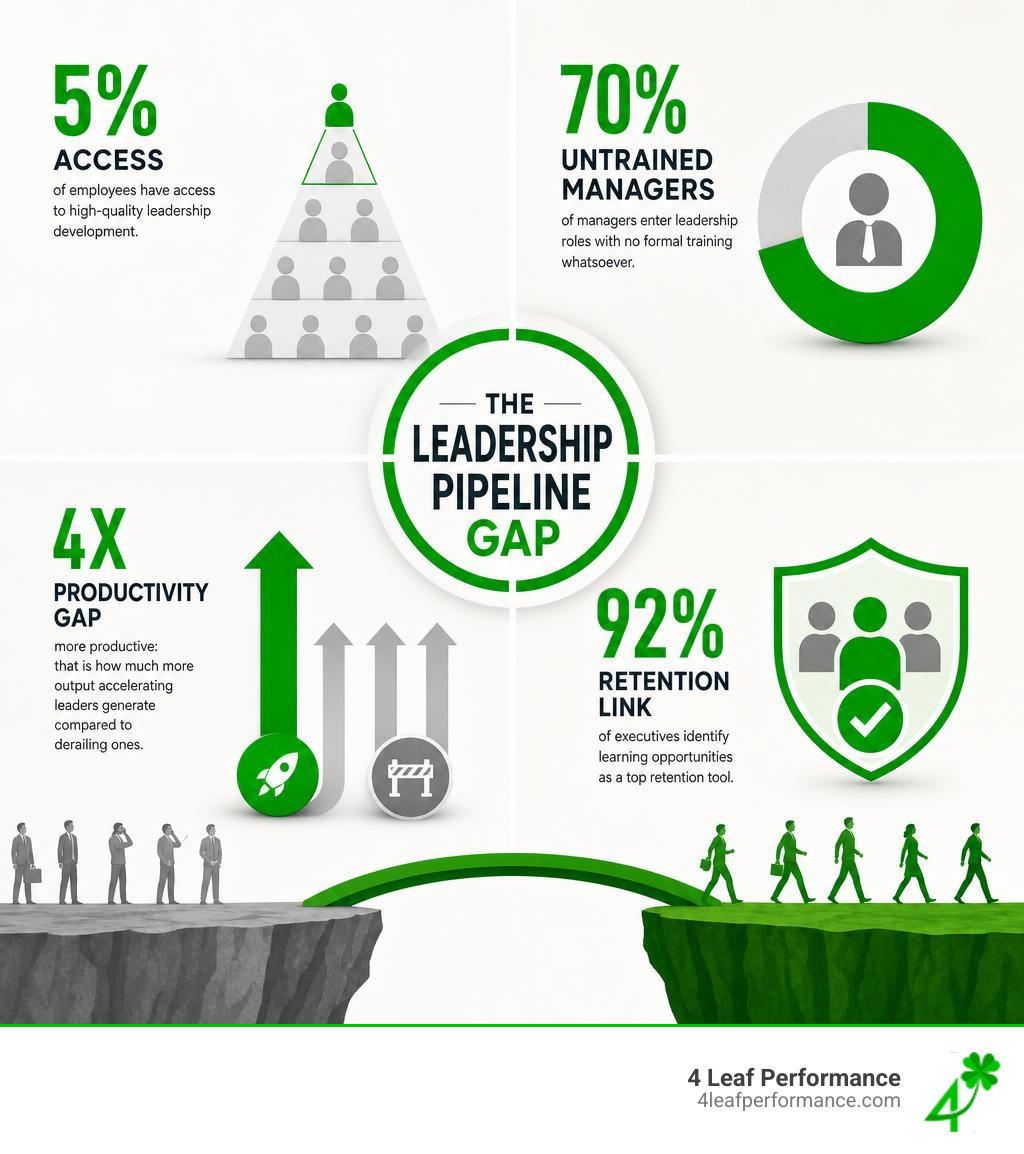
The numbers make the cost of inaction hard to ignore. Seventy-seven percent of executives say they risk losing talent because competitors offer better development opportunities. Ninety-two percent of executives identify learning opportunities as a top retention tool. And yet, only 5% of employees have access to high-quality leadership development, while 70% of managers enter leadership roles with no formal training whatsoever.
That is not a training problem. It is a strategic one.
Most organizations are not underspending on leadership development. They are misaligning it. Programs reach the visible few at the top while the broader leadership pipeline goes underdeveloped. The result is predictable: team dysfunction, communication breakdowns, and a talent base that plateaus well before its potential.
“4X more productive: that is how much more output accelerating leaders generate compared to derailing ones.” — Heidrick & Struggles Leadership Research
The gap between who gets developed and who actually has potential is where most organizations quietly lose ground.
This guide is built for senior leaders, executives, and business owners who are ready to close that gap, not with generic training programs, but with a clear, evidence-based approach to building leadership capacity at every level of the organization.
I am Andrew Lamb, executive coach, M&A integration specialist, and founder of 4 Leaf Performance, where I have spent over 25 years in senior global leadership roles helping organizations build the people systems that drive career and leadership development from the inside out. Everything in this guide reflects what actually works when the stakes are real and the margin for error is thin.
Easy career and leadership development glossary:
- developing leadership skills in the workplace
- developing leaders in the workplace
- leadership development
The Strategic Intersection of Career and Leadership Development

To build an organization capable of sustained growth, executives must stop viewing career advancement and leadership readiness as parallel tracks. They are fundamentally interdependent. When an organization fails to align these two disciplines, high performers find themselves promoted into leadership roles for which they have no behavioral preparation. The result is operational friction and cultural decline.
To prevent this, organizations must understand how to construct a unified pathway where professional growth directly feeds the leadership pipeline. By integrating these systems, we can systematically transform individual high performers into cohesive, strategic leaders. For a deeper analysis of these structures, consult our Detailed Guide to Leadership Development and explore how structured interventions operate within The Definitive Guide to Leadership Coaching Programs.
Defining the Boundaries of Career and Leadership Development
While they overlap, career development and leadership development have distinct boundaries that dictate how they should be managed and measured:
- Career Development (Individual Trajectory): This is the continuous process of skill acquisition, role diversification, and credentialing. It centers on the individual’s journey through the professional ecosystem. It answers the employee’s fundamental question: “How do I grow my personal value and progress within this market?”
- Leadership Development (Organizational Capability): This is the strategic expansion of an individual’s capacity to build trust, align teams, execute strategy, and manage systemic complexity. It answers the organization’s fundamental question: “How do we cultivate the collective capability required to execute our long-term strategy?”
When we focus solely on career development, we build highly skilled specialists who lack the emotional intelligence and strategic alignment to lead. Conversely, focusing solely on leadership training without clear career pathing leads to stagnation; leaders leave because they see no viable future within the company. To build foundational skills early on, refer to our Beginner’s Guide to Developing Leadership Skills in the Workplace.
The Overlap: Where Individual Ambition Meets Organizational Need
The sweet spot of organizational growth lies at the intersection of individual ambition and corporate succession planning. This intersection is where high-potential talent is identified, engaged, and retained.
According to the 2025 Global Leadership Development Study, organizations that actively align individual aspirations with strategic business needs report significantly higher retention rates and smoother leadership transitions. This alignment requires shifts in how we measure success:
- From Performance to Potential: Traditional talent reviews confuse current performance with future leadership capability. True overlap requires evaluating cognitive agility, emotional resilience, and motivational drivers.
- From Retention to Acceleration: We should not aim merely to keep people in their seats. We must accelerate their readiness to transition from executing tasks to orchestrating ecosystems.
- From Passive Pathing to Active Partnership: Career progression must be a collaborative negotiation where the individual’s professional goals directly support the organization’s future leadership requirements.
Scaling High-Impact Leadership Pipelines Beyond the Top Ten Percent

The traditional approach to corporate education is broken. Most organizations reserve high-quality development programs for the top 5 to 10 percent of their workforce, typically senior executives and designated high-potentials. This concentration of resources creates a severe bottleneck. Meanwhile, the mid-level managers who supervise 90 percent of the workforce are left to learn by trial and error.
To scale effectively, organizations must democratize leadership training. If we only develop the tip of the spear, the shaft will inevitably splinter under pressure. We must move away from exclusive, episodic events and implement continuous, scalable learning models. To understand how to break this cycle, see our guide Stop Checking the Box: Rethink Leadership Training for Real Results.
The MES Sequence: Mindset, Environment, and Skills
To scale leadership development without diluting its quality, we must follow a precise structural sequence: Mindset, Environment, and Skills (MES). Most corporate training programs fail because they reverse this order; they teach tactical skills to individuals who lack the mindset to apply them, within environments that actively penalize innovation.
- Mindset First: Before a manager can learn to delegate or resolve conflict, they must shift their professional identity. They must transition from finding value in personal execution to finding value in facilitating team success. Without this cognitive shift, skill training is useless.
- Environment Second: A leader does not operate in a vacuum. The organizational environment, its cultural norms, communication channels, and accountability structures, must support the desired behaviors. If your culture rewards silent compliance, a training program on “courageous conversations” will fail.
- Skills Third: Only when the mindset is established and the environment is aligned should we introduce specific skill training. This includes strategic communication, financial acumen, and operational execution.
This structured sequence ensures that learning is not merely an intellectual exercise but a permanent behavioral transformation. For strategies on embedding this sequence, read From Training to Transformation: Making Leadership Development Stick.
Overcoming the Visibility Bias in Talent Identification
One of the greatest barriers to building a diverse and robust leadership pipeline is visibility bias. Executives naturally tend to nominate individuals who are highly visible, extroverted, or physically proximate to headquarters. This approach excludes quiet high-performers, remote contributors, and diverse talent who may lack traditional corporate sponsorship but possess exceptional leadership potential.
To overcome this bias, organizations must implement objective talent assessment frameworks. By utilizing data-driven psychometrics and diagnostic tools, we can evaluate objective potential rather than subjective popularity. This shifts the focus from who is loudest in meetings to who possesses the cognitive capacity, emotional stability, and strategic alignment to drive long-term business outcomes.
The Role of Psychometrics, Diagnostics, and Personalized Learning
Modern leadership development has moved past the era of one-size-fits-all seminars. Today, high-impact growth is driven by personalization at scale. By leveraging advanced diagnostic tools, organizations can pinpoint the exact developmental needs of each leader, saving time and maximizing training budgets. To see how these programs are structured for maximum impact, review Professional Development Programs for Ambitious Leaders.
Leveraging the WHY.OS Framework for Career and Leadership Development
At 4 Leaf Performance, we utilize the proprietary WHY.OS framework as the foundation of our diagnostic approach. The WHY.OS identifies an individual’s core operating system: their Why (their driving purpose), their How (the way they naturally find solutions), and their What (what they ultimately deliver to the world).
When applied to career and leadership development, the WHY.OS framework delivers immediate clarity:
- Self-Awareness: Leaders understand exactly why they react to stress in specific ways, why certain tasks drain them, and where their natural strengths lie.
- Team Alignment: By mapping the WHY.OS of an entire executive team, we can identify communication gaps, eliminate friction, and align roles based on natural cognitive styles rather than job titles.
- Purpose-Driven Leadership: Leaders who understand their core operating system lead with authenticity and intention rather than reacting to daily crises.
This level of self-awareness is critical for anyone transitioning into senior leadership roles. To learn more about applying these principles at the highest levels, see our insights on Developing Executive Leadership.
Digital Platforms and Scalable Diagnostics
To scale personalization across a global workforce, organizations must utilize digital platforms that combine psychometric profiling with self-paced, actionable learning. Modern platforms allow human resource leaders to deploy diagnostics to thousands of employees simultaneously.
These platforms generate personalized development plans that guide employees through targeted modules based on their specific cognitive gaps. By utilizing these scalable tools, organizations can track progress, measure engagement, and build a clear, data-driven view of their internal talent pipeline. This approach removes the guesswork from succession planning and ensures that every promotion is backed by objective performance and behavioral data.
How Academic Institutions and Youth Organizations Build Foundational Competencies
The foundation for successful executive careers is laid long before an individual enters the corporate arena. Academic institutions and youth organizations play a critical role in developing the early behavioral competencies that make future corporate leadership possible.
University Career Centers as Incubators for Future Executives
Modern university career centers have evolved from simple job-posting boards into sophisticated professional development hubs. Leading institutions integrate career coaching with structured leadership training to prepare students for the demands of the corporate world.
Through experiential learning, structured internships, and strategic career planning, these centers help students identify their professional strengths early. In regions with dense corporate and civic ecosystems, such as Houston, Texas, localized programs demonstrate the power of this integration. For example, the Leadership Development – United Way Greater Houston initiative and public sector models like the Harris County Accelerated Leadership Program (ALP) show how structured regional pathways can bridge the gap between academic preparation and senior executive execution.
Career and Leadership Development Events in Youth Organizations
Youth organizations, such as the National FFA, have pioneered highly structured methods for building early professional capabilities. Their Career and Leadership Development Events are competitive platforms designed to test real-world business skills.
Participants engage in events focused on public speaking, agricultural sales, marketing plan development, and parliamentary procedure. These competitions require students to analyze complex scenarios, collaborate in teams, and present strategic recommendations to industry professionals. The result is the early development of critical thinking, emotional intelligence, and executive presence, proving that structured leadership training is highly effective when introduced early in an individual’s career path.
Overcoming Barriers to Executive Growth and Measuring Program ROI
Even when organizations recognize the value of developing their people, they often face significant barriers to execution. Understanding how to dismantle these hurdles and calculate the tangible return on investment is essential for securing long-term executive buy-in. To explore advanced methods for senior leader growth, read our guide on Mastering Executive Leadership Development.
- Delivery model: Traditional training uses episodic classroom seminars. Modern transformational coaching uses continuous, diagnostic-led coaching.
- Focus area: Traditional training teaches generic tactical skills. Modern coaching builds mindset, environment, and WHY.OS alignment.
- Scalability: Traditional training often has a high cost per person and limited access. Modern coaching enables personalization at scale through digital diagnostics.
- Measurement: Traditional training relies on post-event satisfaction surveys. Modern coaching tracks long-term behavior change and business ROI.
Identifying and Dismantling Barriers to Access
The primary barriers to accessing high-quality career and leadership development are not lack of interest, but operational friction:
- Time Constraints: Senior leaders are consumed by daily operational demands. Expecting them to attend multi-day offsite training without adjusting their workloads leads to burnout and poor retention.
- Budget Allocation: Traditional training is often viewed as a discretionary expense rather than a strategic investment. When market conditions tighten, training budgets are the first to be cut.
- Lack of Executive Buy-In: If the executive suite does not model the behaviors taught in development programs, the rest of the organization will dismiss the training as a corporate check-the-box exercise.
To overcome these barriers, organizations must integrate development into the daily flow of work. This means utilizing micro-learning, virtual coaching sessions, and projects that allow leaders to apply their new skills to current business challenges in real time.
Quantifying the ROI of Leadership Interventions
Securing budget for development requires presenting a clear, financial business case. Fortunately, the return on investment for structured leadership coaching is highly quantifiable:
- Retention Velocity: Replacing a senior executive costs up to 200% of their annual salary. By reducing turnover among high-potentials, organizations directly save millions in recruitment and onboarding costs.
- Productivity Gains: Well-aligned teams execute strategy faster and with fewer errors. Accelerating a leader’s transition into a new role can improve team productivity by up to four times, as demonstrated by global talent research.
- Internal Promotion Rates: Organizations with robust internal pipelines reduce their reliance on expensive external executive searches.
By tracking these metrics over a twelve-to-eighteen-month period, HR and business leaders can clearly demonstrate that developing their people is a highly profitable strategic investment. For a detailed framework on measuring these outcomes, refer to The Definitive Guide to Leadership Coaching Programs.
Frequently Asked Questions about Career and Leadership Development
What is the difference between career development and leadership development?
Career development focuses on an individual’s professional trajectory, emphasizing technical skill acquisition, job rotation, and personal advancement. Leadership development focuses on expanding an individual’s capacity to influence others, align teams, manage systemic complexity, and execute organizational strategy.
How do university career centers help students build leadership skills?
University career centers build these skills by offering experiential learning opportunities, leadership certificates, professional mentorship programs, and structured workshops that teach foundational competencies such as strategic communication, conflict resolution, and executive presence.
How can organizations measure the return on investment of leadership training?
Organizations can measure ROI by tracking metrics such as employee retention rates, internal promotion velocity, employee engagement scores, team productivity gains, and the successful execution of strategic business initiatives led by program participants.
Conclusion
Building a high-performing organization requires a deliberate, strategic commitment to career and leadership development. By aligning individual career goals with organizational leadership needs, democratizing access to development, and leveraging advanced diagnostic frameworks like the WHY.OS, you can eliminate team dysfunction, establish strategic clarity, and build a business that scales predictably.
At 4 Leaf Performance, we bring over 25 years of global executive experience to help mid-market companies and growth-stage organizations build high-impact leadership pipelines. We do not offer generic advice; we deliver customized, results-focused coaching and organizational development strategies that align your teams and accelerate your business growth.
Are you ready to stop reacting to team dysfunction and start leading with clear, strategic intention?
Schedule a Discovery Call with our team today, and let us help you build the leadership capacity your business needs to scale.