Why Most Managers Struggle to Lead (And What Actually Changes That)
Leadership skills for managers are the difference between a team that performs and one that quietly falls apart. If you are managing a team right now and feeling like something is off, you are not alone. Research shows that managers account for at least 70% of the difference in employee engagement across teams, yet most are promoted without a single hour of formal leadership training.
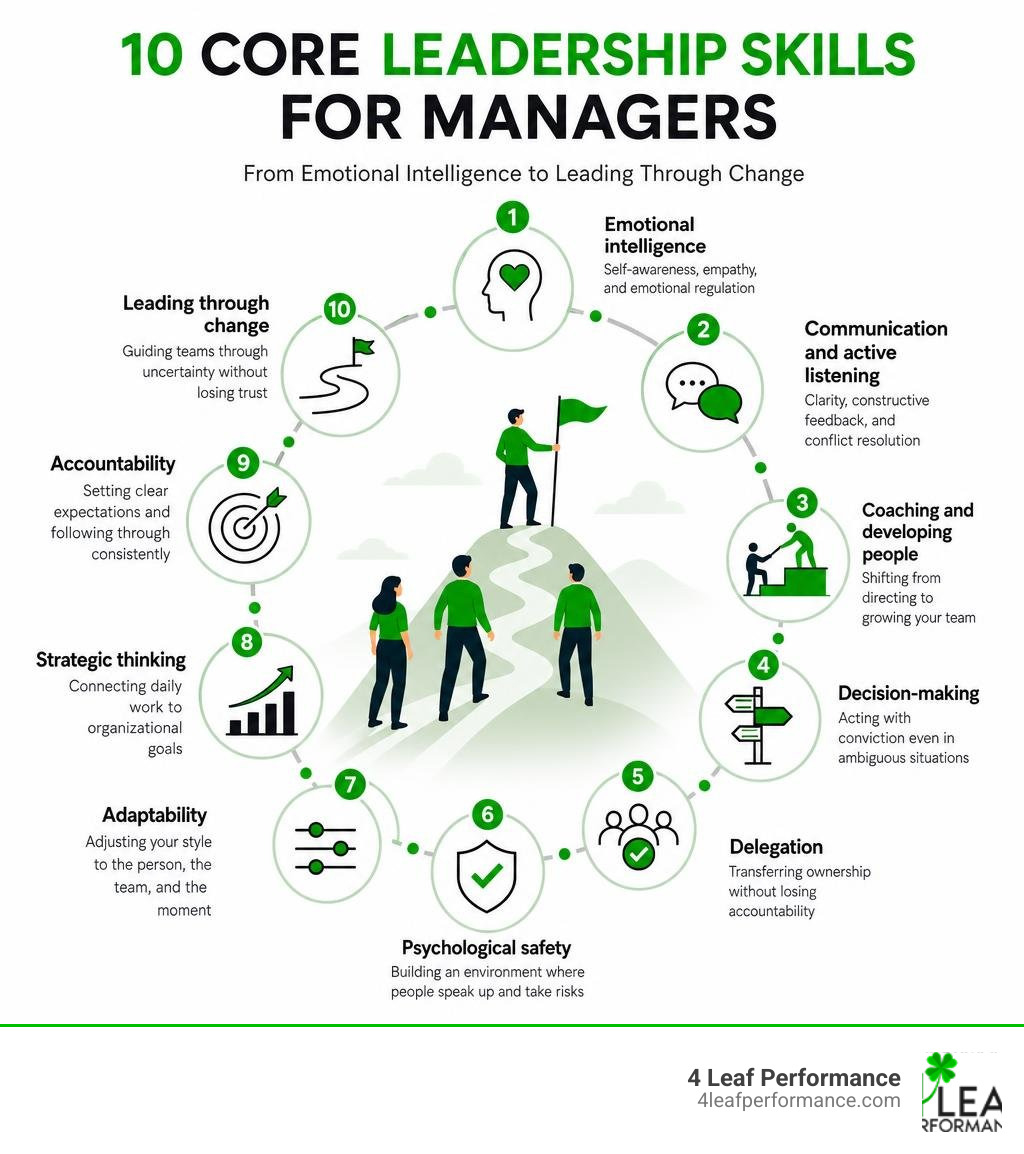
Here are the core leadership skills managers need to drive team performance:
- Emotional intelligence – Self-awareness, empathy, and emotional regulation under pressure
- Communication and active listening – Clarity, constructive feedback, and conflict resolution
- Coaching and developing people – Shifting from directing to growing your team
- Decision-making – Acting with conviction even in ambiguous situations
- Delegation – Transferring ownership without losing accountability
- Psychological safety – Building an environment where people speak up and take risks
- Adaptability – Adjusting your style to the person, the team, and the moment
- Strategic thinking – Connecting daily work to organizational goals
- Accountability – Setting clear expectations and following through consistently
- Leading through change – Guiding teams through uncertainty without losing trust
The problem is not effort. Most managers work hard. The problem is that the skills that earned them the promotion are not the same skills required to lead others. Technical excellence, individual output, and personal execution are exactly the habits that can limit a team when carried unchecked into a management role.
Up to 50% of new leaders fail within their first 18 months, not because they lack intelligence or commitment, but because they were never taught how to lead people.
The gap between managing tasks and leading people is real, measurable, and closable. But it requires deliberate development, honest self-assessment, and a willingness to change how you define success.
I’m Andrew Lamb, a leadership advisor and executive coach with more than 25 years of senior global leadership experience, including over two decades at HP, where I saw which leadership skills for managers separate high-performing teams from stagnant ones. In this guide, I will walk you through what those skills are, how to build them, and how to apply them to the real challenges you are facing right now.
Leadership skills for managers word roundup:
Distinguishing Management from Leadership: The Strategic Shift
The transition from a tactical executor to a strategic leader is one of the most difficult shifts a professional can make. Many organizations suffer from team dysfunction and strategic misalignment because their leaders continue to manage tasks rather than guide people. While tactical management focuses on operational control, maintaining the status quo, and executing defined processes, strategic leadership requires inspiring a shared vision, driving organizational alignment, and fostering long-term people development.
This distinction is not merely academic: it directly impacts the bottom line. According to industry data, companies with strong managers earn approximately 48% higher profits than those with average ones. When managers operate purely as taskmasters, they create bottlenecks. By shifting toward leadership, they empower their teams to operate autonomously, which dramatically increases operational efficiency.

To understand this shift, we must look at how daily activities differ between these two modalities:
| Tactical Management | Strategic Leadership |
|---|---|
| Focuses on processes, budgets, and immediate timelines | Focuses on vision, long-term alignment, and growth |
| Relies on direct control and task delegation | Relies on influence, empowerment, and trust |
| Solves immediate operational problems | Identifies systemic opportunities and root causes |
| Measures success through individual or team output | Measures success through team capability and engagement |
| Minimizes risk and maintains operational stability | Navigates ambiguity and drives calculated innovation |
At 4 Leaf Performance, we utilize the proprietary WHY.OS framework to help leaders navigate this transition. Every manager operates with a unique combination of their Why (their driving purpose), their How (their operational methodology), and their What (their tangible results).
When a manager does not understand their own WHY.OS, they often default to a rigid, command-and-control style that clashes with their team’s dynamics. By defining this operational blueprint, managers gain the clarity needed to align their natural strengths with the strategic needs of the organization, moving from reactive task management to intentional, purpose-driven leadership.
To explore this dynamic further, review our analysis on The Two Faces of Leadership: When to Lead Naturally vs When to Adapt.
Core Leadership Skills for Managers to Drive Team Performance
To build high-performing teams, managers must cultivate a specific set of core competencies. These skills do not replace technical expertise: they amplify it. When implemented correctly, these behaviors directly counter team dysfunction and establish the clear, open communication channels required for sustained execution.

Google’s landmark Project Oxygen research analyzed thousands of manager observations to identify the behaviors that correlate with high team performance and retention. Interestingly, technical expertise ranked at the bottom of the list. The number one predictor of managerial success was being an effective coach.
Coaching requires a shift from providing immediate answers to asking guiding questions. This practice is essential because managers who fail to coach often fall into micromanagement, which is one of the 12 Common Leadership Weaknesses and How to Improve Them.
Furthermore, Google’s subsequent Project Aristotle study identified psychological safety as the single most critical factor in team effectiveness. Psychological safety is the shared belief that team members will not be embarrassed, rejected, or punished for speaking up with ideas, questions, or mistakes. When psychological safety is present, teams report fewer errors because they actively surface problems rather than hiding them.
To understand the core traits that build this level of trust, managers can reference the behavioral frameworks detailed in What makes a good manager? 10 traits to build trust [2026] • Asana and explore the research-backed behaviors outlined in What Makes a Good Manager: 9 Research-Backed Behaviors.
To scale these behaviors across an organization, managers must focus on skills that compound over time. As discussed in Leadership Skills for New Managers: 10 That Compound, compounding skills are those that show delayed but highly leveraged rewards, such as developing others and building deep relationship networks.
By prioritizing these long-term competencies, managers lay the groundwork for continuous professional growth, a concept we explore thoroughly in The Definitive Guide to Career and Leadership Development.
Developing Emotional Intelligence as a Core Component of Leadership Skills for Managers
Emotional intelligence is the foundation upon which all other leadership skills are built. At senior organizational levels, research indicates that nearly 90% of the difference between star performers and average ones is attributable to emotional intelligence rather than cognitive ability. Furthermore, divisions led by emotionally intelligent managers outperform their revenue goals by roughly 20%.
According to psychologist Daniel Goleman, emotional intelligence consists of five core components: self-awareness, self-regulation, motivation, empathy, and social skill. For a manager, these components translate into concrete, daily behaviors:
- Self-Awareness: Recognizing your emotional triggers in real time. While 95% of people believe they are self-aware, rigorous research by Tasha Eurich indicates that only 10% to 15% actually are. Managers must understand how their emotional state “leaks” onto their team during high-stress situations.
- Self-Regulation: Pausing before reacting. When receiving bad news or facing an operational bottleneck, taking a brief pause allows the analytical brain to override the emotional alarm center, preventing impulsive, destructive responses.
- Empathy: Understanding the cognitive and emotional state of your direct reports. Empathy allows managers to tailor their coaching approach to each individual’s developmental stage.
Developing these capabilities requires deliberate, structured practice. Managers can begin by implementing a simple reflective practice, such as a weekly review to analyze their emotional reactions to challenging interactions. For those starting this development path, our Beginner’s Guide to Developing Leadership Skills in the Workplace provides an actionable starting point.
Additionally, understanding how emotional intelligence underpins critical executive capabilities is explored in The 8 Key Leadership Skills You Need to Know in 2026.
Mastering Communication and Conflict Resolution as Essential Leadership Skills for Managers
Clear, adaptive communication is the primary mechanism through which managers drive strategic clarity and eliminate team dysfunction. Ineffective communication is incredibly costly: workplace conflict costs organizations an estimated $359 billion annually in lost productivity. Conversely, effective communication builds trust, aligns expectations, and creates a highly engaged work environment.
To communicate with impact, managers must master active listening and the delivery of constructive, actionable feedback. Rather than treating communication as a one-way broadcast, leaders must establish mutual understanding. This involves paraphrasing a team member’s point and asking clarifying questions before offering solutions.
To systematically guide these conversations, managers can utilize the GROW model, a structured coaching framework:
- Goal: Define what the employee wants to achieve in a specific scenario.
- Reality: Assess the current situation, identifying existing obstacles and resources.
- Options: Brainstorm multiple potential solutions without immediate judgment.
- Will: Establish clear commitment, defining the exact next steps, timelines, and accountability metrics.
When conflict inevitably arises, managers must address it constructively rather than avoiding the conversation. Healthy conflict can be an exceptional opportunity for team members to clarify differing perspectives and drive innovation.
To build these critical communication pathways, managers should review Unlock Your Voice: A Guide to Developing Effective Communication and consult A Comprehensive Guide to Leadership Communication for advanced strategic frameworks.
Adapting Leadership Styles to Situational Dynamics
One of the most common mistakes managers make is using a single, static leadership style for every employee and situation. High-performing leaders exhibit style flexibility, adjusting their approach based on the competence and commitment of their team members.
The Hersey-Blanchard Situational Leadership model provides a highly effective framework for this adaptability. It categorizes leadership into four distinct styles based on the developmental level of the employee for a specific task:
- Directing (High Directive, Low Supportive): Used for employees who are new to a task and require clear, step-by-step instructions.
- Coaching (High Directive, High Supportive): Used for employees who have some experience but still need guidance and emotional support to build confidence.
- Supporting (Low Directive, High Supportive): Used for experienced employees who possess the necessary skills but may lack the confidence or motivation to execute independently.
- Delegating (Low Directive, Low Supportive): Used for highly competent and committed employees who can take full ownership of the outcome.
Adapting your style requires deep situational awareness and the ability to read the room. During organizational changes or high-pressure situations, a manager must remain highly adaptable without losing their core values or strategic focus.
To master this balance, review our strategic insights in Leadership Under Pressure: Mastering Adaptability Without Losing Yourself and ensure you are not relying on guesswork by reviewing Don’t Wing Your Leadership Style.
Overcoming Common Leadership Challenges for New and Experienced Managers
The transition from peer to leader is fraught with psychological and operational challenges. Newly promoted managers often struggle to redefine their professional relationships, frequently falling into the trap of trying to remain “one of the team” or, conversely, overcompensating by becoming overly authoritarian. This transition requires a fundamental shift in identity: success is no longer measured by personal output, but by the performance and growth of the team.
Another pervasive challenge is the urge to micromanage, which typically stems from a lack of trust or fear of failure. Micromanagement suffocates innovation and leads to severe team burnout. To overcome this, managers must learn to delegate effectively.
Delegation is not merely dumping tasks onto others: it is a strategic tool for development. By clearly defining the desired outcome and the boundaries of authority, while leaving the “how” to the employee, managers foster autonomy and accountability. This strategic focus is highly profitable: research indicates that CEOs who delegate effectively generate 33% higher revenue than those who do not.
In the modern corporate landscape, managers must also navigate technological disruptions, specifically the integration of artificial intelligence. According to data from Go1, the average number of direct reports per manager increased from 10.9 in 2024 to 12.1 in 2025, while only 50% of employees report that their leadership has clearly communicated an AI strategy.
To lead effectively, modern managers must develop basic AI literacy, guiding their teams on how to leverage these tools ethically and productively to automate routine tasks, freeing up time for high-value strategic work.
To make sound decisions amidst this rapid change, managers can leverage critical thinking frameworks. As highlighted in The 8 Key Leadership Skills You Need to Know in 2026, IMD’s research emphasizes the Frame-Explore-Decide (FrED) process:
- Frame: Clearly define the core problem and surface underlying assumptions.
- Explore: Investigate multiple diverse scenarios and gather data from various stakeholders.
- Decide: Make the decision with conviction, clearly communicating the trade-offs and reasoning to the team to secure buy-in.
For a comprehensive guide on overcoming these operational hurdles and driving executive alignment, refer to Mastering Leadership Competencies for Executive Impact and stay ahead of evolving expectations by reviewing Top Leadership Skills for Managers in 2026 | Go1.
How Organizations Can Systematically Build Leadership Competencies
Leadership development cannot be left to chance. Organizations that prioritize the systematic development of their managers experience significantly higher retention, engagement, and profitability. According to industry statistics, 83% of organizations prioritize leader development, and those that implement structured coaching programs see a 21% improvement in overall business results.
To build an effective Learning and Development (L&D) strategy, organizations must move away from generic, one-off training seminars. Effective development requires a structured, multi-faceted approach:
- Spaced Learning: Breaking training content into smaller, digestible modules delivered over several weeks or months. This allows managers to practice new skills in real-world scenarios and return to coaching sessions with feedback and reflections.
- 360-Degree Feedback: Utilizing comprehensive, multi-rater feedback instruments to help managers identify blind spots in their leadership style and emotional intelligence.
- Mentorship Programs: Pairing emerging managers with experienced executives to facilitate knowledge transfer and provide a safe space for discussing complex leadership challenges.
- Localized Development Resources: Utilizing professional development networks can be highly beneficial. For organizations looking to implement external training, utilizing reputable regional programs, such as those found through AMA Management Training Seminars and Workshops in Houston or local executive events listed on Discover Leadership Training Events & Activities in Houston, TX, can provide excellent structured learning environments for managers to hone their skills.
By embedding these practices into the corporate culture, organizations build a robust leadership pipeline capable of navigating future market disruptions. To design a comprehensive development strategy for your organization, consult our Detailed Guide to Leadership Development and explore the global competencies outlined in 7 Global Leadership Skills in High Demand.
Frequently Asked Questions about Leadership Skills for Managers
What is the difference between management and leadership?
Management focuses primarily on tactical execution, operational control, resource allocation, and the optimization of existing processes to achieve predictable results. Leadership, conversely, focuses on strategic vision, inspiring and aligning people, driving change, and fostering an organizational culture of continuous development. High-performing managers must master both disciplines to lead successfully.
How does emotional intelligence impact managerial effectiveness?
Emotional intelligence directly influences a manager’s capacity for self-awareness, emotional regulation, and empathy. Managers with high emotional intelligence are significantly more effective at resolving team conflicts, maintaining composure under executive pressure, and building high-trust environments. This directly correlates with improved team retention, higher employee engagement, and superior financial performance.
How can a manager build psychological safety within a dysfunctional team?
Building psychological safety within a dysfunctional team requires a deliberate, step-by-step approach centered on vulnerability and consistent behavior. Managers must lead by example, openly admitting their own mistakes and demonstrating a constructive, curious response to team errors rather than placing blame.
Additionally, practicing active listening, soliciting dissenting opinions during strategic planning, and holding sacred, uninterrupted one-on-one meetings are essential steps to rebuild trust and eliminate dysfunction.
Conclusion
Developing robust leadership skills for managers is not a luxury: it is a strategic business imperative. When managers lack the tools to lead effectively, the costs are felt across the entire organization in the form of team dysfunction, communication breakdowns, and lost profitability.
At 4 Leaf Performance, we specialize in helping senior leaders, executives, and business owners bridge this gap. Leveraging our 25 years of global executive experience and our proprietary WHY.OS framework, we help you align your team, establish absolute strategic clarity, and build a purpose-driven culture that executes with precision.
Do not allow team dysfunction or a lack of alignment to stall your organization’s growth. We invite you to Schedule a Discovery Call with our team today to discuss how we can help you systematically build the leadership competencies your business needs to thrive.
To further understand how balancing technical credibility with soft skills drives long-term team loyalty, read our detailed analysis on Upgrading Your Leadership Skills.