Why Most Leadership Development Falls Flat (And What Actually Works)
Fun leadership activities for managers are one of the most underutilized tools in a leader’s development arsenal. Most teams sit through another slide deck, nod politely, and return to their desks having retained almost nothing. Experiential activities change that equation entirely.
Here are the most effective leadership activities managers can run with their teams right now:
- Marshmallow Challenge – Teams build the tallest freestanding tower using spaghetti, tape, string, and a marshmallow in 18 minutes. Develops rapid prototyping, collaboration, and assumption testing.
- Minefield Navigation – One blindfolded team member navigates obstacles guided only by a partner’s voice. Builds trust, active listening, and communication clarity.
- Reverse Brainstorm – Teams identify ways to make a problem worse, then reverse those ideas into solutions. Sharpens creative problem-solving.
- Leadership Crisis Simulation – Teams respond to a realistic crisis scenario with real budget, time, and stakeholder constraints. Tests decision-making under pressure.
- Leadership Bingo – Participants observe and record specific leadership behaviors in colleagues during meetings. Builds peer recognition and self-awareness.
- Hot Seat Leadership – One participant answers leadership scenario questions under a two-minute time limit with follow-up pressure. Simulates real decision-making stakes.
- Blind Square Rope Game – Blindfolded participants form a perfect square using only verbal coordination. Reveals natural leaders and communication patterns.
- STAR Storytelling Framework – Leaders practice communicating impact through structured situation, task, action, and result narratives.
The research is clear on why this matters. Employees who see their managers investing in their growth are 3.5 times more likely to feel engaged and committed to their organization. Yet most leadership training still leans on lectures and frameworks that never leave the whiteboard.
The gap between knowing and doing is where teams quietly lose momentum. Activities that put people in motion, under pressure, and in relationship with each other close that gap faster than any training module ever will.
I’m Andrew Lamb, executive coach and leadership advisor with over 25 years of senior global leadership experience, including more than two decades at HP, where I saw which development approaches actually changed how leaders behaved under pressure. The fun leadership activities for managers covered in this article reflect the same principles I now apply through 4 Leaf Performance to help growth-stage organizations build aligned, high-performing teams. Let’s get into what works and why.
Related content about fun leadership activities for managers:
The Strategic Value of Fun Leadership Activities for Managers
To justify taking a highly compensated executive team away from their operational duties, a development exercise must deliver measurable strategic value. Experiential learning is not merely a break from routine; it is a diagnostic tool that reveals team dynamics, communication barriers, and latent talent. When senior leaders participate in structured play, they step out of their rigid corporate personas and reveal their natural operating styles.
This behavioral observation is invaluable for succession planning and talent identification. In a controlled, low-risk simulation, managers can observe how team members handle ambiguity, allocate resources, and manage interpersonal conflict. This environment allows quiet contributors to demonstrate emergent leadership qualities that might otherwise remain hidden behind corporate hierarchies.
Furthermore, these activities directly foster organizational commitment and adaptability. According to global executive research, 71 percent of executives from 90 countries rate adaptability as their most valuable leadership trait. Because experiential activities introduce unexpected constraints, they force participants to quickly pivot, test new hypotheses, and manage the frustration of initial failures.
By incorporating these exercises into a broader development strategy, organizations build the exact behavioral muscles required to navigate complex market shifts. To understand how these exercises fit into a comprehensive development roadmap, consult our Beginners Guide to Developing Leadership Skills in the Workplace and explore our Detailed Guide to Team Leadership Skills.
At 4 Leaf Performance, we filter these behavioral observations through our proprietary WHY.OS framework. Every leader operates with a deep-seated operating system that dictates how they build trust, solve problems, and make decisions. When you observe a manager during a high-stakes team activity, you are seeing their WHY.OS in action. Some will instinctively seek to simplify the challenge, others will focus on challenging the status quo, while some will prioritize establishing a clear, repeatable process. Recognizing these fundamental drivers is the key to resolving team dysfunction and establishing strategic alignment.
High-Impact Experiential Exercises for Corporate Teams

True executive development requires active participation over passive listening. When teams engage in physical or highly interactive challenges, they build cognitive pathways that lectures cannot replicate. This hands-on approach breaks down silos and accelerates team cohesion by forcing individuals to rely on one another to achieve a shared objective.
To maximize the impact of these exercises, facilitators must transition from simple game coordinators to strategic debriefers. The value of any exercise lies in the reflective discussion that follows. Leaders must connect the behaviors exhibited during the challenge to their daily operational realities. For a deeper analysis of how structured communication drives alignment, refer to A Comprehensive Guide to Leadership Communication.
Let us examine two premier experiential exercises that consistently deliver deep leadership insights when facilitated correctly.
The Marshmallow Challenge: Prototyping as Fun Leadership Activities for Managers
The Marshmallow Challenge is a classic design-thinking exercise that exposes how teams approach planning, execution, and risk management. The instructions are deceptively simple: in 18 minutes, teams of four must construct the tallest freestanding structure using 20 sticks of spaghetti, one yard of tape, one yard of string, and one marshmallow, which must sit on the very top of the structure.
While many view this as a simple creative exercise, it is actually a profound lesson in rapid prototyping and assumption testing. Statistically, kindergarteners consistently build taller structures than business school graduates. This outcome occurs because business students are trained to find the single best plan, execute that plan, and place the marshmallow on top at the very last second. When the structure inevitably collapses under the weight of the marshmallow, they run out of time. Kindergarteners, conversely, start with the marshmallow and build iterative structures around it, testing their assumptions throughout the process.
To run this exercise for maximum learning, facilitators should utilize the structured approach detailed in How to Run the Marshmallow Challenge for Learning. During the debrief, managers should evaluate their performance through Lencioni’s five dysfunctions framework, analyzing whether fear of conflict or lack of commitment prevented them from speaking up when they saw the structure failing.
Ask the team:
- Did you spend too much time planning without validating your assumptions?
- How did your team handle the sudden realization that the marshmallow was heavier than expected?
- Who assumed the leadership role, and was that role delegated or seized?
Minefield Navigation: Trust-Building Fun Leadership Activities for Managers
Trust is the foundation of any high-performing team, but it cannot be established through a memo. Minefield Navigation is a high-stakes communication challenge that forces teams to practice vulnerability and active listening under chaotic conditions.
To set up the exercise, mark a large rectangular boundary on the floor and scatter various obstacles, such as cups, chairs, or paper sheets, inside the boundary. One team member is blindfolded and designated as the Traveler, while the remaining team members act as Navigators standing outside the boundary. The Traveler must cross the minefield relying solely on the verbal directions of their partner.
To simulate real corporate noise, run multiple pairs simultaneously. The room will erupt into a cacophony of competing voices. To make the challenge even more realistic, enforce a “no-name” rule: Navigators cannot use the Traveler’s actual name to get their attention. This constraint forces the Traveler to filter out the external noise and lock onto the specific signal of their trusted partner.
As teams struggle and adapt, they naturally develop custom codewords and communication protocols to cut through the confusion. This exercise is an excellent practical application for teams looking to improve their daily collaboration. For detailed setup instructions and variations, see the Minefield Team Building Game: Great Team Communication Activity and explore our curated list of exercises in Talk the Talk: The Ultimate List of Team Building Games for Better Communication.
During the debrief, focus on the psychological experience of both parties:
- Travelers: How did you manage the anxiety of moving blindfolded in a noisy room? What specific verbal cues helped you trust your guide?
- Navigators: How did you adjust your communication style when you realized your partner was overwhelmed? Did you adjust your volume or your clarity?
Selecting and Facilitating the Right Exercise for Your Team
Choosing the wrong activity can alienate an executive team and reinforce the exact dysfunction you are trying to cure. If a team is suffering from deep-seated trust issues, forcing them into a highly competitive, high-pressure game can lead to defensive behaviors and further silo building. Conversely, an aligned team looking to sharpen their strategic thinking will find basic icebreakers patronizing and disengaging.
To avoid these pitfalls, managers must align the activity with the team’s current development needs and operational constraints. Use the following framework to select the appropriate exercise:
| Activity Name | Primary Skill Focus | Group Size | Time Required | Materials Needed |
|---|---|---|---|---|
| The Marshmallow Challenge | Iterative design, collaboration, managing assumptions | 4 to 20 (divided into small teams) | 30 to 45 minutes | Spaghetti, tape, string, marshmallows |
| Minefield Navigation | Trust building, active listening, signal filtering | 2 to 30 (paired up) | 20 to 30 minutes | Cones, cups, blindfolds |
| Reverse Brainstorming | Creative problem-solving, breaking cognitive bias | 5 to 50 | 30 to 45 minutes | Whiteboard, markers |
| Leadership Bingo | Peer recognition, behavioral observation, awareness | 10 to 100 | Ongoing (over a meeting or retreat) | Customized bingo cards |
| Hot Seat Leadership | Decision-making under pressure, crisis management | 5 to 15 | 30 minutes | Scenarios, timer |
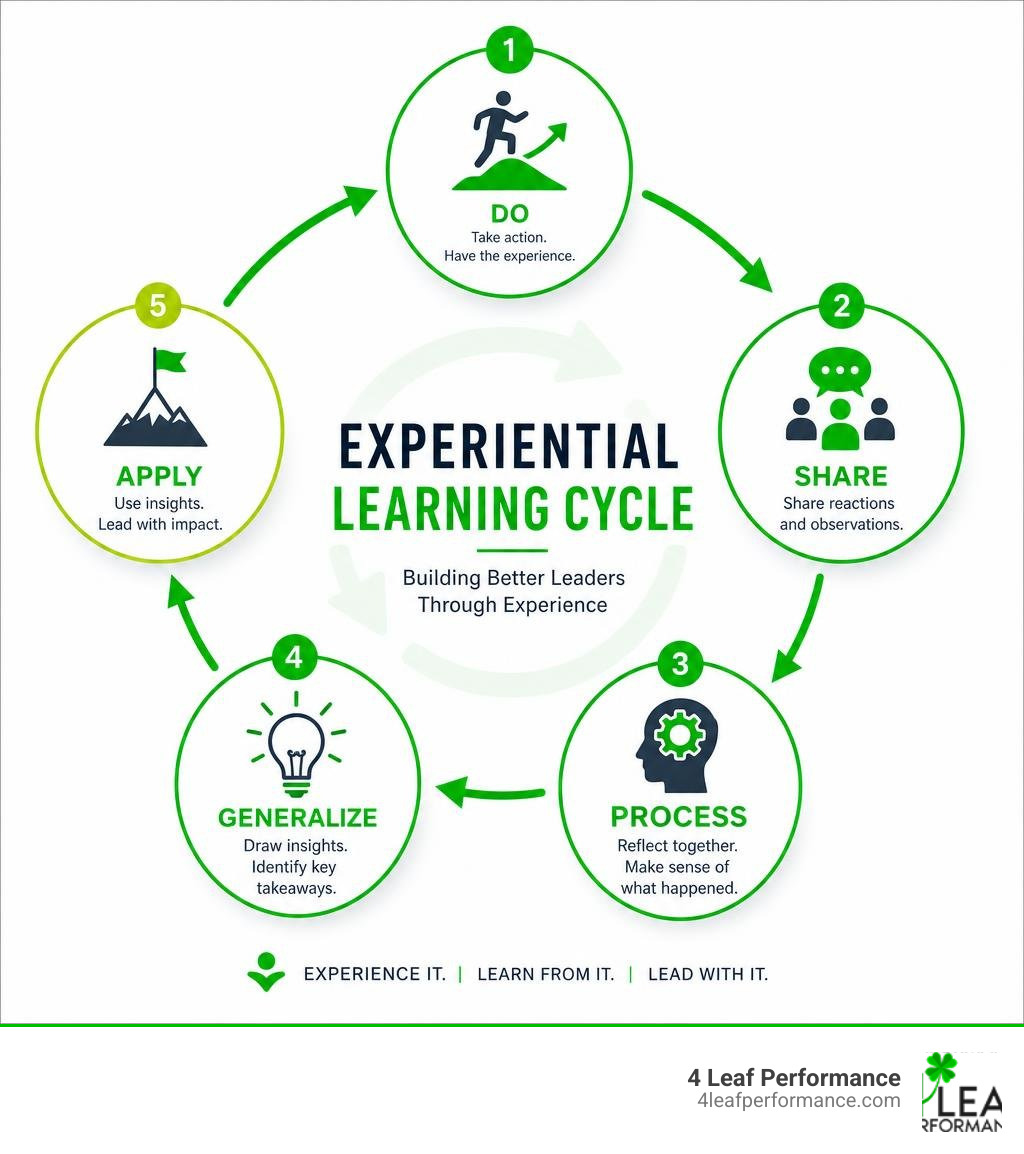
When facilitating these activities, the magic happens during the debrief. A common mistake is to let the energy of the game dissipate without extracting the business lessons. Facilitators should follow the five-stage experiential learning model:
- Do: Run the activity exactly as instructed without giving hints that manipulate natural behavior.
- Share: Ask participants what happened. Focus on their immediate emotional and physical reactions.
- Process: Analyze the patterns and dynamics that emerged. Who led? How did communication break down?
- Generalize: Connect the dynamics of the game to real-world business challenges. How is the “noise” in the Minefield game similar to the competing priorities in your business units?
- Apply: Identify one concrete behavioral change the team will commit to in their daily work.
To integrate these exercises seamlessly into your broader team alignment strategy without causing eye-rolls, review our guide on How to Engage Your Team Without More Awkward Icebreakers. If you are preparing for a larger strategic alignment event, consult our step-by-step methodology in How to Run Team Purpose Workshops in 7 Easy Steps and explore our comprehensive Team Purpose Workshop resources.
Frequently Asked Questions About Leadership Exercises
How often should managers facilitate leadership activities?
To build a culture of continuous growth, leadership development must be treated as an ongoing practice rather than an annual event. We recommend a monthly cadence for short, targeted leadership exercises. Running a 10 to 15-minute exercise during a monthly team meeting keeps communication and trust at the forefront of the team’s mind.
Larger, high-impact experiential exercises should be integrated into quarterly retreats or biannual strategic alignment sessions. This cadence ensures that skills are reinforced consistently without disrupting operational momentum. To understand how to structure these sessions over a longer timeline, read our insights in Activities for Leadership Retreats and learn 10 Shocking Things You Probably Don’t Know About Leadership Retreats.
How do these activities help identify natural leaders under pressure?
Under the artificial pressure of a timed simulation, formal corporate titles lose their meaning. When a team is given 18 minutes to build a tower or navigate a chaotic minefield, natural leadership behaviors emerge organically.
Observers should look for individuals who:
- Actively listen and synthesize diverse viewpoints rather than shouting over others.
- Pivot the team’s strategy when initial assumptions fail, demonstrating cognitive flexibility.
- Keep the team focused on the objective while managing interpersonal friction.
- Delegate tasks based on individual strengths rather than attempting to control the entire project.
These emergent leaders often possess a high degree of emotional intelligence and a clear WHY.OS alignment that makes them highly effective in crisis situations. Identifying these traits early allows organizations to build robust succession pipelines.
Can these exercises be adapted for remote or hybrid teams?
Yes. Virtual collaboration requires even more intentional trust-building than co-located environments because remote teams lose the spontaneous interactions of a physical office. Many classic leadership activities can be adapted for digital platforms using breakout rooms, virtual whiteboards, and custom digital games.
For example, the Reverse Brainstorming exercise can be run seamlessly on a shared digital canvas where participants use virtual sticky notes to brainstorm how to intentionally sabotage a project before reversing those points into a robust risk-mitigation plan. For a highly engaging, structured remote game that challenges teams to read behavioral cues and communicate clearly over video, check out the Engaging Remote Team Game: Find the Faker Offsite Challenge.
Conclusion
Running fun leadership activities for managers is not about taking a break from real work. It is the real work of building a cohesive, resilient, and strategically aligned executive team. When leaders step out of their silos and engage in experiential learning, they reveal the behavioral patterns that either drive organizational success or fuel chronic team dysfunction.
At 4 Leaf Performance, we help growth-stage companies bridge the gap between leadership theory and operational execution. Combining over 25 years of global executive experience with our proprietary WHY.OS framework, we help senior leaders identify their core operating drivers, resolve deep-seated communication breakdowns, and build high-performing cultures that scale.
To explore how these experiential principles and structured coaching can transform your leadership team, read our strategic guide on Upgrading Your Leadership Skills: Hard Skills Build Credibility, But Soft Skills Build Loyalty.
Ready to eliminate team dysfunction and lead with clear strategic intention? Schedule a Discovery Call with our team today.